
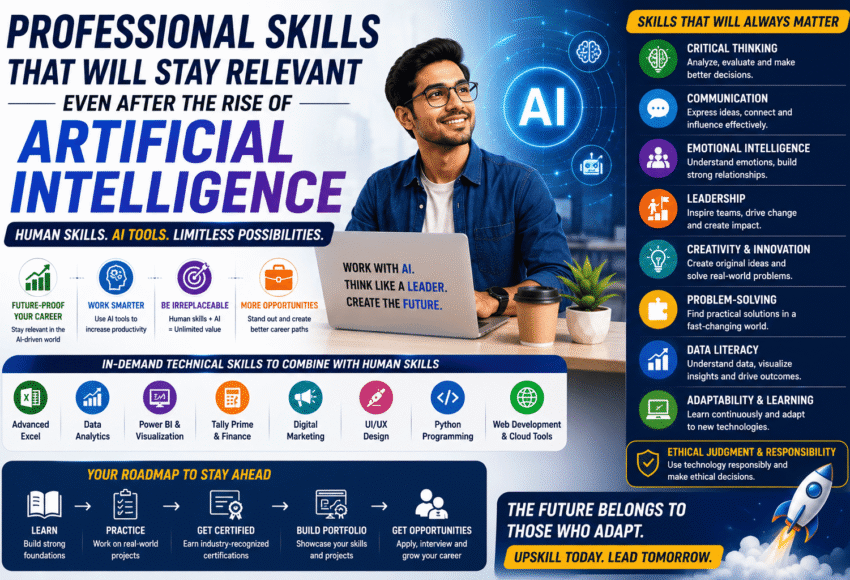
Professional Skills That Will Stay Relevant Even After the Rise of Artificial Intelligence (2026 Career Guide)
Artificial Intelligence (AI) is transforming industries, automating repetitive tasks, and changing how businesses operate. While AI is increasing productivity and reshaping job roles, it is also creating demand for professionals who can combine technology with human expertise.
The future workforce will not simply compete with AI—it will work alongside it. Professionals who develop critical thinking, communication, leadership, creativity, problem-solving, digital literacy, and industry-specific technical skills will remain valuable in the years ahead.
This guide explores the professional skills that continue to matter in the AI era and explains how students, graduates, and working professionals can prepare for sustainable career growth through practical learning, certifications, and continuous upskilling.
Why AI Is Changing the Workplace
Artificial Intelligence is helping organizations:
- Automate repetitive tasks
- Analyze large volumes of data
- Improve customer service
- Increase operational efficiency
- Support business decision-making
- Enhance productivity
Rather than replacing every role, AI is changing the nature of work. Many jobs now require professionals to supervise AI outputs, interpret results, communicate insights, and solve complex business problems.
Will AI Replace All Jobs?
No.
AI performs well in areas such as:
- Pattern recognition
- Data processing
- Content assistance
- Automation
- Prediction
However, many responsibilities still depend on human judgment, including:
- Strategic decision-making
- Leadership
- Relationship building
- Ethical reasoning
- Creativity
- Negotiation
- Empathy
The professionals most likely to thrive are those who combine technical knowledge with human-centered skills.
The Skills That Will Continue to Matter
1. Critical Thinking
AI can generate recommendations, but professionals must evaluate whether those recommendations are accurate, appropriate, and aligned with business goals.
Critical thinking helps you:
- Analyze situations
- Identify risks
- Make informed decisions
- Evaluate AI-generated outputs
Industries:
- Finance
- Healthcare
- IT
- Marketing
- Manufacturing
- Education
2. Problem-Solving
Organizations value people who can solve real business challenges.
Examples include:
- Improving workflows
- Reducing operational costs
- Increasing productivity
- Enhancing customer experiences
AI provides insights, but professionals implement solutions.
3. Communication Skills
Strong communication remains essential.
Develop:
- Spoken English
- Business Communication
- Presentation Skills
- Professional Email Writing
- Public Speaking
Clear communication improves teamwork, leadership, client relationships, and interview performance.
4. Emotional Intelligence
Emotional intelligence supports:
- Team collaboration
- Conflict resolution
- Leadership
- Customer interaction
Human understanding remains difficult to automate.
5. Leadership
Future leaders will need to:
- Manage hybrid teams
- Coordinate AI-enabled workflows
- Guide organizational change
- Make strategic decisions
Leadership combines vision, accountability, and communication.
6. Adaptability
Technology evolves quickly.
Professionals who continuously learn new tools and processes are better prepared for changing job requirements.
Develop the habit of lifelong learning.
7. Creativity
Creativity drives:
- Innovation
- Branding
- Product Design
- Marketing
- Storytelling
- User Experience
AI can assist with ideation, but human creativity shapes meaningful and original solutions.
8. Data Literacy
Almost every industry now relies on data.
Learn:
- Advanced Excel
- Data Visualization
- Power BI
- Business Reporting
- Basic Statistics
Understanding data supports better business decisions.
9. Digital Literacy
Modern professionals should understand:
- Cloud Collaboration
- Productivity Software
- AI Tools
- Online Research
- Cybersecurity Awareness
Digital literacy is increasingly expected across industries.
10. Ethical Decision-Making
Responsible use of AI requires professionals to consider:
- Privacy
- Fairness
- Transparency
- Security
- Accountability
Ethical judgment remains a human responsibility.
Technical Skills That Complement AI
Data Analytics
Learn:
- Advanced Excel
- Power BI
- Python
- Data Visualization
Career Opportunities:
- Data Analyst
- Business Analyst
- Reporting Analyst
Finance & Accounting
Learn:
- Tally Prime
- GST
- Payroll
- Financial Reporting
- FinTech
Career Opportunities:
- Accountant
- Finance Executive
- Financial Analyst
Digital Marketing
Learn:
- SEO
- Social Media Marketing
- Google Ads
- Analytics
- AI Marketing Tools
Career Opportunities:
- Digital Marketing Executive
- SEO Specialist
- Performance Marketer
UI/UX Design
Learn:
- Figma
- User Research
- Wireframing
- Prototyping
Career Opportunities:
- UI Designer
- UX Designer
- Product Designer
Graphic Design
Learn:
- Photoshop
- Illustrator
- Branding
- AI Design Tools
Career Opportunities:
- Graphic Designer
- Visual Designer
Website Design & Development
Learn:
- HTML
- CSS
- WordPress
- Responsive Design
Career Opportunities:
- Website Developer
- Front-End Developer
Python Programming
Learn:
- Programming Fundamentals
- Automation
- APIs
- AI Integration
Career Opportunities:
- Python Developer
- Automation Engineer
Motion Graphics & Video Editing
Learn:
- After Effects
- Premiere Pro
- Storytelling
- AI Video Tools
Career Opportunities:
- Motion Graphics Designer
- Video Editor
- Multimedia Creator
Skill Stacking for Long-Term Career Growth
Combining complementary skills creates stronger career opportunities.
Examples:
Finance
Tally Prime + Advanced Excel + Power BI + AI
Data Analytics
Excel + Python + Power BI + AI
Marketing
SEO + Analytics + AI + Content Strategy
Design
Graphic Design + UI/UX + AI Design Tools
Development
Python + Website Development + Automation
Creative Media
Motion Graphics + Video Editing + AI Filmmaking
Skill stacking prepares professionals for cross-functional responsibilities.
Why Practical Projects Matter
Employers increasingly value candidates who can demonstrate their skills.
Build projects such as:
- Business Dashboards
- Marketing Campaigns
- Portfolio Websites
- Brand Identity Designs
- Python Applications
- Financial Reports
- Motion Graphics Videos
Projects help translate knowledge into practical capability.
The Importance of Industry Certifications
Professional certifications can strengthen your profile by validating your learning.
Look for programs that provide:
- Practical assignments
- Industry-standard software
- Portfolio development
- Updated curriculum
- Career guidance
Certifications are most effective when combined with real-world projects.
Why Ahmedabad Is Preparing Professionals for the AI Economy
Ahmedabad has become an important hub for:
- Information Technology
- Finance
- Digital Marketing
- Creative Design
- Manufacturing
- Startups
- Professional Education
Students and professionals can access practical training, internships, and skill development opportunities that align with evolving industry needs.
Common Mistakes to Avoid
Depending Only on AI
AI is a productivity tool, not a replacement for professional judgment.
Ignoring Communication Skills
Technical expertise is more effective when combined with strong communication.
Stopping After One Certification
Continuous learning helps professionals adapt to changing technologies.
Avoiding Practical Projects
Hands-on experience strengthens confidence and employability.
Learning Too Many Unrelated Skills
Focus on complementary skills that align with your career goals.
AI-Era Career Readiness Framework
| Stage | Focus | Outcome |
|---|---|---|
| Stage 1 | Digital Literacy | Strong Foundation |
| Stage 2 | Communication & Professional Skills | Workplace Readiness |
| Stage 3 | Technical Specialization | Career Expertise |
| Stage 4 | AI Integration | Increased Productivity |
| Stage 5 | Projects & Portfolio | Demonstrated Capability |
| Stage 6 | Continuous Learning | Long-Term Career Growth |
Frequently Asked Questions (FAQs)
1. Which professional skills cannot be easily replaced by AI?
Critical thinking, communication, leadership, creativity, emotional intelligence, ethical decision-making, and complex problem-solving continue to rely heavily on human expertise.
2. Should I learn AI or focus on human skills?
Both are important. Learning how to use AI effectively while strengthening professional and interpersonal skills provides a balanced approach to career development.
3. Which technical skills remain valuable in the AI era?
Data Analytics, Advanced Excel, Power BI, Python Programming, Digital Marketing, Tally Prime, UI/UX Design, Graphic Design, Website Development, and Motion Graphics remain relevant when combined with practical experience.
4. Is communication still important if AI can generate content?
Yes. Professionals still need to explain ideas, collaborate with teams, present findings, negotiate, and build relationships—areas where effective communication is essential.
5. What is skill stacking?
Skill stacking involves combining complementary skills—such as Excel with Power BI or Graphic Design with UI/UX—to increase versatility and expand career opportunities.
6. Are certifications enough for long-term career success?
Certifications support learning, but employers also value practical projects, portfolios, internships, and continuous skill development.
7. Why is Ahmedabad a good place to develop AI-era skills?
Ahmedabad has a growing ecosystem of IT companies, financial institutions, creative agencies, startups, manufacturing industries, and professional training providers that support career-oriented learning.
8. How can I stay relevant as AI continues to evolve?
Commit to lifelong learning, build practical experience, strengthen communication and leadership skills, and regularly update your technical knowledge to keep pace with industry changes.
Conclusion
Artificial Intelligence is transforming the workplace, but it is changing the way people work—not eliminating the need for skilled professionals. The careers of the future will be built by individuals who combine technical expertise, critical thinking, communication, creativity, ethical judgment, and continuous learning.
Whether you are pursuing Finance, Data Analytics, Digital Marketing, UI/UX Design, Graphic Design, Website Development, Python Programming, Motion Graphics, or AI-enabled roles, success will depend on your ability to integrate technology with human capabilities.
Invest in practical projects, earn relevant industry certifications, build a strong portfolio, and embrace lifelong learning. By combining AI literacy with professional skills, you can remain adaptable, valuable, and ready for the evolving opportunities of 2026 and beyond.

Leave a Comment