One Professional Course Isn’t Enough: Why Multi-Disciplinary Skills Are the Future of Hiring (2026 Career Guide)
The workplace has changed dramatically over the past decade. Organizations no longer seek professionals who excel in only one area—they increasingly value individuals who can combine technical expertise, business understanding, communication, creativity, and digital proficiency.
In 2026, companies are investing in professionals who can work across departments, solve complex problems, and adapt to emerging technologies such as Artificial Intelligence (AI). This shift has made multi-disciplinary learning one of the most important career strategies for students, graduates, career changers, and working professionals.
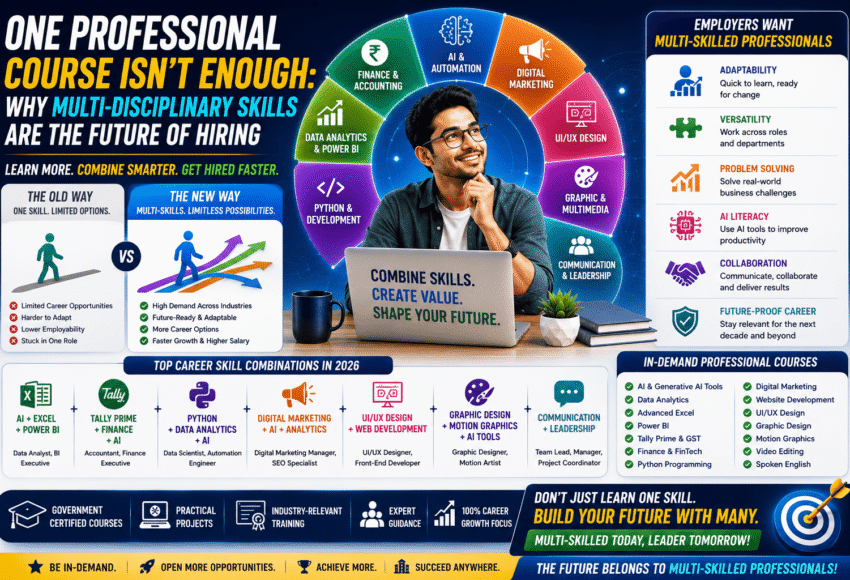
Instead of relying on a single certification or qualification, candidates who combine AI, Data Analytics, Advanced Excel, Power BI, Tally Prime, Finance, Python Programming, Website Development, Digital Marketing, UI/UX Design, Graphic Design, Motion Graphics, Video Editing, Spoken English, Business Communication, and Government-Certified professional courses are often better positioned to meet evolving industry needs.
This guide explains why one professional course is no longer enough and how building complementary skills can help create a resilient, future-ready career.
Why Hiring Trends Are Changing
Businesses today face rapid technological change, increased competition, digital transformation, and evolving customer expectations.
As a result, employers prefer professionals who can:
- Work with modern digital tools
- Understand business processes
- Collaborate across teams
- Analyze data effectively
- Communicate clearly
- Learn continuously
- Use AI responsibly to improve productivity
Rather than hiring multiple specialists for every task, organizations increasingly value professionals with broader capabilities.
What Are Multi-Disciplinary Skills?
Multi-disciplinary skills combine knowledge from different fields to solve real-world business challenges.
Examples include:
- Finance + Data Analytics
- Marketing + AI
- Design + Website Development
- Programming + Business Intelligence
- Communication + Leadership
- Accounting + Automation
These combinations help professionals contribute more effectively across projects and departments.
Why One Professional Course Is No Longer Enough
Technology Is Changing Every Industry
AI, automation, cloud computing, and digital transformation are reshaping how businesses operate.
Professionals who understand only one tool or technology may need to expand their expertise as workplace requirements evolve.
Jobs Require Cross-Functional Collaboration
A marketing executive works with designers.
Designers collaborate with developers.
Finance teams rely on data analysts.
Business leaders use AI-powered dashboards.
Success increasingly depends on understanding multiple disciplines.
Employers Value Adaptability
Industries continue to change rapidly.
Professionals with broader skill sets can adapt more easily to new technologies, responsibilities, and career opportunities.
The Most Valuable Multi-Disciplinary Skill Combinations
1. AI + Advanced Excel + Power BI + Data Analytics
Why It Matters
Organizations increasingly rely on data-driven decisions supported by AI.
Learn
- AI productivity tools
- Advanced Excel
- Power BI
- Dashboard creation
- Data visualization
Career Opportunities
- Data Analyst
- Business Analyst
- MIS Executive
- Reporting Specialist
2. Tally Prime + Finance + AI + Advanced Excel
Why It Matters
Modern finance professionals combine accounting knowledge with automation and analytics.
Learn
- Tally Prime
- GST
- Financial Reporting
- AI-assisted workflows
- Excel dashboards
Career Opportunities
- Accountant
- Finance Executive
- Financial Analyst
- Accounts Manager
3. Python + AI + Automation
Why It Matters
Automation and intelligent systems improve efficiency across industries.
Learn
- Python Programming
- AI integration
- Automation scripts
- APIs
- Data processing
Career Opportunities
- Python Developer
- Automation Engineer
- AI Support Specialist
4. Digital Marketing + AI + Analytics
Why It Matters
Modern marketing relies on performance measurement and AI-assisted optimization.
Learn
- SEO
- Social Media Marketing
- Analytics
- Google Ads
- AI marketing tools
Career Opportunities
- Digital Marketing Executive
- SEO Specialist
- Performance Marketer
5. UI/UX Design + Website Development
Why It Matters
Businesses need professionals who understand both user experience and technical implementation.
Learn
- Figma
- Wireframing
- HTML
- CSS
- WordPress
Career Opportunities
- UI Designer
- UX Designer
- Front-End Developer
6. Graphic Design + Motion Graphics + AI Design Tools
Why It Matters
Visual storytelling has become central to branding and digital communication.
Learn
- Photoshop
- Illustrator
- Motion Graphics
- Video Editing
- AI design tools
Career Opportunities
- Graphic Designer
- Motion Graphics Designer
- Multimedia Designer
7. Website Development + Digital Marketing
Why It Matters
Understanding both website creation and online promotion helps businesses improve digital performance.
Learn
- HTML
- CSS
- WordPress
- SEO
- Analytics
Career Opportunities
- Website Developer
- SEO Executive
- Digital Marketing Specialist
8. Spoken English + Business Communication + Leadership
Why It Matters
Technical expertise becomes more valuable when professionals communicate ideas effectively and lead teams.
Learn
- Public Speaking
- Business Writing
- Presentation Skills
- Team Collaboration
- Leadership
Career Opportunities
These skills benefit professionals across every industry.
Industry-Wise Examples
Finance
Best Combination
- Tally Prime
- Advanced Excel
- AI
- Power BI
Information Technology
Best Combination
- Python
- AI
- Website Development
- Automation
Digital Marketing
Best Combination
- SEO
- AI
- Analytics
- Content Strategy
Design
Best Combination
- UI/UX Design
- Graphic Design
- Motion Graphics
- AI Design Tools
Manufacturing
Best Combination
- Data Analytics
- Excel
- Automation
- Communication
Healthcare
Best Combination
- AI
- Data Reporting
- Communication
- Analytics
The Role of AI in Multi-Disciplinary Careers
AI is becoming a productivity tool across industries.
Professionals use AI for:
- Research
- Reporting
- Content creation
- Data analysis
- Customer support
- Workflow automation
- Decision support
Learning to work with AI enhances efficiency while allowing professionals to focus on creativity, strategy, and collaboration.
Why Practical Learning Matters More Than Ever
Employers increasingly evaluate portfolios alongside resumes.
Projects might include:
- Financial dashboards
- Marketing campaigns
- Responsive websites
- UI/UX prototypes
- Python automation scripts
- Graphic design portfolios
- Motion graphics videos
- Business intelligence reports
These projects demonstrate practical problem-solving and technical competence.
Government-Certified Professional Courses
Government-certified, industry-oriented courses can support career readiness by offering:
- Structured learning
- Practical assignments
- Industry-standard software exposure
- Portfolio development
- Career guidance
- Recognized credentials
The greatest value comes when certifications are paired with hands-on experience and continuous skill development.
Why Ahmedabad Is Becoming a Multi-Skill Learning Hub
Ahmedabad has emerged as a strong destination for career-focused education due to opportunities in:
- Information Technology
- Finance
- Manufacturing
- Digital Marketing
- Creative Design
- Startups
- Professional Training
Students and professionals benefit from practical learning environments, internships, and industry-aligned training.
Common Career Mistakes
Depending on One Skill
Develop complementary capabilities that expand your career options.
Ignoring AI
AI literacy is becoming valuable across almost every profession.
Weak Communication
Communication supports teamwork, leadership, and client relationships.
No Practical Experience
Real-world projects strengthen portfolios and interview performance.
Stopping After Certification
Continuous learning helps professionals remain relevant in changing industries.
Multi-Disciplinary Career Roadmap
| Stage | Focus | Outcome |
|---|---|---|
| Step 1 | Build Core Digital Skills | Strong Foundation |
| Step 2 | Learn Primary Professional Skill | Technical Expertise |
| Step 3 | Add Complementary Skills | Cross-Functional Ability |
| Step 4 | Learn AI Tools | Higher Productivity |
| Step 5 | Build Practical Projects | Professional Portfolio |
| Step 6 | Earn Industry Certifications | Career Credibility |
| Step 7 | Continue Upskilling | Long-Term Employability |
Career Opportunities
Professionals with multi-disciplinary skills can pursue roles such as:
- Accountant
- Financial Analyst
- Data Analyst
- Business Analyst
- Python Developer
- Website Developer
- Digital Marketing Executive
- SEO Specialist
- UI Designer
- UX Designer
- Graphic Designer
- Motion Graphics Designer
- Product Designer
- Automation Engineer
- Business Intelligence Analyst
- AI Productivity Consultant
Frequently Asked Questions (FAQs)
1. Why is one professional course no longer enough?
Employers increasingly need professionals who can combine technical expertise, business knowledge, communication, and AI literacy to solve complex, cross-functional challenges.
2. What are multi-disciplinary skills?
Multi-disciplinary skills combine knowledge from different fields, such as Finance with Data Analytics or UI/UX Design with Website Development, to create a broader professional profile.
3. Which skill combinations are most valuable in 2026?
Popular combinations include AI + Data Analytics + Power BI, Tally Prime + Finance + AI, Python + Automation, Digital Marketing + AI, and UI/UX Design + Website Development.
4. How does AI support multi-disciplinary careers?
AI helps automate repetitive tasks, improve productivity, analyze information, and assist with decision-making across many industries.
5. Why are practical projects important?
Projects demonstrate your ability to apply skills in real-world scenarios, making your portfolio more compelling to employers.
6. government-certified professional courses improve employability?
Industry-oriented, government-certified courses can enhance career readiness when they include practical training, current tools, and portfolio-building opportunities.
7. Why is Ahmedabad a good place to learn professional skills?
Ahmedabad offers growing opportunities in IT, finance, manufacturing, digital marketing, startups, and creative industries, supported by practical training and internship opportunities.
8. How can I future-proof my career?
Build a combination of technical, business, AI, communication, and creative skills, complete practical projects, earn relevant certifications, and commit to lifelong learning.
Conclusion
The future of hiring belongs to professionals who can connect ideas, technologies, and disciplines—not just those with expertise in a single subject. As organizations embrace AI, automation, and digital transformation, the ability to combine Finance, Data Analytics, AI, Digital Marketing, Programming, Design, Website Development, and Communication will become increasingly valuable.
Rather than relying on one qualification, invest in complementary skills, practical projects, and continuous learning. A multi-disciplinary approach not only increases employability but also prepares you to adapt to new opportunities throughout your career. In 2026 and beyond, success will come from your ability to learn broadly, apply knowledge across domains, and create value in a rapidly changing workplace.