
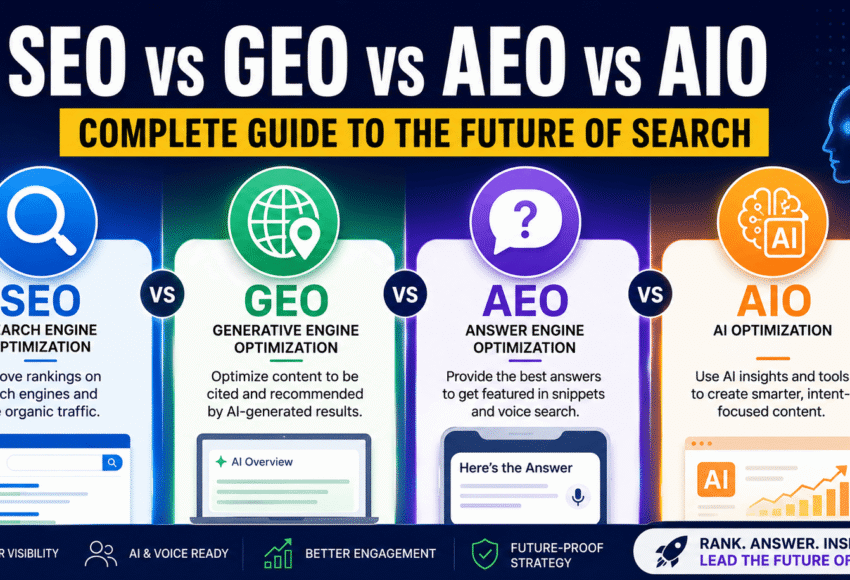
SEO vs GEO vs AEO vs AIO: Complete Guide to the Future of Search in 2026
Search is evolving faster than ever. Traditional Search Engine Optimization (SEO) is no longer enough to achieve online visibility in 2026. Businesses now need to optimize for AI-powered search experiences, answer engines, and generative AI platforms. This guide explains the differences between SEO, GEO, AEO, and AIO, how each works, when to use them, and why combining all four creates a future-ready digital marketing strategy.
Introduction
The way people search online has changed dramatically.
Instead of typing simple keywords into search engines, users now ask conversational questions through AI assistants, voice search, and generative AI platforms. Search engines increasingly provide direct answers rather than just lists of websites.
As a result, digital marketers must expand their optimization strategy beyond traditional SEO.
The four major optimization approaches in 2026 are:
- SEO (Search Engine Optimization)
- GEO (Generative Engine Optimization)
- AEO (Answer Engine Optimization)
- AIO (AI Optimization)
Understanding how they work together is essential for businesses, marketers, bloggers, and content creators.
What is SEO (Search Engine Optimization)?
SEO is the practice of improving a website’s visibility in search engine results.
Its primary goal is to increase organic traffic by helping pages rank for relevant keywords.
Core Components of SEO
- Keyword Research
- On-Page SEO
- Technical SEO
- Off-Page SEO
- Content Marketing
- Link Building
- User Experience
- Core Web Vitals
Best For
- Google Search
- Bing Search
- Website traffic
- Blog growth
- E-commerce websites
Main Goal
Rank higher in traditional search engine results.
What is GEO (Generative Engine Optimization)?
Generative Engine Optimization (GEO) focuses on helping AI-powered search systems reference, summarize, and recommend your content in AI-generated responses.
Instead of only ranking webpages, GEO aims to make your brand a trusted source for AI-generated answers.
GEO Focus Areas
- Authoritative content
- Clear factual information
- Structured data
- Expert insights
- Original research
- High topical authority
- Reliable citations
Best For
- AI search engines
- AI assistants
- Large language models
- AI-generated search experiences
Main Goal
Become a trusted source used by generative AI.
What is AEO (Answer Engine Optimization)?
Answer Engine Optimization focuses on providing direct, concise, and accurate answers to user questions.
Search engines increasingly display answers without requiring users to click through to a website.
AEO helps your content appear in:
- Featured Snippets
- AI Overviews
- Voice Search
- People Also Ask
- Smart Assistants
AEO Best Practices
- Use question-based headings
- Create FAQ sections
- Write concise answers
- Structure content clearly
- Use schema markup
- Optimize for conversational queries
Main Goal
Deliver the best answer to a user’s question.
What is AIO (AI Optimization)?
AI Optimization (AIO) is the process of creating, optimizing, and improving content for AI-powered search ecosystems while using AI responsibly throughout the content creation process.
It combines:
- AI-assisted research
- Content optimization
- Intent analysis
- Semantic optimization
- Personalization
- Predictive content strategy
AIO is not about replacing human expertise—it is about using AI to improve efficiency while maintaining originality, accuracy, and value.
Main Goal
Create AI-friendly, user-focused, and trustworthy content.
SEO vs GEO vs AEO vs AIO: Key Differences
| Feature | SEO | GEO | AEO | AIO |
|---|---|---|---|---|
| Primary Focus | Search rankings | AI-generated answers | Direct answers | AI-assisted optimization |
| Target Platform | Search engines | Generative AI | Answer engines | AI ecosystems |
| Content Style | Keyword optimized | Authoritative | Question & answer | Intent-focused |
| Success Metric | Organic traffic | AI citations | Featured answers | User engagement & AI visibility |
| Main Audience | Website visitors | AI users | Voice & search users | Humans + AI systems |
Why Businesses Need All Four in 2026
Relying only on SEO means missing opportunities in AI-powered search experiences.
Modern businesses should combine all four strategies to maximize online visibility.
Benefits
- Higher Google rankings
- Better AI visibility
- More featured snippets
- Increased voice search traffic
- Improved user experience
- Higher brand authority
- Better conversion rates
- Future-proof digital presence
Real-World Example
Imagine someone searches:
“Which digital marketing course is best for beginners?”
Traditional SEO
Your blog ranks on Google’s first page.
AEO
Google extracts your answer into a Featured Snippet or AI Overview.
GEO
An AI assistant cites your website while generating a comprehensive recommendation.
AIO
Your content is optimized using AI insights while remaining helpful, original, and authoritative.
Best Practices for Future-Proof Search Optimization
1. Publish High-Quality Content
Create helpful, experience-based content that solves real user problems.
2. Focus on Search Intent
Understand whether users want information, comparisons, products, or services.
3. Add FAQ Sections
Question-and-answer formats improve visibility in answer engines and voice search.
4. Use Structured Data
Schema markup helps search engines and AI systems understand your content.
5. Build Topical Authority
Publish comprehensive content clusters around your niche instead of isolated articles.
6. Improve Technical Performance
Optimize page speed, mobile responsiveness, Core Web Vitals, and website security.
7. Demonstrate Experience and Trust
Show expertise with original insights, case studies, author information, and reliable sources.
8. Update Content Regularly
Keep articles current with the latest trends, tools, and search technologies.
Common Mistakes to Avoid
- Focusing only on keywords
- Publishing AI-generated content without editing
- Ignoring user intent
- Neglecting technical SEO
- Writing without structure
- Skipping FAQ sections
- Forgetting local search optimization
- Producing duplicate or thin content
Future of Search Beyond 2026
Search will continue to evolve toward:
- AI-first experiences
- Conversational search
- Personalized recommendations
- Voice assistants
- Visual search
- Multimodal search
- Predictive search
- Zero-click experiences
Businesses that embrace SEO, GEO, AEO, and AIO together will be best positioned to thrive.
Frequently Asked Questions (FAQs)
1. What is the difference between SEO and GEO?
SEO improves visibility in traditional search engine results, while GEO helps AI-powered search systems recognize and reference your content in generated responses.
2. Is SEO still important in 2026?
Yes. SEO remains the foundation of online visibility, but it is most effective when combined with GEO, AEO, and AIO strategies.
3. What is AEO used for?
AEO helps content appear in featured snippets, AI overviews, voice search, and direct-answer experiences by providing clear, well-structured responses.
4. Does AI replace SEO?
No. AI complements SEO by improving research, analysis, and optimization. Human expertise, originality, and trust remain essential.
5. Which optimization strategy should beginners learn first?
Start with SEO fundamentals, then expand into AEO, GEO, and AIO as your skills grow. Together, they form a complete modern search optimization strategy.
Conclusion
The future of search is no longer limited to ranking webpages. Success in 2026 requires a comprehensive strategy that combines SEO, GEO, AEO, and AIO. SEO builds your foundation, AEO helps you answer users directly, GEO increases visibility in AI-generated responses, and AIO enhances content creation and optimization through intelligent workflows.
Businesses, marketers, and content creators who adopt this integrated approach will be better equipped to reach audiences across search engines, AI assistants, voice platforms, and emerging search experiences. By prioritizing high-quality content, user intent, technical excellence, and trustworthy information, you can build a resilient digital presence that continues to perform as search technology evolves.




Leave a Comment