
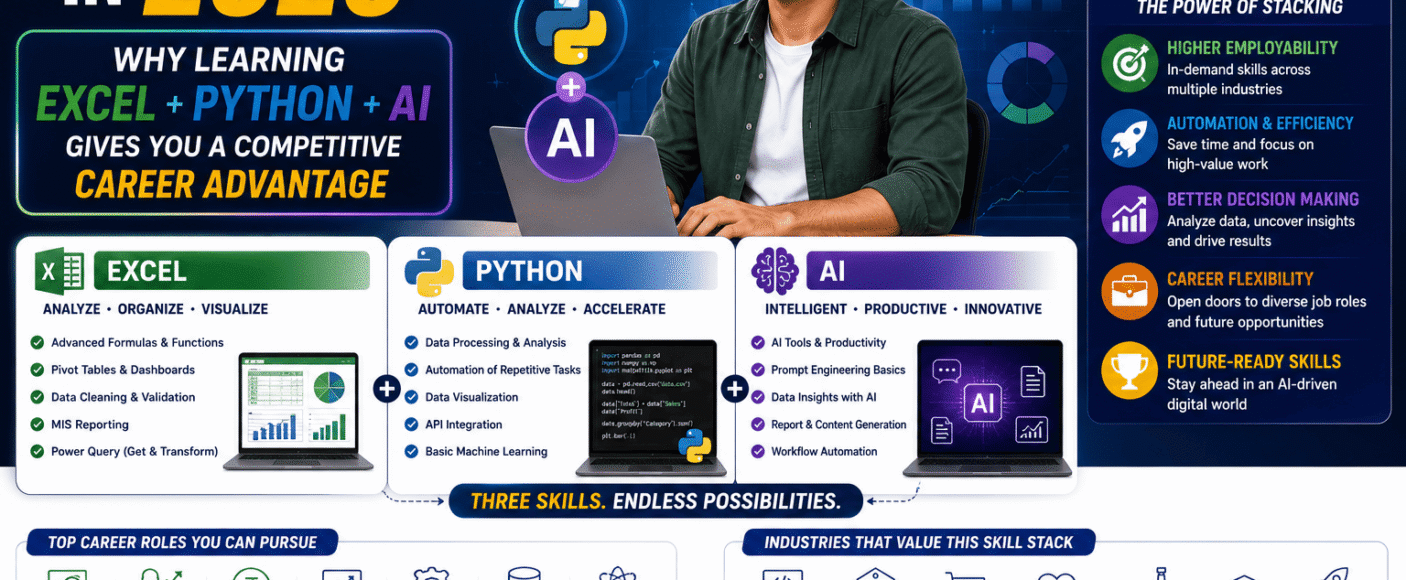
Skill Stacking in 2026: Why Learning Excel + Python + AI Gives You a Competitive Career Advantage
The modern workplace no longer rewards professionals who rely on a single skill. Employers increasingly prefer candidates who can combine technical knowledge with analytical thinking and AI-powered productivity. This approach, known as skill stacking, helps professionals solve complex business problems, adapt to changing technologies, and contribute across multiple functions.
One of the most valuable combinations in 2026 is Advanced Excel + Python + Artificial Intelligence (AI). Together, these skills enable professionals to organize data, automate repetitive tasks, build dashboards, analyze business performance, and make faster, data-driven decisions.
Whether you’re a student, graduate, finance professional, business analyst, data enthusiast, or career changer, learning these complementary skills can significantly strengthen your career profile and prepare you for future opportunities.
What Is Skill Stacking?
Skill stacking is the process of combining multiple complementary skills that work together to increase your professional value.
Instead of becoming highly specialized in only one area, professionals develop a balanced combination of technical, analytical, and business skills.
For example:
- Advanced Excel + Data Analysis
- Python + AI
- Digital Marketing + Analytics
- Graphic Design + Motion Graphics
- UI/UX Design + Front-End Development
- Finance + Data Visualization
Skill stacking helps professionals become more adaptable in evolving workplaces.
Why Skill Stacking Matters in 2026
Today’s organizations seek professionals who can perform beyond a single job function.
Technology, automation, and AI have changed how businesses operate, creating demand for professionals who can:
- Analyze information
- Automate workflows
- Interpret business data
- Use AI responsibly
- Communicate insights
- Improve productivity
- Solve real business problems
Employers increasingly value versatility alongside technical expertise.
Why Excel + Python + AI Is a Powerful Combination
Each skill addresses different business needs while complementing the others.
Advanced Excel
Excel remains one of the most widely used business tools across industries.
Skills You Learn
- Advanced Formulas
- Pivot Tables
- Lookup Functions
- Data Cleaning
- Dashboard Creation
- MIS Reporting
- Financial Analysis
Common Uses
- Business Reporting
- Sales Analysis
- HR Dashboards
- Financial Planning
- Inventory Tracking
Python Programming
Python enables professionals to automate repetitive work and analyze large datasets efficiently.
Skills You Learn
- Programming Fundamentals
- Data Processing
- Automation
- File Handling
- APIs
- Basic Machine Learning Concepts
Common Uses
- Business Automation
- Data Analysis
- Report Generation
- Workflow Optimization
- Data Integration
Artificial Intelligence (AI)
AI helps professionals work faster by supporting analysis, research, content generation, and decision-making.
Skills You Learn
- AI Productivity Tools
- Prompt Engineering Basics
- AI-Assisted Research
- Workflow Automation
- Responsible AI Practices
Common Uses
- Data Summarization
- Report Drafting
- Business Insights
- Customer Support
- Content Creation
How These Skills Work Together
When combined, Excel, Python, and AI complement each other in practical business scenarios.
| Skill | Primary Role | Business Value |
|---|---|---|
| Advanced Excel | Organize, analyze, and visualize data | Reporting and decision support |
| Python | Automate and process data | Improved efficiency and scalability |
| AI | Accelerate analysis and routine tasks | Faster insights and productivity |
Professionals who understand how to integrate these tools can contribute to more efficient business processes.
Career Opportunities
Learning Excel, Python, and AI can support careers such as:
- Data Analyst
- Business Analyst
- MIS Executive
- Financial Analyst
- Operations Executive
- Reporting Specialist
- Automation Support Associate
- Business Intelligence Assistant
- Digital Transformation Coordinator
Specific responsibilities vary by employer and experience level.
Industries That Value This Skill Stack
These combined skills are relevant across many sectors, including:
- Banking & Finance
- Information Technology
- Healthcare
- Manufacturing
- Retail
- Logistics
- E-commerce
- Consulting
- Education Technology
- Startups
Organizations in these industries increasingly rely on data and automation to improve decision-making.
Benefits of Learning Excel + Python + AI
Better Problem Solving
You can organize data, automate repetitive tasks, and interpret results more effectively.
Improved Productivity
Automation reduces manual work and allows more time for analysis and strategic thinking.
Greater Career Flexibility
These skills apply across multiple industries and job roles, making career transitions easier.
Stronger Resume
Relevant technical skills, practical projects, and certifications can strengthen your overall candidate profile.
Continuous Learning
Skill stacking encourages professionals to adapt to evolving technologies and workplace expectations.
Suggested Learning Roadmap
Stage 1 – Advanced Excel
Start with:
- Formulas
- Pivot Tables
- Conditional Formatting
- Charts
- Dashboards
- Data Validation
Complete business reporting exercises.
Stage 2 – Data Analysis
Learn:
- Data Cleaning
- Visualization
- Business Metrics
- Reporting Techniques
Work with realistic datasets.
Stage 3 – Python Programming
Focus on:
- Variables
- Loops
- Functions
- File Handling
- Libraries for data analysis
Practice automating routine tasks.
Stage 4 – Artificial Intelligence
Understand:
- AI productivity tools
- Prompt writing
- AI-assisted workflows
- Responsible AI usage
Use AI to support—not replace—your analytical thinking.
Stage 5 – Build Projects
Create practical projects such as:
- Sales Dashboard
- Expense Tracker
- Automated Reports
- Business Performance Dashboard
- Data Cleaning Scripts
Projects help demonstrate applied knowledge during interviews.
Skills Employers Expect Alongside Technical Knowledge
Recruiters also value:
- Communication
- Teamwork
- Critical Thinking
- Adaptability
- Time Management
- Business Communication
- Presentation Skills
- Professional Ethics
Combining technical expertise with strong workplace skills improves employability.
How Skill Stacking Supports Career Growth
Professionals who continue learning complementary skills often become better equipped to:
- Work across departments
- Contribute to business decisions
- Learn new technologies
- Adapt to changing job roles
- Support digital transformation initiatives
Continuous upskilling can help maintain career relevance over time.
Common Mistakes to Avoid
Learning Tools Without Practice
Complete practical assignments and projects to reinforce your understanding.
Ignoring Business Fundamentals
Technical tools are most valuable when you understand the business problems they help solve.
Relying Entirely on AI
Use AI as a productivity assistant while maintaining your own analytical judgment.
Skipping Communication Skills
Being able to explain insights clearly is just as important as generating them.
Avoiding Continuous Learning
Technology evolves rapidly, making regular skill updates essential.
Why Ahmedabad Is a Great Place to Learn Future Skills
Ahmedabad continues to expand across:
- Information Technology
- Financial Services
- Manufacturing
- Startups
- Data Analytics
- Digital Marketing
- Professional Education
Students and professionals can benefit from practical training, industry-oriented courses, and opportunities to build real-world projects.
Frequently Asked Questions (FAQs)
1. What is skill stacking?
Skill stacking is the practice of learning complementary skills that work together to increase your value in the job market.
2. Why should I learn Excel, Python, and AI together?
These skills complement each other by combining data analysis, automation, and AI-assisted productivity, making them useful across many business functions.
3. Is Python difficult for beginners?
Python is often considered beginner-friendly because of its readable syntax. Consistent practice and project-based learning help build confidence.
4. Is Advanced Excel still relevant in 2026?
Yes. Advanced Excel continues to be widely used for reporting, financial analysis, dashboards, and business operations across many industries.
5. Can AI replace Excel or Python?
AI can assist with many tasks but does not eliminate the need to understand data, programming logic, or business analysis. These skills complement AI rather than compete with it.
6. Which careers benefit from this skill combination?
Data Analytics, Finance, Business Intelligence, Operations, Reporting, Automation Support, and Digital Transformation are examples of fields where these skills can be valuable.
7. Is Ahmedabad a good city for learning these skills?
Ahmedabad offers growing opportunities in IT, finance, analytics, startups, and professional training, making it a strong location for career-focused learning.
8. How can I become more employable?
Develop technical expertise, build practical projects, strengthen communication skills, learn AI responsibly, and continue upgrading your knowledge.
Conclusion
The future belongs to professionals who combine complementary skills rather than relying on a single area of expertise. Advanced Excel, Python, and Artificial Intelligence form a powerful skill stack that supports data-driven decision-making, workflow automation, and business productivity across industries.
Whether you’re a student preparing for your first job, a working professional aiming to upskill, or someone planning a career transition, learning these technologies together can help you build a stronger, more adaptable professional profile. Pair your technical knowledge with communication, critical thinking, and real-world projects to maximize your career potential in 2026 and beyond.

Leave a Comment