
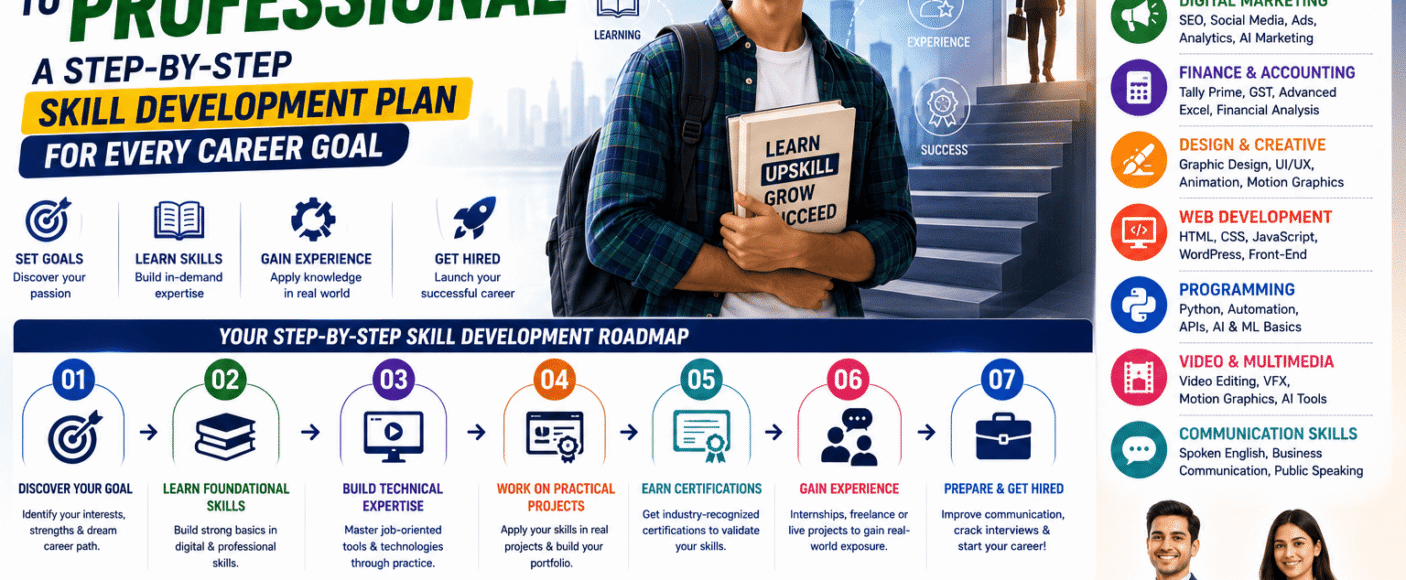
From Student to Professional: A Step-by-Step Skill Development Plan for Every Career Goal (2026 Guide)
Completing school or college is only the beginning of your career journey. Today’s employers expect candidates to possess practical skills, digital expertise, problem-solving abilities, communication skills, and industry knowledge in addition to academic qualifications.
Whether your dream is to become a Data Analyst, Digital Marketing Specialist, Accountant, Financial Analyst, UI/UX Designer, Graphic Designer, Website Developer, Python Programmer, Motion Graphics Designer, AI Professional, or Business Communication Expert, following a structured skill development plan can help you move confidently from the classroom to the corporate world.
This guide provides a practical roadmap that students, graduates, freshers, and working professionals can follow to build job-ready skills, strengthen employability, and prepare for future career opportunities in 2026.
Why Skill Development Is More Important Than Ever
The workplace is evolving rapidly due to:
- Artificial Intelligence (AI)
- Automation
- Digital Transformation
- Cloud Technologies
- Data-Driven Decision Making
- Hybrid Work Models
Recruiters increasingly seek candidates who combine technical expertise with communication, adaptability, teamwork, and practical experience.
Continuous learning has become an essential part of long-term career success.
Step 1: Identify Your Career Goal
Before enrolling in any professional course, define your destination.
Ask yourself:
- What type of work do I enjoy?
- Do I like creativity or technology?
- Am I interested in business or finance?
- Do I enjoy solving analytical problems?
- Would I like to work with AI and emerging technologies?
Examples of career goals include:
- Data Analyst
- Digital Marketing Executive
- Graphic Designer
- UI/UX Designer
- Financial Analyst
- Accountant
- Website Developer
- Python Developer
- Motion Graphics Designer
- Video Editor
- AI Professional
A clear career goal helps you choose relevant skills instead of learning unrelated topics.
Step 2: Build Strong Digital Foundations
Every profession now requires digital competency.
Essential digital skills include:
- Microsoft Office
- Advanced Excel
- Internet Research
- Google Workspace
- Online Collaboration Tools
- Cloud Storage
- Cybersecurity Awareness
These skills improve productivity across industries.
Step 3: Learn Industry-Relevant Technical Skills
Choose technical skills that align with your career aspirations.
Career Goal: Data Analytics
Recommended Learning
- Advanced Excel
- Power BI
- Data Visualization
- Python Basics
- AI Productivity Tools
Career Opportunities
- Data Analyst
- Business Analyst
- MIS Executive
Career Goal: Finance & Accounting
Recommended Learning
- Tally Prime
- GST
- Payroll
- Advanced Excel
- Financial Reporting
- FinTech Basics
Career Opportunities
- Accountant
- Finance Executive
- Accounts Executive
Career Goal: Digital Marketing
Recommended Learning
- SEO
- Google Ads
- Social Media Marketing
- Content Marketing
- Analytics
- AI Marketing Tools
Career Opportunities
- Digital Marketing Executive
- SEO Specialist
- Performance Marketer
Career Goal: Graphic Design
Recommended Learning
- Adobe Photoshop
- Illustrator
- Canva
- Branding
- AI Design Tools
Career Opportunities
- Graphic Designer
- Visual Designer
- Brand Designer
Career Goal: UI/UX Design
Recommended Learning
- Figma
- Wireframing
- Prototyping
- User Research
- Design Systems
Career Opportunities
- UI Designer
- UX Designer
- Product Designer
Career Goal: Website Development
Recommended Learning
- HTML
- CSS
- WordPress
- Responsive Design
- Basic SEO
Career Opportunities
- Website Developer
- Front-End Developer
Career Goal: Python Programming
Recommended Learning
- Python Fundamentals
- Automation
- APIs
- Problem Solving
- AI Libraries
Career Opportunities
- Python Developer
- Automation Engineer
Career Goal: Motion Graphics & Video Editing
Recommended Learning
- After Effects
- Premiere Pro
- Storytelling
- Motion Graphics
- AI Video Tools
Career Opportunities
- Motion Graphics Designer
- Video Editor
- Multimedia Designer
Step 4: Learn Artificial Intelligence
AI is becoming a valuable skill across industries.
Focus on learning:
- AI Productivity Tools
- Prompt Engineering Basics
- Workflow Automation
- AI-Assisted Research
- Responsible AI Practices
AI enhances productivity but should complement—not replace—human expertise and decision-making.
Step 5: Strengthen Professional Skills
Technical expertise should be supported by workplace competencies.
Develop:
- Spoken English
- Business Communication
- Presentation Skills
- Email Writing
- Teamwork
- Leadership
- Critical Thinking
- Time Management
- Adaptability
- Emotional Intelligence
These skills improve collaboration and career progression.
Step 6: Build Practical Experience
Employers often value practical application alongside theoretical knowledge.
Gain experience through:
- Live Projects
- Internships
- Freelance Work
- Personal Projects
- Case Studies
- Portfolio Development
Examples include:
- Business dashboards
- Marketing campaigns
- Graphic design portfolios
- Websites
- Python automation scripts
- Financial reports
- Motion graphics videos
Step 7: Earn Relevant Certifications
Professional certifications can demonstrate ongoing learning and familiarity with industry tools.
Look for courses that offer:
- Practical assignments
- Industry-standard software
- Updated curriculum
- Portfolio development
- Career support
Certifications are most effective when backed by real projects and demonstrable skills.
Step 8: Build a Professional Resume
Your resume should highlight:
✅ Technical skills
✅ Relevant certifications
✅ Internship experience
✅ Practical projects
✅ AI literacy
✅ Communication skills
✅ Quantifiable achievements
For creative and technical roles, include links to your portfolio or GitHub where applicable.
Step 9: Prepare for Interviews
Interview preparation should include:
- Researching the company
- Understanding the job role
- Practicing technical concepts
- Discussing projects confidently
- Improving communication
- Preparing behavioural interview examples
Confidence grows through preparation and practice.
Step 10: Continue Learning
Learning does not stop after securing a job.
Stay updated by:
- Following industry trends
- Learning new software
- Exploring AI applications
- Attending webinars
- Reading professional resources
- Completing advanced courses
Continuous improvement supports long-term career growth.
Career Roadmaps by Interest
| Career Interest | Recommended Skill Path |
|---|---|
| Data & Analytics | Advanced Excel → Power BI → Python → AI |
| Finance | Tally Prime → GST → Advanced Excel → FinTech |
| Digital Marketing | SEO → Social Media → Analytics → AI Tools |
| Design | Graphic Design → UI/UX → Motion Graphics → AI Design |
| Programming | Python → APIs → Automation → AI |
| Website Development | HTML → CSS → WordPress → SEO |
| Communication | Spoken English → Business Communication → Public Speaking |
Why Skill Stacking Works
Instead of relying on a single expertise, combining complementary skills increases versatility.
Examples include:
- Advanced Excel + Power BI + AI
- Digital Marketing + Analytics + AI
- Graphic Design + Motion Graphics + AI
- UI/UX Design + Website Development
- Finance + Data Analytics
- Python + Automation + AI
Skill stacking prepares professionals for cross-functional responsibilities.
Common Mistakes Students Make
Learning Without a Career Plan
Choose courses that align with your goals rather than following trends alone.
Ignoring Practical Projects
Projects help demonstrate your ability to apply knowledge in real-world situations.
Weak Communication Skills
Strong communication enhances teamwork, interviews, and leadership potential.
Avoiding AI
AI literacy is becoming an important complement to many professional roles.
Stopping Learning After Getting a Job
Technology evolves continuously. Ongoing learning helps maintain career relevance.
Why Ahmedabad Is a Great Place for Skill Development
Ahmedabad offers growing opportunities across:
- Information Technology
- Finance
- Manufacturing
- Digital Marketing
- Creative Design
- Startups
- Professional Education
The city’s expanding business ecosystem provides opportunities to combine learning with practical exposure.
Frequently Asked Questions (FAQs)
1. What is the best way to start skill development?
Begin by identifying your career goal, then learn the technical and professional skills required for that role through structured training and practical projects.
2. Which professional skills are important in 2026?
Communication, teamwork, adaptability, critical thinking, emotional intelligence, and business communication remain essential across industries.
3. Why should I learn AI?
AI tools can improve productivity, automate repetitive tasks, and support decision-making across many professions.
4. Are certifications enough to get a job?
Certifications strengthen your profile, but employers also consider practical experience, technical knowledge, communication, and interview performance.
5. How important are internships?
Internships provide real-world experience, improve confidence, and help bridge the gap between education and employment.
6. What is skill stacking?
Skill stacking means combining complementary skills—such as Advanced Excel, Python, AI, or Graphic Design with Motion Graphics—to increase your career opportunities.
7. Is Ahmedabad a good city for career-oriented learning?
Yes. Ahmedabad has a growing ecosystem of IT companies, financial services, startups, manufacturing industries, and professional training institutes that support skill development.
8. How can I become job-ready after graduation?
Build technical expertise, strengthen communication skills, complete practical projects, earn relevant certifications, learn AI fundamentals, and continue updating your knowledge.
Conclusion
Transitioning from student to professional requires more than academic success. Employers in 2026 are looking for individuals who combine technical expertise, AI literacy, practical experience, communication skills, and a commitment to continuous learning.
Whether your goal is to build a career in Data Analytics, Finance, Digital Marketing, Graphic Design, UI/UX Design, Website Development, Python Programming, Motion Graphics, Video Editing, or Business Communication, following a structured skill development roadmap can help you prepare for long-term success.
Start with a clear career goal, learn industry-relevant skills, build practical projects, strengthen your communication abilities, and continue learning throughout your career. By combining technical knowledge with professional development, you’ll be better equipped to meet the evolving expectations of employers and build a rewarding future.
Leave a Comment