
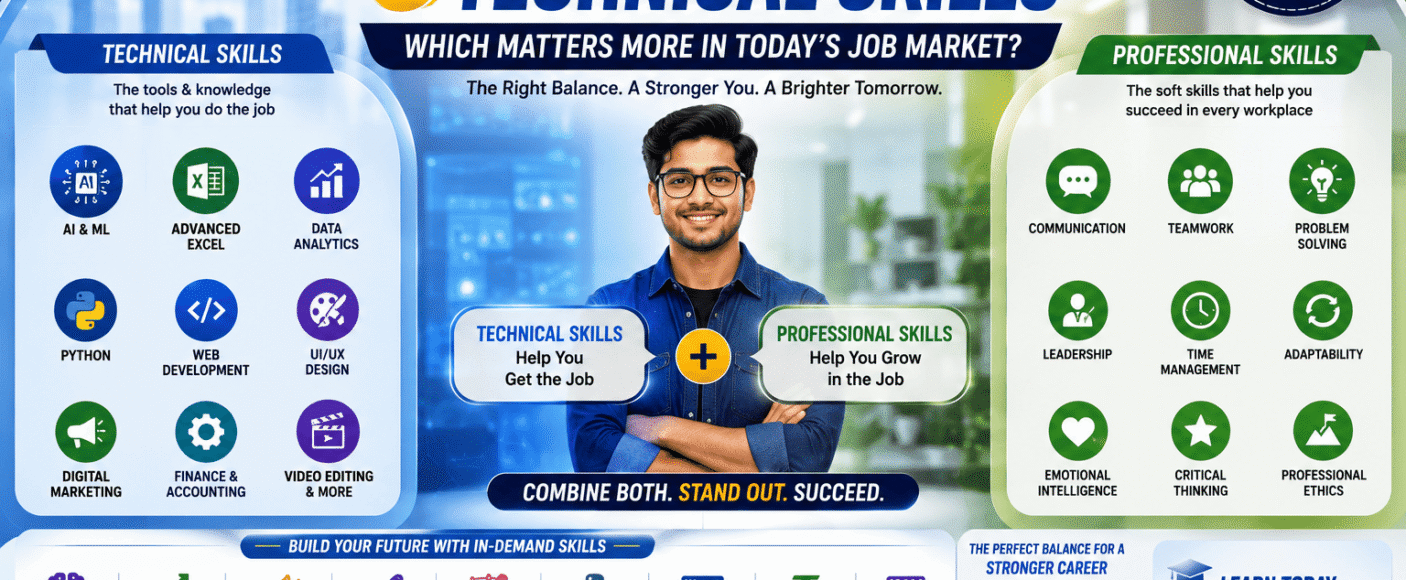
Professional Skills vs Technical Skills: Which Matters More in Today’s Job Market? (2026 Career Guide)
In today’s competitive job market, having technical knowledge alone is no longer enough to build a successful career. Employers are looking for professionals who can combine technical expertise with communication, teamwork, adaptability, critical thinking, and AI literacy. Whether you’re a student, fresher, graduate, or working professional, balancing both technical and professional skills is essential for long-term career growth.
This guide explains the differences between professional and technical skills, why both matter, how employers evaluate candidates, and which skills you should prioritize in 2026 to remain competitive in industries such as Artificial Intelligence, Data Analytics, Digital Marketing, Finance, UI/UX Design, Graphic Design, Website Development, Python Programming, Motion Graphics, Video Editing, and Business Communication.
What Are Technical Skills?
Technical skills are measurable, job-specific abilities that enable professionals to perform specialized tasks using tools, software, programming languages, or technical processes.
These skills are usually learned through structured education, professional courses, certifications, workshops, and practical projects.
Examples of Technical Skills
- Artificial Intelligence (AI) Tools
- Prompt Engineering
- Advanced Excel
- Data Analytics
- Power BI
- Python Programming
- Tally Prime
- GST & Payroll
- Digital Marketing
- SEO
- Google Ads
- UI/UX Design
- Figma
- Adobe Photoshop
- Illustrator
- Motion Graphics
- Video Editing
- Website Development
- HTML & CSS
- WordPress
- Financial Analysis
- Data Visualization
Technical skills help professionals perform role-specific responsibilities efficiently.
What Are Professional Skills?
Professional skills (also called workplace or soft skills) are personal and interpersonal abilities that help individuals collaborate, communicate, solve problems, and adapt to workplace challenges.
Unlike technical skills, these abilities apply across industries and job roles.
Examples of Professional Skills
- Communication
- Business Communication
- Spoken English
- Teamwork
- Leadership
- Time Management
- Problem Solving
- Critical Thinking
- Creativity
- Adaptability
- Emotional Intelligence
- Decision Making
- Negotiation
- Customer Service
- Presentation Skills
- Professional Ethics
Professional skills influence how effectively individuals work with others and contribute to organizational goals.
Professional Skills vs Technical Skills
| Technical Skills | Professional Skills |
|---|---|
| Job-specific | Applicable across industries |
| Measurable | Behavioural and interpersonal |
| Learned through courses and practice | Developed through experience and practice |
| Software and tool focused | People and communication focused |
| Required to perform tasks | Required to work effectively with others |
| Easier to assess through tests | Often evaluated during interviews and workplace interactions |
Both categories complement each other and contribute to overall employability.
Why Employers Need Both
Imagine two candidates applying for the same role.
Candidate A
- Excellent technical knowledge
- Poor communication
- Difficulty working in teams
- Limited adaptability
Candidate B
- Strong technical skills
- Effective communication
- Team collaboration
- Problem-solving mindset
- Positive attitude
In many workplaces, Candidate B may be better positioned to contribute across projects because they combine technical expertise with professional competencies.
Skills Recruiters Value in 2026
Modern recruiters increasingly look for candidates who demonstrate:
Technical Expertise
- AI Literacy
- Advanced Excel
- Power BI
- Data Analytics
- Python Programming
- Digital Marketing
- UI/UX Design
- Graphic Design
- Website Development
- Tally Prime
- Financial Analysis
Professional Competencies
- Communication
- Collaboration
- Adaptability
- Creativity
- Leadership
- Critical Thinking
- Emotional Intelligence
- Time Management
- Customer Focus
How AI Is Changing Skill Requirements
Artificial Intelligence is reshaping nearly every profession.
Professionals who understand how to use AI responsibly alongside their core expertise can improve productivity and efficiency.
Examples include:
Marketing
- AI-assisted content creation
- Campaign optimization
- Keyword research
Finance
- Automated reporting
- Financial forecasting
- Data analysis
Design
- AI-generated concepts
- Image editing
- Workflow enhancement
Programming
- Code suggestions
- Debugging assistance
- Automation
AI complements human expertise but does not replace the need for critical thinking, creativity, communication, or ethical judgment.
Technical Skills for Different Career Paths
Data Analytics
Learn
- Advanced Excel
- Power BI
- Data Visualization
- Python
Career Opportunities
- Data Analyst
- Business Analyst
- MIS Executive
Digital Marketing
Learn
- SEO
- Google Ads
- Social Media Marketing
- Analytics
- AI Marketing Tools
Career Opportunities
- Digital Marketing Executive
- SEO Specialist
- Performance Marketer
Finance & Accounting
Learn
- Tally Prime
- GST
- Payroll
- Advanced Excel
- Financial Reporting
Career Opportunities
- Accountant
- Finance Executive
- Accounts Executive
UI/UX Design
Learn
- Figma
- Wireframing
- Prototyping
- User Research
Career Opportunities
- UI Designer
- UX Designer
- Product Designer
Graphic Design
Learn
- Photoshop
- Illustrator
- Branding
- AI Design Tools
Career Opportunities
- Graphic Designer
- Visual Designer
Website Development
Learn
- HTML
- CSS
- WordPress
- Responsive Design
Career Opportunities
- Website Developer
- Front-End Developer
Python Programming
Learn
- Programming Fundamentals
- Automation
- APIs
- AI Libraries
Career Opportunities
- Python Developer
- Automation Engineer
Motion Graphics & Video Editing
Learn
- After Effects
- Premiere Pro
- Storytelling
- Animation
Career Opportunities
- Motion Graphics Designer
- Video Editor
Professional Skills Every Student Should Build
Regardless of your career choice, focus on developing:
Communication
Speak clearly, write professionally, and present ideas confidently.
Teamwork
Work effectively with diverse teams and contribute to shared goals.
Problem Solving
Approach challenges with structured thinking and practical solutions.
Adaptability
Stay open to learning new technologies, tools, and business practices.
Leadership
Take initiative, support colleagues, and contribute positively to projects.
Time Management
Prioritize tasks, meet deadlines, and manage workloads effectively.
How to Build Both Skill Sets
Technical Skills
- Enroll in professional courses
- Complete certifications
- Practice using industry-standard software
- Build projects
- Participate in internships
Professional Skills
- Join group projects
- Practice public speaking
- Improve business communication
- Participate in workshops
- Seek constructive feedback
- Develop workplace professionalism
Building a Balanced Resume
Recruiters appreciate resumes that demonstrate:
✅ Technical expertise
✅ Professional certifications
✅ Practical projects
✅ Internship experience
✅ Communication skills
✅ AI literacy
✅ Team collaboration
✅ Leadership experience
A balanced profile often reflects both role-specific abilities and workplace readiness.
Common Mistakes Candidates Make
Focusing Only on Technical Skills
Strong technical knowledge is valuable, but communication and collaboration are also important in many roles.
Ignoring AI
Learning how AI tools support your profession can improve efficiency and adaptability.
Weak Communication
Technical expertise should be supported by clear written and verbal communication.
No Practical Experience
Projects, internships, and portfolios help demonstrate real-world application of your skills.
Avoiding Continuous Learning
Industries continue to evolve. Regular upskilling helps maintain career relevance.
Why Ahmedabad Is an Excellent Place to Learn Professional Skills
Ahmedabad offers opportunities across:
- Information Technology
- Digital Marketing
- Finance
- Manufacturing
- Creative Design
- Startups
- Professional Education
Learners can access practical training, industry-oriented courses, and growing employment opportunities.
Frequently Asked Questions (FAQs)
1. Which is more important: professional skills or technical skills?
Both are important. Technical skills enable you to perform your job, while professional skills help you collaborate, communicate, and grow within an organization.
2. Can technical skills alone help me get a job?
Technical skills may help you qualify for a role, but employers also evaluate communication, teamwork, adaptability, and interview performance.
3. What technical skills are most in demand in 2026?
Artificial Intelligence, Data Analytics, Advanced Excel, Power BI, Digital Marketing, UI/UX Design, Graphic Design, Website Development, Python Programming, Finance, and Tally Prime continue to align with industry demand.
4. What professional skills do recruiters value?
Communication, leadership, teamwork, problem-solving, adaptability, emotional intelligence, time management, and professionalism are consistently valued across industries.
5. Why is AI literacy becoming important?
AI tools are increasingly integrated into business processes, helping professionals automate routine tasks, analyse data, and improve productivity.
6. How can students improve professional skills?
Participate in internships, presentations, group projects, public speaking activities, workshops, and practical training.
7. Is Ahmedabad a good place for professional education?
Ahmedabad has a growing ecosystem of IT companies, financial services, startups, creative agencies, and professional training institutes that support skill development.
8. How can I become more employable?
Develop a combination of technical expertise, AI literacy, professional communication, practical experience, certifications, and continuous learning.
Conclusion
The debate between professional skills and technical skills does not have a single winner because successful careers require both. Technical skills help you perform specialized tasks, while professional skills enable you to communicate effectively, solve problems, collaborate with teams, and adapt to change.
As industries continue to adopt Artificial Intelligence and digital technologies, employers increasingly seek professionals who combine technical competence, AI awareness, business understanding, and strong interpersonal skills.
Whether you are pursuing a career in Data Analytics, Finance, Digital Marketing, UI/UX Design, Graphic Design, Website Development, Python Programming, Motion Graphics, Video Editing, or Business Communication, investing in both technical and professional development will help you build a well-rounded profile and prepare for long-term career success in 2026 and beyond.


Leave a Comment