
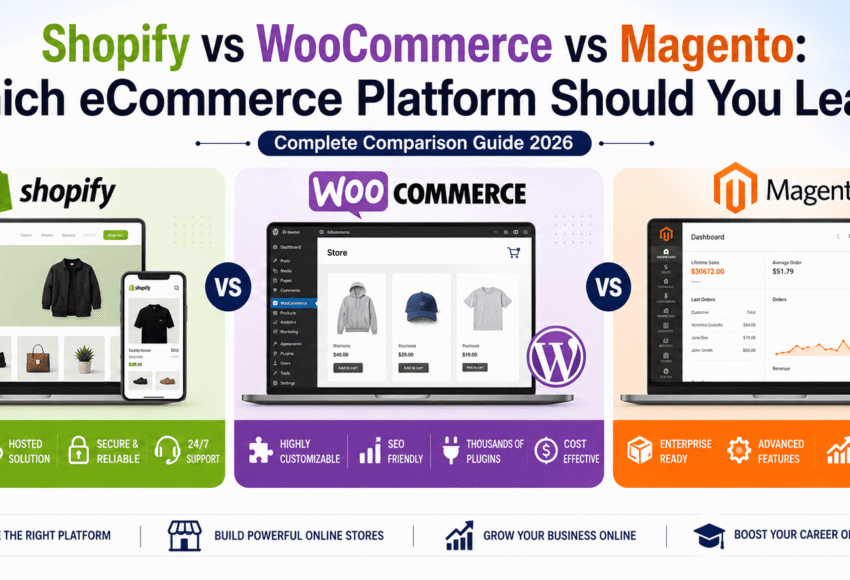
Shopify vs WooCommerce vs Magento: Which eCommerce Platform Should You Learn?
Choosing the right eCommerce platform is one of the most important decisions for aspiring developers, digital marketers, freelancers, and entrepreneurs. Shopify, WooCommerce, and Magento are three of the world’s leading eCommerce platforms, each serving different business needs.
If you’re planning to build a career in eCommerce development developmentour own online store in 2026, this comprehensive guide compares these platforms based on ease of use, features, pricing, customisation, SEO, performance, scalability, career opportunities, and future demand.
Whether you’re a beginner or an experienced developer, this guide will help you make the right learning choice.
Why Learning an eCommerce Platform Matters
The global eCommerce industry continues to grow rapidly, creating strong demand for professionals who can build, manage, and optimise online stores.
Learning an eCommerce platform can help you become:
- Shopify Developer
- WooCommerce Developer
- Magento Developer
- Freelance Web Developer
- Digital Marketing Specialist
- eCommerce Consultant
- Agency Owner
- Online Entrepreneur
It is also a valuable skill if you plan to start your own online business.
Quick Comparison
| Feature | Shopify | WooCommerce | Magento |
|---|---|---|---|
| Platform Type | Hosted SaaS | WordPress Plugin | Open Source / Enterprise |
| Ease of Learning | ⭐⭐⭐⭐⭐ | ⭐⭐⭐⭐☆ | ⭐⭐☆☆☆ |
| Coding Required | Very Low | Moderate | High |
| Beginner-Friendly | Excellent | Very Good | Limited |
| Customization | Good | Excellent | Outstanding |
| SEO Capabilities | Very Good | Excellent | Excellent |
| Scalability | High | High | Enterprise Level |
| Maintenance | Minimal | Moderate | Advanced |
| Best For | Beginners & SMEs | Bloggers & Growing Businesses | Large Enterprises |
What is Shopify?
Shopify is a cloud-based eCommerce platform that allows businesses to create an online store without extensive technical knowledge.
Advantages
- Easy to learn
- Fast setup
- Secure hosting included
- Mobile responsive themes
- Built-in payment integrations
- Excellent App Store
- 24/7 support
Limitations
- Monthly subscription
- Limited backend customization
- Premium apps increase costs
Best For
- Beginners
- Entrepreneurs
- Small businesses
- Freelancers
- Digital marketers
What is WooCommerce?
WooCommerce is a free WordPress plugin that transforms a WordPress website into a fully functional online store.
Advantages
- Free to use
- Unlimited customization
- Excellent SEO capabilities
- Thousands of plugins
- Large community support
Limitations
- Requires hosting
- Regular maintenance
- Plugin compatibility issues
- Security management
Best For
- Bloggers
- Content creators
- Small and medium businesses
- WordPress users
What is Magento?
Magento (Adobe Commerce) is an enterprise-grade eCommerce platform designed for businesses requiring advanced functionality and large-scale operations.
Advantages
- Highly customizable
- Enterprise features
- Supports large product catalogs
- Multi-store management
- Excellent performance for large businesses
Limitations
- Steep learning curve
- Requires strong programming skills
- Higher development and hosting costs
- Complex maintenance
Best For
- Enterprise companies
- Large online retailers
- Experienced developers
- Custom eCommerce projects
Feature Comparison
1. Ease of Learning
Shopify
- Beginner-friendly interface
- No coding required for basic stores
- Quick setup
WooCommerce
- Moderate learning curve
- Basic WordPress knowledge required
- Flexible customization
Magento
- Advanced development knowledge required
- Suitable for experienced programmers
Winner: Shopify
2. Customization
Shopify
Uses themes and apps with moderate customisation.
WooCommerce
Offers extensive customisation through plugins and themes.
Magento
Provides complete flexibility for enterprise-level customisation.
Winner: Magento
3. SEO Performance
SEO is essential for organic traffic.
Shopify
- Clean URLs
- SSL included
- Fast loading
- SEO apps available
WooCommerce
- Full SEO control
- Works well with SEO plugins
- Schema support
- Excellent for content marketing
Magento
- Advanced technical SEO
- Enterprise-level optimization
- Custom URL management
Winner: WooCommerce
4. Performance
Shopify
Excellent because hosting is fully managed.
WooCommerce
Depends on hosting quality.
Magento
Outstanding when configured correctly but requires technical expertise.
Winner: Shopify
5. Pricing
Shopify
- Monthly subscription
- Additional app costs
- Premium themes
WooCommerce
- Free plugin
- Pay for hosting, themes, plugins, and domain
Magento
- Open Source version available
- The enterprise edition can be expensive
Most Affordable: WooCommerce
6. Security
Shopify
- Automatic updates
- SSL certificate
- PCI compliance
- Managed security
WooCommerce
Security depends on hosting, updates, and plugins.
Magento
Enterprise-grade security with proper configuration.
Winner: Shopify
7. Scalability
Shopify
Ideal for small to large businesses.
WooCommerce
Scales well with quality hosting.
Magento
Built specifically for enterprise-level businesses.
Winner: Magento
Career Opportunities
Shopify Developer
Responsibilities:
- Store setup
- Theme customization
- App integration
- Store optimization
Average Salary (India):
₹4–12 LPA
Freelancers can earn significantly more based on project complexity.
WooCommerce Developer
Responsibilities:
- WordPress development
- Plugin customization
- Theme development
- SEO optimization
Average Salary:
₹3.5–10 LPA
Magento Developer
Responsibilities:
- Enterprise store development
- API integration
- Performance optimization
- Custom module development
Average Salary:
₹6–20+ LPA
Which Platform Should You Learn?
Learn Shopify If:
- You are a beginner.
- You want to freelance quickly.
- You plan to start an online business.
- You want faster project delivery.
- You prefer a low-code environment.
Learn WooCommerce If:
- You already know WordPress.
- You enjoy website customisation.
- You want to combine blogging and eCommerce.
- You are interested in SEO-driven websites.
Learn Magento If:
- You have programming experience.
- You want enterprise-level development work.
- You aspire to work with large organisations.
- You enjoy complex backend development.
Future Scope in 2026
The future of eCommerce platforms is being shaped by AI, automation, and personalized shopping experiences.
Emerging Trends
- AI-powered product recommendations
- Voice commerce
- Headless commerce
- Mobile-first shopping
- Omnichannel retail
- Marketing automation
- AI chatbots
- Predictive analytics
Professionals who combine platform expertise with digital marketing, analytics, and AI tools will have a competitive advantage.
GEO, AIO & AEO Optimization Tips
GEO (Generative Engine Optimization)
- Create in-depth comparison content.
- Include real-world use cases.
- Publish location-specific success stories.
- Use structured headings and schema markup.
AIO (AI Optimization)
- Optimise content for AI-assisted search.
- Include semantic keywords.
- Use conversational language.
- Demonstrate expertise with accurate, well-organised information.
AEO (Answer Engine Optimization)
- Answer common user questions directly.
- Add concise summaries.
- Include FAQ sections.
- Use clear, descriptive headings.
Frequently Asked Questions (FAQs)
1. Which eCommerce platform is best for beginners?
Shopify is generally the best choice for beginners because it is easy to learn, requires minimal technical knowledge, and includes hosting, security, and support.
2. Is WooCommerce free?
Yes. WooCommerce is a free WordPress plugin, but you’ll need to pay for hosting, a domain name, and optional premium themes or plugins.
3. Is Magento difficult to learn?
Yes. Magento has a steeper learning curve and is best suited for developers with experience in PHP, databases, and enterprise web development.
4. Which platform is best for SEO?
WooCommerce offers the greatest SEO flexibility, especially when combined with WordPress and advanced SEO plugins. Shopify and Magento also provide strong SEO capabilities.
5. Which platform offers the best career opportunities?
All three platforms have strong demand. Shopify is ideal for beginners and freelancers, WooCommerce is excellent for WordPress professionals, and Magento offers high-paying enterprise development roles.
6. Should I learn more than one platform?
Yes. Starting with Shopify or WooCommerce provides a solid foundation. As your skills grow, learning Magento can open opportunities in enterprise eCommerce development.
Conclusion
Choosing between Shopify, WooCommerce, and Magento depends on your goals, technical background, and career aspirations. Shopify is the fastest route for beginners, entrepreneurs, and freelancers who want to build and manage online stores with ease. WooCommerce is an excellent choice for WordPress users seeking flexibility, powerful SEO capabilities, and complete control over their websites. Magento is the preferred platform for experienced developers aiming to work on large-scale, enterprise-level eCommerce projects.
As the eCommerce industry continues to evolve with AI, automation, and personalized shopping experiences, learning any of these platforms can significantly enhance your career prospects. By mastering one platform first and expanding your expertise over time, you’ll be well-positioned to succeed in the rapidly growing world of eCommerce development and digital marketing



Leave a Comment