
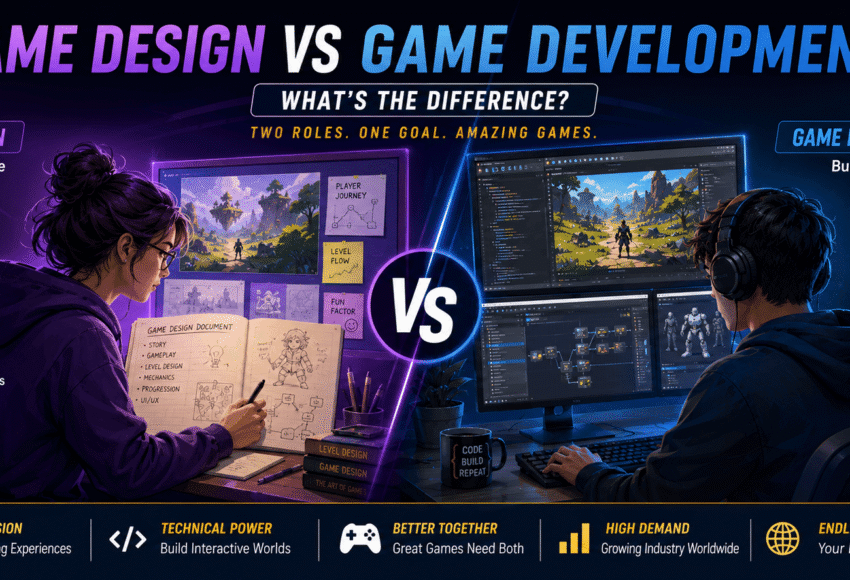
Game Design vs Game Development: What’s the Difference? (Complete 2026 Guide)
If you’re planning a career in the gaming industry, you’ve probably come across the terms ‘game design’ and ‘game development’. While these fields work together to create successful games, they involve different skills, responsibilities, and career paths. This comprehensive guide explains the key differences between game design and game development, compares salaries, required skills, software, and career opportunities, and helps you decide which path is right for you in 2026.
Game Design vs Game Development: What’s the Difference?
The gaming industry is one of the fastest-growing technology sectors worldwide, driven by mobile gaming, PC gaming, console games, esports, virtual reality (VR), and augmented reality (AR). Behind every successful game is a team of talented game designers and game developers working together.
Although these roles are closely connected, they serve very different purposes. Understanding the difference can help students, aspiring professionals, and career changers choose the right learning path.
What is Game Design?
Game design is the creative process of planning and designing a game’s overall experience. Game designers focus on making games enjoyable, engaging, balanced, and immersive.
They answer questions like:
- How should the game be played?
- What are the rules?
- How does the player progress?
- What challenges should players face?
- How should levels be structured?
- How should the story unfold?
Simply put, game designers create the vision of the game.
Responsibilities of a Game Designer
- Designing gameplay mechanics
- Creating game concepts
- Story and narrative planning
- Character design concepts
- Level design
- Difficulty balancing
- User experience (UX)
- Writing Game Design Documents (GDD)
- Designing rewards and progression systems
Skills Required for Game Designers
Creative Skills
- Creativity
- Storytelling
- Imagination
- Player psychology
- Problem-solving
Technical Skills
- Unity
- Unreal Engine
- Figma
- Blender (basic knowledge)
- Adobe Photoshop
- UI/UX principles
Programming knowledge is helpful but not always mandatory.
What is Game Development?
Game development is the technical process of building the game using programming languages and development tools. Developers transform ideas and designs into fully functional games.
Game developers create:
- Game mechanics
- Physics
- Artificial Intelligence (AI)
- Multiplayer systems
- Graphics rendering
- User interaction
- Performance optimization
Simply put, game developers bring the designer’s vision to life through code.
Responsibilities of a Game Developer
- Writing code
- Building gameplay systems
- Programming AI
- Creating multiplayer functionality
- Optimizing game performance
- Fixing bugs
- Testing game systems
- Integrating animations and assets
Skills Required for Game Developers
Programming Languages
- C#
- C++
- Python
- Java (mobile games)
- JavaScript (browser games)
Development Tools
- Unity
- Unreal Engine
- Visual Studio
- Git & GitHub
- Android Studio
- Xcode
Game Design vs Game Development: Quick Comparison
| Feature | Game Design | Game Development |
|---|---|---|
| Primary Focus | Creativity and gameplay | Programming and implementation |
| Main Responsibility | Designing the game | Building the game |
| Requires Coding | Basic knowledge is beneficial | Strong coding skills required |
| Nature of Work | Creative | Technical |
| Core Objective | Create engaging experiences | Make the game functional |
| Documents | Game Design Document (GDD) | Source Code & Technical Documentation |
| Collaboration | Works with artists and developers | Works with designers, artists, and testers |
Game Design Workflow
A game designer typically:
- Creates the game idea
- Defines gameplay mechanics
- Designs levels
- Plans rewards
- Creates player progression
- Balances gameplay
- Improves player experience
Game Development Workflow
A game developer typically:
- Reviews the Game Design Document
- Writes code
- Develops game mechanics
- Implements AI
- Adds animations
- Optimizes performance
- Fixes bugs
- Prepares the game for release
Popular Software Used
Game Designers
- Unity
- Unreal Engine
- Blender
- Adobe Photoshop
- Figma
- Miro
Game Developers
- Unity
- Unreal Engine
- Visual Studio
- GitHub
- Android Studio
- Rider
Career Opportunities
Careers in Game Design
- Game Designer
- Level Designer
- Narrative Designer
- UI/UX Designer
- System Designer
- Quest Designer
- Economy Designer
Careers in Game Development
- Game Developer
- Gameplay Programmer
- AI Programmer
- Graphics Programmer
- Multiplayer Developer
- Engine Programmer
- Mobile Game Developer
- VR/AR Developer
Salary Comparison
India
| Experience | Game Designer | Game Developer |
|---|---|---|
| Fresher | ₹3–6 LPA | ₹4–8 LPA |
| Mid-Level | ₹6–12 LPA | ₹8–15 LPA |
| Senior | ₹12–20+ LPA | ₹15–30+ LPA |
International
Game developers generally earn slightly higher salaries because of advanced programming requirements. However, experienced game designers working on AAA titles or leading design teams can also command excellent compensation.
Which Career is Easier to Learn?
Choose Game Design if you enjoy:
- Creativity
- Storytelling
- Level creation
- User experience
- Game mechanics
- Character concepts
Choose Game Development if you enjoy:
- Programming
- Coding challenges
- Mathematics
- Logic
- Software engineering
- Building complex systems
Can One Person Do Both?
Yes.
Many indie developers perform both roles.
A solo game creator often:
- Designs gameplay
- Writes code
- Creates artwork
- Adds animations
- Publishes the game
Learning both skills makes you highly valuable in indie development and startups.
Future Scope
The future of both careers looks exceptionally promising because of growth in:
- Artificial Intelligence
- Virtual Reality
- Augmented Reality
- Cloud Gaming
- Mobile Gaming
- Esports
- Metaverse
- Cross-platform Gaming
Companies worldwide continue hiring both designers and developers.
How to Choose the Right Career
Choose Game Design if:
- You love creativity.
- You enjoy designing experiences.
- You like storytelling.
- You enjoy creating game worlds.
Choose Game Development if:
- You enjoy coding.
- You like solving technical problems.
- You enjoy building software.
- You are interested in game engines and programming.
Many professionals start in one specialisation and later develop complementary skills in the other.
GEO (Geographic SEO)
The gaming industry is expanding rapidly across India, with major job opportunities in Bengaluru, Hyderabad, Pune, Mumbai, Chennai, Noida, and Gurugram. Internationally, countries such as the United States, Canada, the United Kingdom, Germany, Japan, South Korea, and Singapore offer strong demand for skilled game designers and developers.
AEO (Answer Engine Optimization)
Which is better: game design or game development?
Neither is universally better. Game design suits creative individuals who enjoy gameplay and storytelling, while game development is ideal for those interested in programming and software engineering.
Do game designers need coding?
Basic coding knowledge is helpful for collaboration and prototyping, but many game design roles focus primarily on creative design rather than programming.
Can I become a game developer without a degree?
Yes. A strong portfolio, practical projects, and proficiency with tools like Unity or Unreal Engine are often more important than a formal degree.
Which pays more: a game designer or a game developer?
Game developers often earn higher average salaries because of specialised programming skills, though senior game designers and design leads can also receive highly competitive compensation.
Is game design a good career in 2026?
Yes. The gaming industry continues to grow, creating opportunities across mobile, console, PC, VR/AR, AI, and cloud gaming.
Frequently Asked Questions (FAQs)
1. Is game design the same as game development?
No. Game design focuses on gameplay, mechanics, and player experience, while game development focuses on coding and building the game.
2. Which course is best for beginners?
A course covering Unity, C#, game mechanics, level design, and portfolio development provides an excellent foundation.
3. Can I switch from game design to game development?
Yes. Many professionals transition by learning programming languages and game engines.
4. Which game engine is best for beginners?
Unity is generally recommended for beginners because of its user-friendly interface, extensive tutorials, and strong community support.
5. What is the most important skill for success?
A strong portfolio showcasing original projects is one of the most valuable assets for both game designers and game developers.
Conclusion
Game design and game development are two essential pillars of the gaming industry. While game designers focus on crafting engaging gameplay, compelling stories, and memorable player experiences, game developers transform those ideas into fully functional games through programming and technical implementation.
Choosing between these career paths depends on your interests and strengths. If you enjoy creativity, storytelling, and designing experiences, game design may be the ideal fit. If you prefer coding, solving technical challenges, and building interactive systems, game development could be your path.
Whichever direction you choose, mastering industry-standard tools, building a strong portfolio, and continuously learning will prepare you for a rewarding career in one of the world’s fastest-growing industries


Leave a Comment