
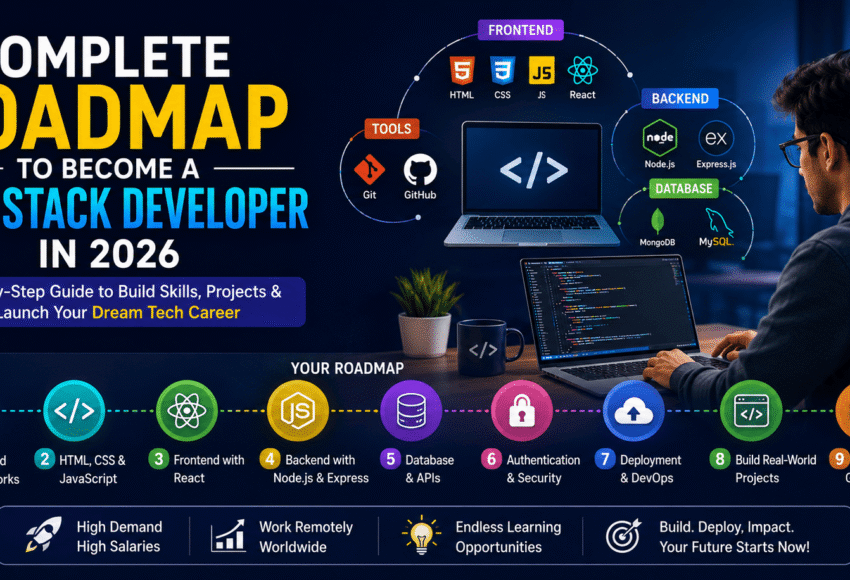
Complete Roadmap to Become a Full Stack Developer in 2026
The demand for Full Stacfull-stack developerss to rise as businesses increasingly rely on modern web applications, cloud technologies, artificial intelligence, and digital transformation. A full stack developer possesses the skills to build complete web applications—from designing interactive user interfaces to developing secure server-side systems and managing databases.
If you’re wondering how to become a full-stack developer in 2026, this roadmap provides a step-by-step learning path covering programming fundamentals, frontend development, backend development, databases, APIs, cloud deployment, DevOps basics, portfolio creation, certifications, and career opportunities.
Whether you’re a student, graduate, working professional, or career changer, this guide will help you build a future-ready career in web development.
Who is a full-stack developer?
A full stack developer is a software professional who develops both the frontend (client-side) and backend (server-side) of web applications.
Instead of specialising in just one area, full-stack developers understand the complete software development lifecycle and can independently build, test, deploy, and maintain web applications.
Why Choose Full Stack Development in 2026?
The technology landscape continues to evolve rapidly, making full-stack development one of the most versatile and in-demand career paths.
Key Benefits
- High demand across industries
- Excellent salary packages
- Remote work opportunities
- Freelancing and global projects
- Startup-friendly skill set
- Opportunity to work with AI-powered applications
- Strong career growth
- Future-proof technology skills
Complete Full Stack Developer Roadmap
Step 1: Learn the Basics of the Internet
Before writing code, understand how websites and web applications work.
Topics to Learn
- How the internet works
- Web browsers
- Domains and hosting
- HTTP & HTTPS
- Client-server architecture
- DNS
- APIs
Step 2: Learn HTML
HTML is the foundation of every website.
Learn
- HTML Elements
- Forms
- Tables
- Semantic HTML
- Accessibility
- Multimedia
- SEO-friendly HTML
Step 3: Master CSS
CSS controls the appearance of websites.
Topics
- Selectors
- Flexbox
- CSS Grid
- Responsive Design
- Media Queries
- Animations
- Transitions
Step 4: Learn JavaScript
JavaScript is the core programming language of modern web development.
Learn
- Variables
- Functions
- Arrays
- Objects
- Loops
- Events
- DOM Manipulation
- ES6+
- Promises
- Async/Await
- Fetch API
Step 5: Version Control with Git & GitHub
Every professional developer should know version control.
Learn:
- Git basics
- Repositories
- Branches
- Commits
- Pull Requests
- GitHub collaboration
Step 6: Learn Responsive Web Design
Modern websites must work across:
- Mobile
- Tablet
- Laptop
- Desktop
- Smart TVs
Frameworks to explore:
- Bootstrap
- Tailwind CSS
Step 7: Learn Frontend Frameworks
The most widely used frontend framework is React.js.
Learn
- Components
- Props
- State Management
- Hooks
- Routing
- API Integration
- Context API
Other options:
- Angular
- Vue.js
Step 8: Learn Backend Development
After mastering the frontend, move to server-side programming.
Popular Backend Technologies
- Node.js
- Express.js
Topics include:
- Routing
- Middleware
- Authentication
- Authorization
- REST APIs
- Error Handling
Step 9: Learn Databases
Web applications need databases to store and retrieve information.
SQL Databases
- MySQL
- PostgreSQL
NoSQL Databases
- MongoDB
Learn:
- CRUD Operations
- Relationships
- Queries
- Indexing
- Data Modeling
Step 10: Learn REST APIs
APIs connect the frontend and backend.
Learn
- GET
- POST
- PUT
- DELETE
- Authentication
- JSON
- API Testing
Tools:
- Postman
- Thunder Client
Step 11: Authentication & Security
Every web application requires secure user authentication.
Topics include:
- JWT Authentication
- Password Encryption
- OAuth Basics
- Session Management
- Role-Based Access Control
- Security Best Practices
Step 12: Learn Deployment
Deploy your projects so they are accessible online.
Popular deployment platforms include:
- Vercel
- Netlify
- Render
- Railway
Cloud platforms:
- AWS
- Microsoft Azure
- Google Cloud Platform
Step 13: Learn DevOps Basics
Modern developers benefit from understanding DevOps practices.
Learn:
- Docker
- CI/CD Pipelines
- Linux Basics
- Environment Variables
- Nginx
- Basic Monitoring
Step 14: Build Real-World Projects
Projects demonstrate your practical skills to employers.
Recommended Portfolio Projects
- Personal Portfolio Website
- To-Do Application
- Weather Application
- Blog Website
- E-commerce Store
- Student Management System
- Online Learning Platform
- Hospital Management System
- Expense Tracker
- Chat Application
Step 15: Learn AI Integration
In 2026, modern web applications increasingly incorporate AI features.
Explore:
- AI chatbots
- AI-powered search
- Text generation APIs
- Image generation APIs
- Recommendation systems
- AI automation workflows
Step 16: Create an Impressive Portfolio
Include:
- About Me
- Skills
- Projects
- GitHub Profile
- Resume
- Certifications
- Contact Information
- Live Project Links
Step 17: Prepare for Interviews
Practice:
- Data Structures
- Algorithms
- JavaScript interview questions
- React to interview questions
- Node.js interview questions
- Database concepts
- System design fundamentals
- Coding challenges
Step 18: Apply for Jobs
Potential job roles include:
- Junior Full Stack Developer
- Web Developer
- React Developer
- Node.js Developer
- MERN Stack Developer
- Software Engineer
- Frontend Developer
- Backend Developer
- Technical Associate
Skills Every Full Stack Developer Should Master
Frontend Skills
- HTML5
- CSS3
- JavaScript
- React.js
- Responsive Design
- Tailwind CSS
- Bootstrap
Backend Skills
- Node.js
- Express.js
- REST APIs
- Authentication
- Middleware
Database Skills
- MongoDB
- MySQL
- PostgreSQL
Additional Skills
- Git & GitHub
- Cloud Deployment
- DevOps Basics
- API Testing
- Problem Solving
- Debugging
- Agile Development
- Communication Skills
Estimated Learning Timeline
| Stage | Duration |
|---|---|
| HTML & CSS | 1 Month |
| JavaScript | 2 Months |
| React.js | 1–2 Months |
| Backend Development | 2 Months |
| Databases | 1 Month |
| APIs & Authentication | 1 Month |
| Deployment & DevOps Basics | 1 Month |
| Portfolio Projects | 2–3 Months |
Total Estimated Time: 8–12 Months (depending on your learning pace and consistency).
Career Opportunities After Becoming a Full Stack Developer
After completing your training, you can pursue roles such as:
- Full Stack Developer
- MERN Stack Developer
- React Developer
- Backend Developer
- Frontend Developer
- Software Engineer
- Cloud Application Developer
- API Developer
- Startup Technical Developer
- Technical Consultant
- Freelance Web Developer
Salary of a Full-Stack Developer in India
| Experience | Average Salary |
|---|---|
| Fresher (0–1 Year) | ₹4–8 LPA |
| 2–4 Years | ₹8–15 LPA |
| 5–8 Years | ₹15–25 LPA |
| Senior Developer | ₹25–40+ LPA |
Actual salaries depend on skills, company, location, certifications, and project experience.
Tips to Become a Successful Full Stack Developer
- Practice coding every day.
- Build real-world projects instead of only completing tutorials.
- Contribute to open-source projects.
- Maintain an active GitHub profile.
- Learn cloud technologies and deployment.
- Stay updated with modern frameworks and AI tools.
- Improve communication and teamwork skills.
- Never stop learning, as web technologies evolve rapidly.
FAQs
1. How long does it take to become a full-stack developer?
Most learners can become job-ready in 8 to 12 months with consistent practice, structured learning, and hands-on projects.
2. Do I need a computer science degree?
No. Many successful full stack developers come from non-technical backgrounds. Practical skills, projects, and problem-solving ability are often more important than a specific degree.
3. Which programming language should I learn first?
JavaScript is the best starting point because it is used for both frontend development and backend development through Node.js.
4. Is full-stack development difficult?
It has a broader learning curve because it combines multiple technologies, but following a structured roadmap and practising regularly makes it manageable for beginners.
5. Which full-stack technology stack is best in 2026?
The MERN Stack (MongoDB, Express.js, React.js, and Node.js) remains one of the most popular choices due to its flexibility, JavaScript-based ecosystem, and widespread industry adoption.
6. Can I get a job without experience?
Yes. Employers often hire freshers who demonstrate strong practical skills through personal projects, internships, GitHub contributions, and a professional portfolio.
7. Is full-stack development a good career in 2026
Absolutely. With increasing demand for web applications, cloud-native software, AI-powered platforms, and digital transformation initiatives, full-stack developers continue to enjoy excellent career opportunities, competitive salaries, and global demand.
Conclusion
Becoming a Full Stack Developer in 2026 is an excellent career choice for anyone passionate about technology, software development, and problem-solving. By following a structured roadmap—from mastering HTML, CSS, and JavaScript to learning React, Node.js, databases, APIs, cloud deployment, and DevOps basics—you can develop the skills needed to build complete, production-ready web applications.
The key to success lies in consistent practice, building real-world projects, maintaining a strong portfolio, and staying updated with emerging technologies such as AI integration and cloud computing. Whether your goal is to secure a high-paying software job, work remotely, freelance internationally, or launch your own startup, Full Stack Development offers a versatile and future-ready career path with exceptional growth potential.



Leave a Comment