
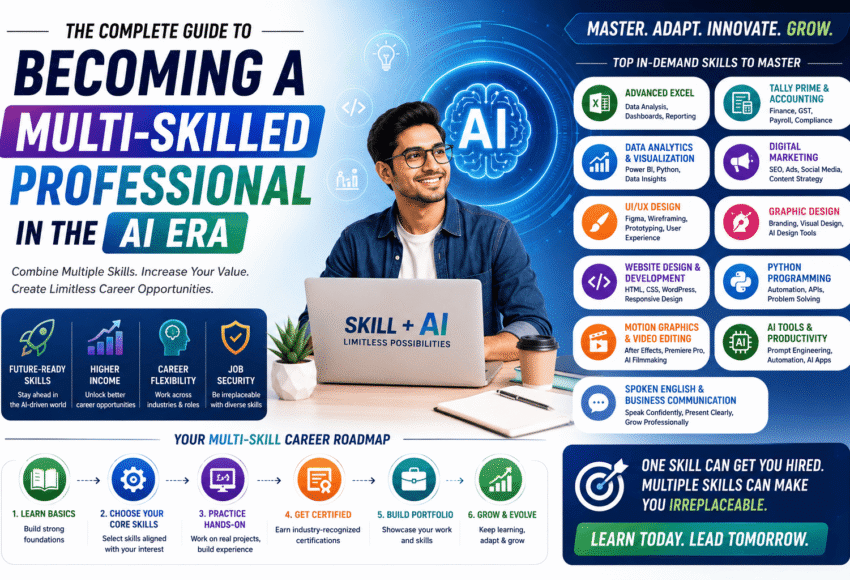
The Complete Guide to Becoming a Multi-Skilled Professional in the AI Era
The future of work is no longer defined by mastering a single skill. In the AI era, companies seek professionals who can combine technical expertise, digital literacy, creativity, business knowledge, communication, and Artificial Intelligence (AI) to solve complex problems and adapt to rapidly changing industries.
Whether you’re a student, fresher, graduate, entrepreneur, or working professional, becoming multi-skilled can improve your employability, career flexibility, and long-term growth. From Data Analytics and Finance to Digital Marketing, UI/UX Design, Graphic Design, Website Development, Python Programming, Motion Graphics, and AI tools, combining complementary skills helps you stand out in today’s competitive job market.
This guide explains why multi-skilled professionals are in demand, which skill combinations are most valuable, and how to build a structured learning roadmap for career success in 2026.
Why Multi-Skilled Professionals Are the Future
Technology is transforming every industry.
Businesses now expect employees to:
- Work with AI-powered tools
- Analyze data
- Communicate effectively
- Collaborate across teams
- Solve business problems
- Adapt to changing technologies
- Learn continuously
Professionals who combine technical and soft skills are often better prepared to contribute across multiple functions.
What Is a Multi-Skilled Professional?
A multi-skilled professional is someone who combines expertise from multiple disciplines to create greater value.
For example:
- A Data Analyst who understands AI and business communication.
- A Graphic Designer who can create UI/UX designs and use AI design tools.
- A Finance Executive who analyzes data using Advanced Excel and Power BI.
- A Digital Marketer who uses AI for content strategy and analytics.
Rather than replacing specialists, multi-skilled professionals often complement teams by connecting different areas of expertise.
Why AI Has Changed the Job Market
Artificial Intelligence has automated many repetitive tasks, allowing professionals to focus more on:
- Strategic thinking
- Creativity
- Decision-making
- Customer experience
- Innovation
Employers increasingly value people who know how to work with AI, interpret results, and apply domain knowledge responsibly.
The Multi-Skill Career Framework
Level 1: Core Digital Skills
Every professional should develop:
- Computer Fundamentals
- Microsoft Office
- Google Workspace
- Cloud Collaboration
- Internet Research
- Cybersecurity Awareness
These skills form the foundation for modern workplaces.
Level 2: Business Productivity Skills
Develop practical workplace expertise through:
Advanced Excel
Learn:
- Formulas
- Pivot Tables
- Dashboards
- Data Cleaning
- Reporting
Advanced Excel remains valuable across finance, operations, HR, marketing, and analytics.
Business Communication
Develop:
- Spoken English
- Presentation Skills
- Email Writing
- Professional Communication
Clear communication supports collaboration and career progression.
Level 3: Choose Your Professional Specialization
Finance & Accounting
Recommended Skills:
- Tally Prime
- GST
- Payroll
- Advanced Excel
- Financial Reporting
- FinTech
Career Roles:
- Accountant
- Finance Executive
- Financial Analyst
Data Analytics
Recommended Skills:
- Power BI
- Python
- Data Visualization
- Business Intelligence
Career Roles:
- Data Analyst
- Business Analyst
- Reporting Analyst
Digital Marketing
Recommended Skills:
- SEO
- Google Ads
- Social Media Marketing
- Content Marketing
- Analytics
Career Roles:
- Digital Marketing Executive
- SEO Specialist
- Performance Marketer
Graphic Design
Recommended Skills:
- Photoshop
- Illustrator
- Branding
- AI Design Tools
Career Roles:
- Graphic Designer
- Visual Designer
UI/UX Design
Recommended Skills:
- Figma
- User Research
- Wireframing
- Prototyping
Career Roles:
- UI Designer
- UX Designer
- Product Designer
Website Design & Development
Recommended Skills:
- HTML
- CSS
- WordPress
- Responsive Design
Career Roles:
- Website Developer
- Front-End Developer
Python Programming
Recommended Skills:
- Programming Fundamentals
- Automation
- APIs
- Problem Solving
Career Roles:
- Python Developer
- Automation Engineer
Motion Graphics & Video Editing
Recommended Skills:
- After Effects
- Premiere Pro
- Storytelling
- Animation
- AI Video Tools
Career Roles:
- Motion Graphics Designer
- Video Editor
- Multimedia Designer
Level 4: Learn Artificial Intelligence
Once you’ve built expertise in your chosen field, integrate AI into your workflow.
Focus on:
- AI Productivity Tools
- Prompt Engineering Basics
- AI-Assisted Research
- Workflow Automation
- Responsible AI Practices
AI works best as a tool that enhances human expertise rather than replacing it.
The Best Skill Combinations for 2026
Finance Professionals
- Tally Prime
- Advanced Excel
- Power BI
- AI
- Business Communication
Data Professionals
- Excel
- Python
- Power BI
- AI
- SQL (if applicable)
Digital Marketing Professionals
- SEO
- Analytics
- AI
- Content Strategy
- Social Media Marketing
Creative Professionals
- Graphic Design
- Motion Graphics
- Video Editing
- AI Design Tools
Designers
- UI/UX Design
- Website Development
- Figma
- AI Tools
Technology Professionals
- Python
- AI
- Automation
- APIs
- Data Analytics
Why Skill Stacking Creates Career Advantages
Skill stacking combines complementary abilities to increase versatility.
Examples:
- Advanced Excel + Power BI + Python
- Digital Marketing + AI + Analytics
- Graphic Design + Motion Graphics + AI
- UI/UX Design + Website Development
- Finance + Data Analytics
- Python + Automation + AI
Professionals with cross-functional skills can often contribute to a wider range of business needs.
Build Practical Experience
Knowledge becomes more valuable when applied.
Gain experience through:
- Live Projects
- Internships
- Freelancing
- Portfolio Development
- Personal Projects
- Case Studies
Examples include:
- Business dashboards
- Marketing campaigns
- Websites
- Design portfolios
- Python automation tools
- Financial reports
- Motion graphics videos
Earn Industry Certifications
Professional certifications can demonstrate familiarity with current tools and methodologies.
Choose programs that offer:
- Practical assignments
- Updated curriculum
- Industry-standard software
- Portfolio development
- Career guidance
Remember that certifications are most effective when supported by practical experience.
Strengthen Your Professional Skills
Technical knowledge should be complemented by workplace competencies.
Develop:
- Communication
- Leadership
- Teamwork
- Adaptability
- Critical Thinking
- Problem Solving
- Time Management
- Emotional Intelligence
These skills remain important across industries.
Create a Future-Ready Portfolio
Your portfolio should showcase practical work, such as:
- Data Dashboards
- Websites
- Graphic Designs
- Marketing Campaigns
- Python Applications
- Financial Reports
- Motion Graphics
- Video Editing Projects
A strong portfolio helps employers understand your capabilities.
Why Ahmedabad Is an Excellent Place to Learn Future Skills
Ahmedabad has emerged as a growing center for:
- Information Technology
- Finance
- Manufacturing
- Digital Marketing
- Creative Design
- Startups
- Professional Education
Students and professionals can access career-oriented training, internships, and opportunities to build practical skills.
Common Mistakes to Avoid
Learning Too Many Unrelated Skills
Choose complementary skills that align with your career goals.
Ignoring Practical Projects
Projects demonstrate your ability to apply knowledge.
Depending Only on AI
AI supports productivity, but domain expertise and critical thinking remain essential.
Weak Communication Skills
Strong communication improves teamwork, interviews, and leadership opportunities.
Stopping After One Certification
Continuous learning is important as technologies and business practices evolve.
Multi-Skill Learning Roadmap
| Stage | Focus | Outcome |
|---|---|---|
| Stage 1 | Digital Literacy & Communication | Strong Foundation |
| Stage 2 | Advanced Excel & Productivity Tools | Workplace Readiness |
| Stage 3 | Technical Specialization | Career Expertise |
| Stage 4 | AI Integration | Higher Productivity |
| Stage 5 | Projects & Portfolio | Practical Experience |
| Stage 6 | Certifications & Continuous Learning | Long-Term Career Growth |
Frequently Asked Questions (FAQs)
1. What is a multi-skilled professional?
A multi-skilled professional combines expertise in multiple complementary areas—such as technical skills, communication, and AI—to contribute effectively across different business functions.
2. Why are multi-skilled professionals in demand?
Organizations increasingly value employees who can adapt to changing technologies, collaborate across teams, and solve business problems using a combination of technical and professional skills.
3. Which skills are most valuable in 2026?
Advanced Excel, Data Analytics, Power BI, Python, AI, Digital Marketing, Tally Prime, UI/UX Design, Graphic Design, Website Development, Motion Graphics, and strong communication skills continue to align with employer demand.
4. What is skill stacking?
Skill stacking means combining complementary skills to broaden your capabilities—for example, Advanced Excel with Power BI, or Graphic Design with Motion Graphics and AI.
5. Are industry certifications important?
Relevant certifications can strengthen your profile by demonstrating practical knowledge, especially when supported by projects and hands-on experience.
6. Can AI replace professionals?
AI can automate certain tasks and improve productivity, but human creativity, judgment, communication, and domain expertise remain essential in most professions.
7. Is Ahmedabad a good place for skill development?
Yes. Ahmedabad has a growing ecosystem of IT companies, financial services, startups, manufacturing industries, and professional training institutes that support career-oriented learning.
8. How can I become future-ready?
Build strong digital foundations, specialize in a technical field, learn AI responsibly, complete practical projects, earn relevant certifications, and continue developing both technical and professional skills.
Conclusion
The AI era rewards professionals who combine technical expertise, practical experience, communication skills, and continuous learning. Becoming a multi-skilled professional is not about learning everything—it is about building complementary skills that work together.
Whether your goal is to build a career in Finance, Data Analytics, Digital Marketing, UI/UX Design, Graphic Design, Website Development, Python Programming, Motion Graphics, or AI-enabled roles, a structured learning roadmap can help you stay competitive and adaptable.
Invest in foundational skills, develop practical expertise, embrace AI as a productivity partner, and continue learning throughout your career. By doing so, you will be better prepared to meet the evolving expectations of employers and create long-term career opportunities in 2026 and beyond.
Leave a Comment