
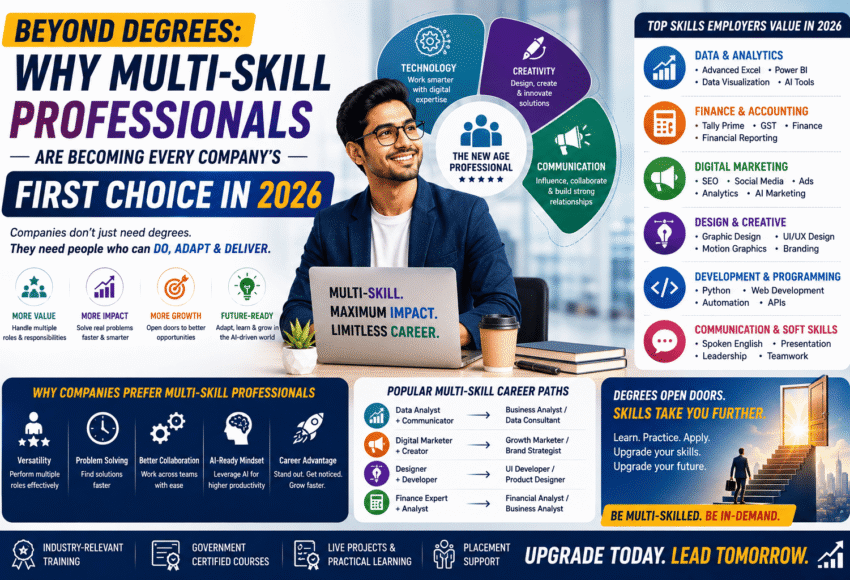
Beyond Degrees: Why Multi-Skill Professionals Are Becoming Every Company’s First Choice in 2026
A college degree remains an important academic achievement, but in today’s rapidly evolving workplace, it is no longer the only factor employers consider. Companies are increasingly looking for professionals who can combine technical expertise, digital literacy, creativity, communication, and practical problem-solving.
The rise of Artificial Intelligence (AI), automation, digital transformation, and data-driven decision-making has changed hiring priorities across industries. Organizations now prefer candidates who can adapt quickly, work with modern technologies, collaborate across teams, and contribute from day one.
Whether you aspire to build a career in Finance, Data Analytics, Digital Marketing, UI/UX Design, Graphic Design, Website Development, Python Programming, Motion Graphics, Video Editing, or AI-enabled business roles, becoming a multi-skilled professional can significantly improve your career prospects in 2026.
This guide explains why multi-skilled professionals are in demand, which skills employers value most, and how students and working professionals can prepare for the future of work.
The Changing Definition of Employability
In the past, employers primarily evaluated candidates based on:
- Academic qualifications
- University reputation
- Marks and grades
- Basic technical knowledge
Today, hiring decisions often include additional factors such as:
- Practical skills
- Project experience
- Industry certifications
- Digital literacy
- Communication abilities
- Adaptability
- AI awareness
- Portfolio quality
The modern workplace values professionals who can apply knowledge, not just possess it.
Why Degrees Alone Are No Longer Enough
A degree provides a strong educational foundation, but technology evolves much faster than academic curricula.
Employers increasingly expect candidates to:
- Work with modern software
- Analyze data
- Collaborate effectively
- Learn new technologies quickly
- Solve real business problems
- Communicate with clients and teams
- Use AI responsibly to improve productivity
Practical, continuously updated skills complement formal education.
What Is a Multi-Skill Professional?
A multi-skill professional combines expertise from multiple complementary domains.
Examples include:
- A Finance Executive who uses Advanced Excel, Power BI, and AI for reporting.
- A Digital Marketer who understands SEO, analytics, and AI content tools.
- A Graphic Designer who also creates UI/UX prototypes and motion graphics.
- A Python Developer who automates workflows and analyzes data.
- A Website Developer who understands user experience and digital marketing.
These combinations help professionals contribute across different business functions.
Why Companies Prefer Multi-Skill Professionals in 2026
1. Greater Workplace Flexibility
Organizations appreciate professionals who can handle diverse responsibilities.
For example:
- Analyze data and present insights
- Design marketing assets and understand branding
- Develop websites while considering user experience
Versatility supports collaboration and operational efficiency.
2. Better Problem-Solving
Complex business challenges often require knowledge from multiple disciplines.
Professionals who understand technology, communication, and business processes can identify more practical solutions.
3. AI-Ready Workforce
Companies increasingly seek employees who know how to:
- Use AI tools responsibly
- Automate repetitive tasks
- Interpret AI-generated insights
- Improve workflows
AI literacy complements—not replaces—professional expertise.
4. Faster Learning and Adaptation
Technology changes rapidly.
Professionals who embrace continuous learning adapt more effectively to:
- New software
- Updated business processes
- Industry innovations
- Emerging technologies
5. Improved Team Collaboration
Cross-functional knowledge enables professionals to work more effectively with:
- Developers
- Designers
- Finance teams
- Marketing departments
- Business leaders
Understanding different perspectives improves collaboration.
The Skills Employers Value Most
Technical Skills
Build expertise in:
- Advanced Excel
- Data Analytics
- Power BI
- Python Programming
- Tally Prime
- Website Development
- Digital Marketing
- UI/UX Design
- Graphic Design
- Motion Graphics
- Video Editing
- AI Productivity Tools
Professional Skills
Develop:
- Business Communication
- Spoken English
- Presentation Skills
- Leadership
- Teamwork
- Critical Thinking
- Time Management
- Adaptability
These competencies remain valuable across industries.
Industry-Specific Career Combinations
Finance & Accounting
Recommended Skills:
- Tally Prime
- GST
- Advanced Excel
- Financial Reporting
- Power BI
- AI
Career Roles:
- Accountant
- Finance Executive
- Financial Analyst
Data Analytics
Recommended Skills:
- Excel
- Python
- Power BI
- Data Visualization
- AI
Career Roles:
- Data Analyst
- Business Analyst
- Reporting Analyst
Digital Marketing
Recommended Skills:
- SEO
- Google Ads
- Social Media Marketing
- Analytics
- AI Marketing Tools
Career Roles:
- Digital Marketing Executive
- SEO Specialist
- Performance Marketing Executive
UI/UX Design
Recommended Skills:
- Figma
- User Research
- Wireframing
- Prototyping
- AI Design Tools
Career Roles:
- UI Designer
- UX Designer
- Product Designer
Graphic Design
Recommended Skills:
- Photoshop
- Illustrator
- Branding
- Motion Graphics
- AI Design Applications
Career Roles:
- Graphic Designer
- Visual Designer
Website Design & Development
Recommended Skills:
- HTML
- CSS
- WordPress
- Responsive Design
- SEO Basics
Career Roles:
- Website Developer
- Front-End Developer
Python Programming
Recommended Skills:
- Programming Fundamentals
- Automation
- APIs
- Data Processing
- AI Integration
Career Roles:
- Python Developer
- Automation Engineer
Motion Graphics & Video Editing
Recommended Skills:
- After Effects
- Premiere Pro
- Animation
- Storytelling
- AI Video Tools
Career Roles:
- Motion Graphics Designer
- Video Editor
- Multimedia Specialist
Skill Stacking: The Career Advantage
Skill stacking means combining complementary capabilities to create a stronger professional profile.
Examples include:
Business Intelligence
Advanced Excel + Power BI + AI
Financial Analytics
Tally Prime + Excel + Data Analytics
Creative Media
Graphic Design + Motion Graphics + Video Editing
Product Design
UI/UX Design + Website Development
AI Marketing
Digital Marketing + Analytics + AI
Automation
Python + AI + Business Processes
Professionals with well-aligned skill stacks are often prepared for a wider range of responsibilities.
Practical Experience Makes the Difference
Employers appreciate candidates who can demonstrate their abilities through:
- Live Projects
- Internships
- Freelancing
- Portfolio Development
- Industry Case Studies
Examples:
- Business dashboards
- Websites
- Brand identity systems
- Marketing campaigns
- Python applications
- Financial reports
- Motion graphics videos
Practical work supports interview discussions and showcases applied knowledge.
Why Industry Certifications Matter
Professional certifications can strengthen your profile by validating your learning.
Choose programs that offer:
- Practical assignments
- Updated curriculum
- Industry-standard software
- Career guidance
- Portfolio development
Certifications work best when paired with real-world experience.
Why Ahmedabad Is Becoming a Skill Development Hub
Ahmedabad has emerged as a growing destination for career-focused learning due to its expanding ecosystem of:
- IT Companies
- Financial Services
- Startups
- Manufacturing Industries
- Digital Marketing Agencies
- Design Studios
- Professional Training Institutes
Students and professionals have access to practical training, internships, and industry-oriented learning opportunities.
Common Mistakes to Avoid
Depending Only on Academic Degrees
Degrees are valuable, but employers increasingly expect practical skills as well.
Ignoring AI
Understanding AI tools helps improve productivity across many professions.
Not Building a Portfolio
A portfolio demonstrates your capabilities through real-world projects.
Weak Communication Skills
Technical expertise is more effective when combined with clear communication.
Learning Too Many Unrelated Skills
Focus on complementary skills that support your chosen career path.
Multi-Skill Career Development Framework
| Stage | Focus Area | Outcome |
|---|---|---|
| Stage 1 | Digital Literacy & Communication | Strong Foundation |
| Stage 2 | Technical Specialization | Core Expertise |
| Stage 3 | Skill Stacking | Cross-Functional Knowledge |
| Stage 4 | AI Integration | Higher Productivity |
| Stage 5 | Projects & Portfolio | Practical Experience |
| Stage 6 | Certifications & Continuous Learning | Long-Term Career Growth |
Frequently Asked Questions (FAQs)
1. Are degrees still important in 2026?
Yes. Degrees provide academic foundations, while practical skills, projects, certifications, and adaptability strengthen employability.
2. What is a multi-skill professional?
A multi-skill professional combines expertise in multiple complementary areas—such as technical knowledge, communication, creativity, and AI—to contribute effectively across different business functions.
3. Why do employers prefer multi-skilled candidates?
Organizations value professionals who can solve problems, adapt to new technologies, collaborate across teams, and apply knowledge in practical situations.
4. Which skills are most valuable in 2026?
Advanced Excel, Data Analytics, Power BI, Python, Digital Marketing, Tally Prime, UI/UX Design, Graphic Design, Website Development, Motion Graphics, AI tools, and communication skills continue to align with employer demand.
5. What is skill stacking?
Skill stacking means combining complementary skills—such as Advanced Excel with Power BI or Graphic Design with Motion Graphics—to broaden your capabilities and career opportunities.
6. Are certifications enough for career success?
Certifications validate learning, but employers also value practical projects, portfolios, internships, and continuous skill development.
7. Why is Ahmedabad a good place for professional learning?
Ahmedabad offers opportunities in IT, finance, manufacturing, digital marketing, creative industries, startups, and professional education, making it a strong destination for career-oriented training.
8. How can I become a multi-skilled professional?
Start with a strong foundation, choose a technical specialization, develop communication and creative skills, complete practical projects, earn relevant certifications, and continue learning throughout your career.
Conclusion
The workplace of 2026 rewards professionals who go beyond degrees by combining technical expertise, creativity, communication, practical experience, and AI literacy. Employers are increasingly searching for candidates who can solve problems, adapt to change, and contribute across multiple business functions.
Whether you are pursuing a career in Finance, Data Analytics, Digital Marketing, UI/UX Design, Graphic Design, Website Development, Python Programming, Motion Graphics, or AI-enabled business roles, developing a balanced combination of technical and professional skills will improve your long-term career prospects.
Invest in industry-relevant learning, complete real-world projects, build a portfolio, strengthen your communication abilities, and embrace lifelong learning. By becoming a multi-skilled professional, you can stay competitive, adaptable, and ready for the opportunities of the modern workforce.

Leave a Comment