
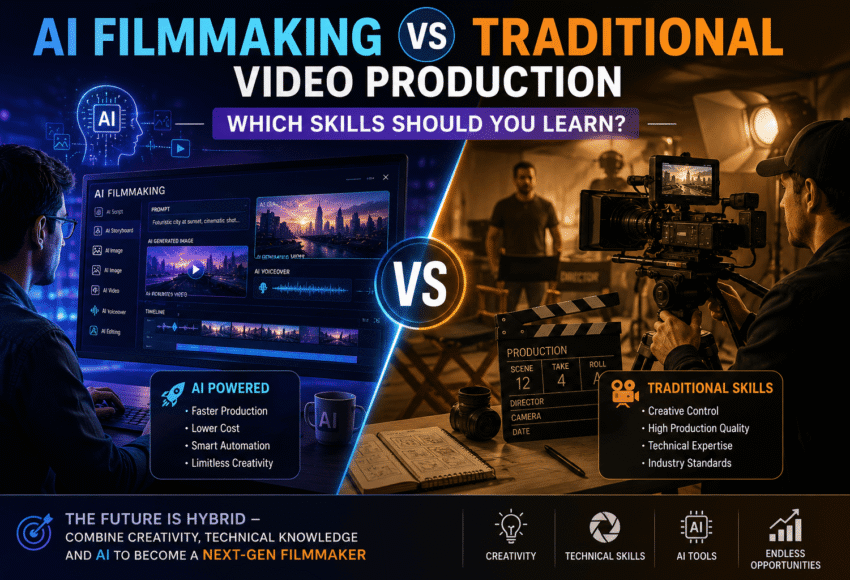
AI Filmmaking vs Traditional Video Production: Which Skills Should You Learn in 2026?
Meta Title
AI Filmmaking vs Traditional Video Production: Which Career Path is Better in 2026?
Meta Description
Compare AI filmmaking and traditional video production. Discover the key differences, required skills, career opportunities, salaries, AI tools, and which path is best for aspiring filmmakers and content creators in 2026.
Summary
The filmmaking industry is undergoing one of its biggest transformations with the rise of artificial intelligence (AI). While traditional video production continues to rely on cameras, lighting, crews, and manual editing, AI filmmaking introduces intelligent tools that automate tasks such as scriptwriting, storyboarding, video generation, editing, voiceovers, and visual effects.
So, which skills should aspiring creators learn? Should you master traditional filmmaking techniques, embrace AI-powered production, or combine both?
This guide compares AI filmmaking and traditional video production, explores the skills required for each, highlights career opportunities, and explains why professionals who blend creative storytelling with AI technology are likely to have the strongest career prospects in 2026 and beyond.
Introduction
The demand for high-quality video content has never been greater. Businesses, brands, educators, influencers, OTT platforms, and production companies create thousands of videos every day for marketing, entertainment, education, and communication.
At the same time, artificial intelligence is transforming how videos are planned, produced, edited, and distributed. AI-powered tools now assist with everything from writing scripts and generating visuals to editing footage and creating multilingual voiceovers.
This shift raises an important question for students and creative professionals:
Should you learn traditional video production, AI filmmaking, or both?
The answer depends on your career goals, but understanding the strengths of each approach will help you make an informed decision.
What is Traditional Video Production?
Traditional video production is the conventional process of creating videos using professional equipment, production teams, and manual editing techniques.
It typically includes:
- Concept development
- Scriptwriting
- Storyboarding
- Camera operation
- Lighting setup
- Sound recording
- Directing
- Video editing
- Color grading
- Visual effects
- Final delivery
Traditional filmmaking focuses heavily on technical expertise, production planning, and artistic storytelling.
What is AI filmmaking?
AI filmmaking integrates artificial intelligence into every stage of video production. Instead of replacing filmmakers, AI helps automate repetitive tasks, improve efficiency, and expand creative possibilities.
AI can assist with:
- Script generation
- Storyboarding
- Concept art creation
- Text-to-image generation
- Text-to-video creation
- AI voiceovers
- Automatic subtitles
- Smart video editing
- Motion graphics
- Visual effects
- Background music generation
- Content optimization
AI allows creators to produce professional-quality content more quickly and cost-effectively.
AI Filmmaking vs Traditional Video Production
| Feature | Traditional Video Production | AI Filmmaking |
|---|---|---|
| Production Time | Longer | Faster |
| Cost | Higher | Lower |
| Team Size | Large crew | Small team or individual creator |
| Equipment | Professional cameras and lighting | AI software plus basic production gear |
| Editing | Manual | AI-assisted automation |
| Storyboarding | Hand-created | AI-generated |
| Visual Effects | Manual workflows | AI-enhanced workflows |
| Scalability | Limited by resources | Highly scalable |
| Learning Curve | Technical and production-focused | Creative plus AI tool proficiency |
| Best For | Films, commercials, documentaries | Digital content, ads, social media, education, rapid production |
Skills Required for Traditional Video Production
Traditional filmmaking develops strong production fundamentals.
Essential skills include:
Cinematography
Understanding:
- Camera settings
- Composition
- Lens selection
- Shot framing
- Camera movement
Lighting
Professional lighting techniques include:
- Three-point lighting
- Natural lighting
- Studio lighting
- Color temperature
- Mood creation
Audio Recording
High-quality sound remains essential. Skills include:
- Microphone placement
- Audio monitoring
- Noise reduction
- Sound mixing
Video Editing
Editors learn:
- Timeline editing
- Color grading
- Audio synchronization
- Visual storytelling
- Motion graphics
Directing
Directors manage:
- Actors
- Crew
- Camera movement
- Scene execution
- Creative vision
Skills Required for AI Filmmaking
AI filmmaking combines creativity with emerging technologies.
Key skills include:
Prompt Engineering
Writing effective prompts for AI tools to generate:
- Images
- Videos
- Scripts
- Characters
- Scenes
AI Video Editing
Professionals use AI-powered editing software to:
- Detect highlights
- Remove silence
- Generate subtitles
- Improve audio
- Apply intelligent transitions
AI Image Generation
Creators produce:
- Movie posters
- Character designs
- Storyboards
- Background environments
- Marketing visuals
AI Video Generation
Text prompts can become:
- Advertisements
- Product videos
- Social media reels
- Educational explainers
- Cinematic sequences
Creative Storytelling
Even with AI, human creativity remains essential for:
- Emotional storytelling
- Audience engagement
- Character development
- Brand communication
Advantages of Traditional Video Production
Traditional filmmaking offers:
- Deep technical expertise
- Superior camera control
- Professional production quality
- Strong storytelling foundation
- Better understanding of lighting and cinematography
- High-end commercial production capabilities
Advantages of AI Filmmaking
AI-powered production provides:
- Faster workflows
- Lower production costs
- Rapid content creation
- Increased productivity
- Enhanced creative experimentation
- Easier localization with multilingual voiceovers and subtitles
- Greater accessibility for solo creators and small teams
Can AI Replace Traditional Filmmaking?
The short answer is no.
AI excels at automating repetitive tasks and accelerating production, but it cannot fully replace:
- Human creativity
- Emotional storytelling
- Directing actors
- Artistic decision-making
- Original vision
- Real-world production expertise
The future belongs to professionals who combine traditional filmmaking knowledge with AI-powered workflows.
Which Skills Should You Learn?
The best approach is to build a hybrid skill set.
Learn Traditional Skills
- Camera operation
- Lighting
- Sound recording
- Storytelling
- Cinematography
- Editing fundamentals
Learn AI Skills
- Prompt engineering
- AI video editing
- AI image generation
- AI voice synthesis
- Automated workflows
- AI-assisted post-production
- Content optimization
Professionals with both creative and AI skills are likely to enjoy stronger career opportunities and greater adaptability.
Career Opportunities
Professionals with AI filmmaking and traditional production expertise can pursue roles such as:
- AI Filmmaker
- Video Producer
- Video Editor
- Motion Graphics Designer
- Visual Effects Artist
- AI Content Creator
- Creative Director
- Corporate Video Producer
- Advertising Film Producer
- YouTube Content Strategist
- Social Media Video Specialist
- Virtual Production Artist
- AI Prompt Engineer
- Multimedia Designer
- Freelance Video Creator
Industries Hiring AI Filmmaking Professionals
Demand spans multiple sectors, including:
- Film and television
- OTT platforms
- Advertising agencies
- Digital marketing companies
- Animation studios
- Gaming companies
- E-learning organizations
- Corporate communication teams
- Startups
- Media houses
- Event production companies
- Real estate marketing
- Healthcare communications
Recommended AI Tools for Modern Filmmakers
Build experience with leading AI-powered tools, including:
- ChatGPT
- Runway
- Pika
- Kling AI
- Luma AI
- Adobe Firefly
- Adobe Premiere Pro (AI features)
- DaVinci Resolve
- CapCut AI
- Descript
- ElevenLabs
- Midjourney
- Canva AI
- Synthesia
Why Students Should Learn Both
Students who understand both traditional production techniques and AI-assisted workflows can:
- Adapt to changing industry demands
- Deliver projects faster
- Produce higher-quality content
- Reduce production costs
- Collaborate effectively with creative teams
- Build stronger portfolios
- Access global freelance opportunities
- Stay competitive in an AI-driven media industry
Frequently Asked Questions (FAQs)
1. Which is better: AI filmmaking or traditional video production?
Neither is inherently better. Traditional filmmaking builds essential creative and technical foundations, while AI filmmaking improves speed, efficiency, and scalability. Combining both offers the greatest career flexibility.
2. Can beginners learn AI filmmaking without filmmaking experience?
Yes. Many AI tools are designed for beginners, though learning storytelling, editing principles, and visual communication will help you produce better results.
3. Will AI replace video editors?
AI is changing how video editors work by automating repetitive tasks, but skilled editors remain valuable for creative decisions, pacing, narrative flow, and visual quality.
4. What skills are most valuable in 2026?
A combination of storytelling, video editing, cinematography basics, prompt engineering, AI-assisted editing, motion graphics, and content strategy is highly valuable.
5. Is AI filmmaking a good career?
Yes. As businesses increasingly rely on video-first communication, professionals who can use AI to create engaging content are in demand across entertainment, marketing, education, and corporate sectors.
6. Should I learn traditional filmmaking before AI tools?
Learning traditional filmmaking fundamentals provides a strong creative base. However, beginners can also learn AI tools alongside these fundamentals to accelerate their growth and remain industry-ready.
Conclusion
AI filmmaking and traditional video production are not competing disciplines—they are complementary. Traditional filmmaking provides the artistic vision, technical understanding, and storytelling skills that define memorable content, while AI empowers creators to work faster, automate repetitive tasks, and scale production efficiently.
For aspiring filmmakers, content creators, marketers, and media professionals, the smartest career strategy is to combine the strengths of both approaches. By mastering camera techniques, editing, lighting, and storytelling alongside AI-powered tools, prompt engineering, and automated workflows, you can build a future-ready skill set that meets the evolving needs of the digital content industry.
Whether your ambition is to work in films, advertising, OTT platforms, or social media or to launch your own creative business, embracing both traditional craftsmanship and AI innovation will position you for long-term success in the future of filmmaking.


Leave a Comment