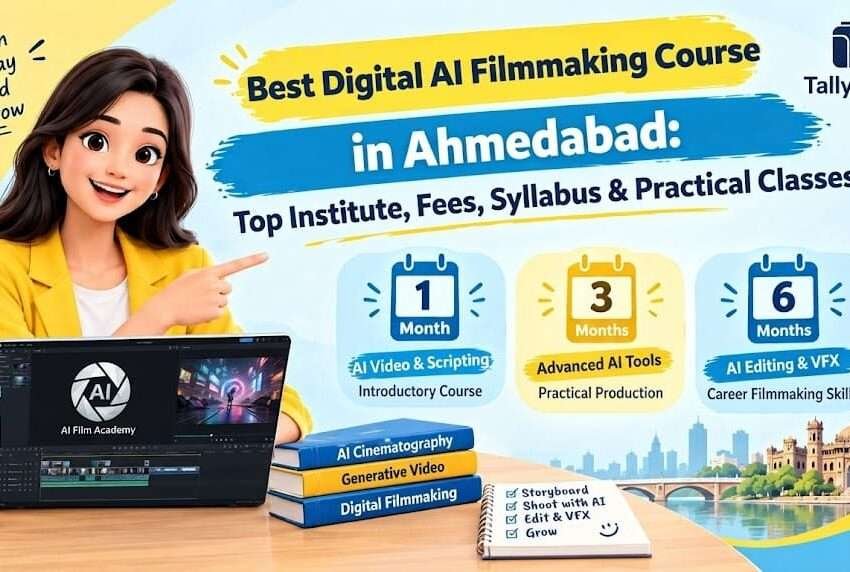
Best Digital AI Filmmaking Course in Ahmedabad, Top Training Institute, Fees, Syllabus & Practical Classes
The filmmaking industry is evolving with the introduction of Artificial Intelligence, digital production techniques, and advanced video editing technologies. Today, aspiring filmmakers can explore creative storytelling, cinematic visuals, video editing, sound design, and AI-assisted production through modern filmmaking education.
If you are searching for the best Digital AI Filmmaking Course in Ahmedabad, understanding the course fees, syllabus, practical training, software, and career opportunities can help you choose a suitable program.
A Digital AI Filmmaking course combines traditional filmmaking fundamentals with modern digital tools and generative AI workflows. Students learn how to develop a story, plan scenes, create visual concepts, shoot footage, edit videos, improve sound, and use AI tools to support creative production.
Whether you are a student, aspiring filmmaker, content creator, video editor, or working professional, practical AI filmmaking training can help you develop skills for the growing digital media and video production industry.
What Is a Digital AI Filmmaking Course?
A Digital AI Filmmaking course is a creative training program that teaches learners how to plan, produce, edit, and deliver digital video content using filmmaking principles, editing software, and AI-assisted creative tools.
The course may combine:
- Film storytelling and scriptwriting
- Pre-production and shot planning
- Camera operations and cinematography
- Lighting and composition
- Digital video editing
- Sound recording and audio editing
- Color correction and grading
- AI-generated visual concepts
- AI-assisted video production
- Motion graphics and visual effects
- Short film and promotional video projects
Unlike a course focused only on video editing, digital filmmaking training covers the complete production process, from the first creative idea to the final exported video.
Why Learn Digital AI Filmmaking in Ahmedabad?
Ahmedabad has a growing ecosystem of businesses, educational institutions, digital agencies, creators, and media-related services that use video for communication and promotion.
Businesses increasingly use video content for:
- Social media marketing
- Product advertisements
- Brand storytelling
- Corporate presentations
- Educational videos
- Promotional campaigns
- YouTube content
- Digital entertainment
Learning digital filmmaking in Ahmedabad can help students build practical creative skills while studying in Gujarat.
An AI filmmaking course can also introduce learners to new production workflows, such as AI-supported storyboarding, concept visualization, and selected generative video applications.
Digital AI Filmmaking Course Fees in Ahmedabad
The fees for a Digital AI Filmmaking course in Ahmedabad depend on the course duration, syllabus, software coverage, studio facilities, practical projects, and certification.
The following figures are illustrative planning estimates, not verified fees from a particular institute.
| Course Type | Indicative Fee Range |
|---|---|
| Basic Video Editing Course | ₹5,000–₹12,000 |
| Digital Filmmaking Course | ₹12,000–₹30,000 |
| AI Video Creation Course | ₹10,000–₹25,000 |
| Digital AI Filmmaking with Practical Projects | ₹20,000–₹45,000 |
| Extended Filmmaking and Post-Production Program | ₹30,000–₹60,000 |
Actual course fees may differ. Confirm current pricing, GST, installment options, software access, project costs, and certificate details directly with the training provider.
Factors That Affect Filmmaking Course Fees
Course duration: Short-term workshops and comprehensive filmmaking programs have different learning structures.
Software training: Programs covering editing, motion graphics, compositing, and AI applications may have different fees.
Practical production: Camera access, lighting equipment, recording facilities, and production exercises can influence course costs.
Project work: Short films, advertisements, documentaries, and portfolio projects require additional planning and practice.
Certification: Confirm the awarding organization and whether the credential is an institute completion certificate or an external qualification.
Career support: Some programs offer portfolio guidance, interview preparation, or industry exposure. Verify the exact services offered.
Complete Digital AI Filmmaking Course Syllabus
A comprehensive Digital AI Filmmaking syllabus should include creative foundations, production techniques, editing, AI applications, and practical project development.
Filmmaking Fundamentals
Students begin by understanding the basic language of cinema and digital video production.
Topics include:
- Introduction to filmmaking
- Film genres and formats
- Visual storytelling
- Story structure
- Scene development
- Film language
- Shot types and camera angles
- Composition and framing
- Continuity
- Production workflow
Scriptwriting and Story Development
Every effective film begins with a clear idea and a structured story.
Learners may study:
- Idea generation
- Story concepts
- Script formatting
- Character development
- Dialogue writing
- Scene breakdown
- Storyboarding
- Shot lists
- Production planning
AI writing assistants may be introduced to support brainstorming, outline development, and script refinement. Human creativity, originality, and editorial judgment remain essential.
Cinematography and Camera Operations
Cinematography involves capturing images that communicate mood, action, and meaning.
Important topics include:
- Camera types and settings
- Exposure fundamentals
- Aperture, shutter speed, and ISO
- Frame rates and resolution
- Lens selection
- Camera movements
- Focus techniques
- Composition
- Natural and artificial lighting
- Indoor and outdoor shooting
Practical camera exercises help students understand how technical settings influence the final visual result.
Lighting Techniques
Lighting plays a major role in creating cinematic visuals.
Students may learn:
- Three-point lighting
- Key, fill, and back lighting
- Soft and hard lighting
- Natural light control
- Product lighting
- Portrait lighting
- Mood lighting
- Basic lighting equipment
Digital Video Editing
Video editing transforms recorded footage into a structured and engaging visual story.
A digital filmmaking course may cover editing applications such as:
- Adobe Premiere Pro
- DaVinci Resolve
- Other suitable non-linear editing software
Topics include:
- Importing and organizing footage
- Timeline editing
- Cutting and trimming
- Transitions
- Multi-camera editing
- Audio synchronization
- Titles and subtitles
- Video export settings
- Editing for social media
- Short-form and long-form content
AI Tools for Digital Filmmaking
AI is introducing new methods for creative planning, visual development, and video production.
A Digital AI Filmmaking course may introduce selected tools and workflows such as:
<Entity value=”ChatGPT” category=”software” disambig=”AI assistant”/>: Supports brainstorming, script outlines, scene descriptions, and production planning.
<Entity value=”Adobe Firefly” category=”software” disambig=”Generative AI creative tools”/>: Can support visual concept development and selected generative creative workflows.
<Entity value=”Runway” category=”software” disambig=”AI video generation and editing platform”/>: Offers AI-powered video creation and editing capabilities, depending on the available plan and features.
<Entity value=”Google Veo” category=”software” disambig=”Generative video model”/>: Supports generative video workflows where access is available.
<Entity value=”ElevenLabs” category=”software” disambig=”AI voice and audio tools”/>: Provides AI voice and audio-related capabilities.
<Entity value=”DaVinci Resolve” category=”software” disambig=”Video editing and color grading software”/>: Supports professional editing, color correction, grading, and selected AI-assisted workflows.
Tool availability, subscription costs, usage rights, and features can change. Students should learn to check licensing, consent, and commercial-use conditions before publishing AI-generated material.
AI Storyboarding and Pre-Visualization
AI-assisted pre-visualization helps filmmakers explore creative ideas before actual production.
Topics may include:
- Visual reference generation
- Scene concept development
- Shot planning
- Mood boards
- Character and environment concepts
- Production reference creation
- AI-assisted storyboard development
These workflows can help communicate creative direction, but generated visuals may require manual correction and consistency checks.
Sound Design and Audio Editing
Sound is essential for creating an immersive film experience.
Students may learn:
- Dialogue recording
- Voice-over recording
- Background music
- Sound effects
- Noise reduction
- Audio synchronization
- Basic mixing
- Sound levels
- Audio export
Color Correction and Color Grading
Color grading helps establish the visual mood and consistency of a film.
Topics may include:
- White balance
- Exposure correction
- Contrast
- Saturation
- Skin tone correction
- Color matching
- Cinematic looks
- Basic color grading workflows
Motion Graphics and Visual Effects
Some comprehensive programs introduce motion graphics and visual effects to expand creative production skills.
Topics may include:
- Animated titles
- Lower thirds
- Logo animation
- Green screen fundamentals
- Chroma keying
- Compositing basics
- Visual effects workflow
- Basic animation principles
Practical Classes in a Digital AI Filmmaking Institute in Ahmedabad
Practical learning is essential because filmmaking involves technical execution, creative decisions, teamwork, and problem-solving.
When comparing a Digital AI Filmmaking training institute in Ahmedabad, check whether students receive guided practice in the following areas.
Camera Practice
Students should have opportunities to practice framing, focus, exposure, camera movements, and lighting arrangements.
Editing Exercises
Learners should work with actual footage to understand cutting, transitions, audio synchronization, color correction, and final exports.
AI Video Creation
Practical AI assignments may include generating visual concepts, preparing storyboards, testing AI video workflows, and combining generated content with edited footage.
Short Film Production
Students can work in teams to plan, shoot, edit, and present a short film.
Advertisement and Promotional Video
A project may involve developing a concept, writing a script, shooting product footage, editing, adding sound, and preparing social media versions.
Portfolio Development
A structured course should help learners select and present their strongest work in a digital portfolio or showreel.
Before enrollment, ask how many practical sessions are included and whether students work on individual projects or only observe demonstrations.
Career Opportunities After a Digital AI Filmmaking Course
Digital filmmaking combines technical, creative, and communication skills. Depending on portfolio quality, experience, and employer requirements, learners may explore several career paths.
Video Editor
Video editors assemble footage, manage timelines, synchronize audio, apply transitions, and prepare final videos for different platforms.
Assistant Filmmaker
Assistant filmmakers support production planning, shooting schedules, camera coordination, and on-set activities.
Content Creator
Content creators develop videos for YouTube, Instagram, educational platforms, businesses, and digital media channels.
AI Video Creator
AI video creators use generative tools and editing workflows to develop visual content, concept videos, and selected promotional assets.
Cinematography Assistant
Cinematography assistants support camera setup, lighting arrangements, equipment preparation, and shooting operations.
Motion Graphics Artist
Motion graphics artists create animated titles, promotional graphics, logo animations, and visual elements for video projects.
Social Media Video Producer
Social media video producers create short-form content, reels, promotional clips, and platform-specific video formats.
Freelance Video Production Professional
After developing practical experience and a portfolio, learners may offer services such as:
- Promotional video editing
- Product videos
- Social media reels
- Event highlight videos
- Corporate videos
- YouTube editing
- AI-assisted creative video production
Career opportunities and income vary according to skill level, project quality, location, client requirements, and experience. Completing a course alone does not guarantee employment or freelance clients.
Who Can Join a Digital AI Filmmaking Course?
A Digital AI Filmmaking course may suit:
- Students interested in film and media
- Beginners exploring creative careers
- Aspiring filmmakers
- Video editors
- Social media content creators
- YouTubers
- Graphic designers
- Digital marketing professionals
- Freelancers
- Working professionals seeking creative skills
Most beginner-level courses do not require prior filmmaking experience. Basic computer knowledge and an interest in visual storytelling can be helpful.
How to Choose the Best Digital AI Filmmaking Training Institute in Ahmedabad
Instead of relying only on advertisements or the word “best,” compare institutes using practical learning criteria.
Check the Complete Course Syllabus
Ensure that the course includes storytelling, cinematography, editing, sound, AI workflows, and project development according to your goals.
Review Trainer Experience
Ask about trainers’ practical experience in filmmaking, editing, production, or digital media.
Confirm Practical Facilities
Check camera availability, lighting equipment, editing systems, software access, and opportunities for actual production work.
Evaluate AI Tool Coverage
Confirm which AI tools are taught, whether learners receive hands-on practice, and whether tool subscriptions are included.
Ask About Portfolio Projects
A good learning plan should help students complete work that can be presented during interviews or to potential clients.
Understand Certification
Verify the certificate’s issuing body and its recognition status. An institute completion certificate should not automatically be described as a government-recognized qualification.
Review Career Support
Ask whether the institute provides portfolio reviews, resume assistance, interview preparation, internship guidance, or placement coordination.
Compare Fees and Learning Hours
Request a written fee structure and confirm the actual number of classes, practical hours, project sessions, and any additional charges.
Digital AI Filmmaking vs Traditional Filmmaking
| Traditional Filmmaking Learning | Digital AI Filmmaking Learning |
|---|---|
| Focus on filmmaking principles | Filmmaking principles plus AI-assisted workflows |
| Manual concept development | May include AI-supported concept visualization |
| Traditional storyboarding | Traditional and AI-assisted storyboard methods |
| Camera-based production | Camera production and selected generative workflows |
| Conventional post-production | Editing with selected AI-assisted tools |
| Creative and technical skills | Creative, technical, and AI workflow skills |
AI filmmaking does not eliminate the importance of camera knowledge, storytelling, editing, or creative judgment. Instead, it introduces additional production methods that filmmakers can evaluate and use where appropriate.
Digital AI Filmmaking Course Duration
Course duration varies depending on the depth of training and practical requirements.
| Course Format | Illustrative Duration |
|---|---|
| Basic Video Editing | 1–2 Months |
| Digital Filmmaking Fundamentals | 2–4 Months |
| AI Video Creation Training | 1–3 Months |
| Comprehensive Digital AI Filmmaking | 4–8 Months |
These are indicative learning periods, not confirmed schedules from a particular institute. Check the actual teaching hours, project timeline, and batch schedule before admission.
Why Practical Filmmaking Projects Matter
A portfolio demonstrates what a learner can actually create.
A well-structured Digital AI Filmmaking course may include projects such as:
Short Film: Develop a story, prepare a storyboard, shoot scenes, edit footage, and complete sound design.
Product Advertisement: Create a promotional video using product shots, lighting, editing, text, and music.
AI-Assisted Concept Film: Combine AI-generated visual references with original editing and creative direction.
Documentary-Style Video: Capture real-world footage, organize interviews, and develop a clear narrative.
Social Media Reel: Produce a short vertical video with suitable framing, subtitles, audio, and platform-specific export settings.
Showreel: Compile selected projects into a concise presentation of creative and technical abilities.
Frequently Asked Questions (FAQs)
Which is the best Digital AI Filmmaking course in Ahmedabad?
Compare training programs based on their syllabus, practical production sessions, AI tool coverage, trainer experience, portfolio projects, fees, and certification details. The most suitable course depends on your learning goals and requirements.
What are the Digital AI Filmmaking course fees in Ahmedabad?
Fees vary by duration, software, equipment access, practical sessions, and project coverage. An illustrative range for structured programs may be ₹12,000–₹45,000 or more. Contact individual institutes for current quotations.
Can beginners join an AI filmmaking course?
Yes. Beginner-friendly courses generally introduce storytelling, camera fundamentals, editing, and AI tools progressively. Prior filmmaking experience may not be necessary.
What is taught in a Digital AI Filmmaking course?
The syllabus may include scriptwriting, cinematography, camera operations, lighting, video editing, sound design, color grading, motion graphics, AI video tools, and practical filmmaking projects.
Which AI tools are used in filmmaking?
Depending on the curriculum, learners may explore ChatGPT, Adobe Firefly, Runway, Google Veo, AI voice tools, and AI-assisted features in video editing software.
How long does a Digital AI Filmmaking course take?
A comprehensive course may take approximately four to eight months, while shorter programs may focus on specific skills such as video editing or AI video creation.
Is practical training important in filmmaking?
Yes. Practical training helps learners develop camera handling, lighting, editing, production planning, teamwork, and problem-solving skills.
What jobs can I pursue after an AI filmmaking course?
Possible career paths include video editor, content creator, assistant filmmaker, AI video creator, motion graphics artist, social media video producer, and freelance video professional.
Can I become a filmmaker without prior experience?
Beginners can start by learning storytelling, camera fundamentals, editing, and production techniques. Building a portfolio through consistent practice is an important part of developing filmmaking skills.
Does a Digital AI Filmmaking course guarantee a job?
No. Employment depends on practical ability, portfolio quality, communication skills, experience, and employer requirements. Ask the institute to explain its exact placement or career-support terms.