
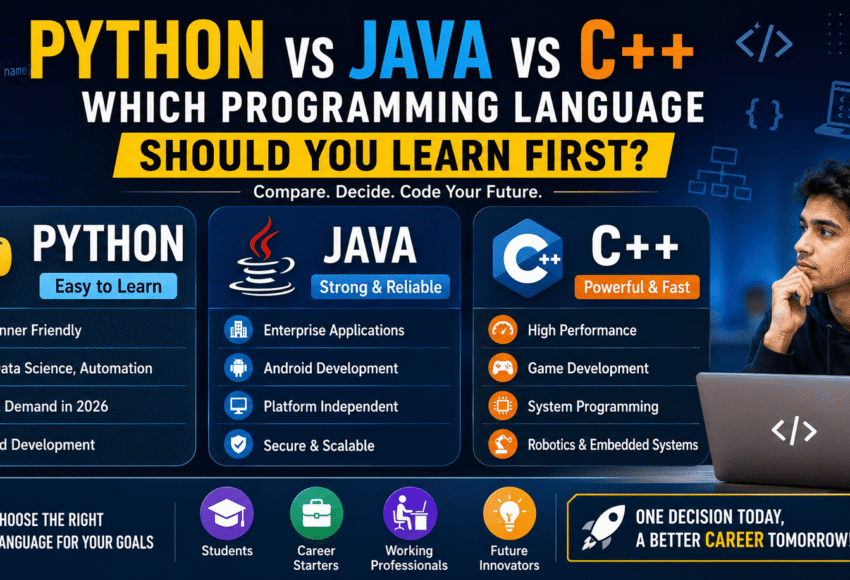
Python vs Java vs C++: Which Programming Language Should You Learn First?
Meta Title
Python vs Java vs C++: Which Programming Language Should You Learn First in 2026?
Meta Description
Compare Python, Java, and C++ to find the best programming language for beginners in 2026. Learn about syntax, difficulty, career opportunities, salaries, and applications, and choose the right language for your goals.
URL Slug
python-vs-java-vs-cpp-which-programming-language-should-you-learn-first
Summary
Choosing your first programming language is one of the most important decisions in your coding journey. Three of the most popular languages—Python, Java, and C++—have shaped modern software development and continue to offer excellent career opportunities.
But which one is best for beginners?
The answer depends on your career goals, learning style, and the type of software you want to build. In this guide, we’ll compare Python, Java, and C++ across learning difficulty, performance, career opportunities, salaries, industry demand, and real-world applications to help you make the right choice in 2026.
Why Choosing the Right Programming Language Matters
Your first programming language helps you build:
- Logical thinking
- Problem-solving skills
- Programming fundamentals
- Software development concepts
- Confidence for learning additional languages
Once you understand one programming language well, learning others becomes much easier.
What is Python?
Python is a high-level, interpreted programming language known for its simple syntax and readability. It is widely used in:
- Artificial Intelligence (AI)
- Machine Learning (ML)
- Data Science
- Automation
- Web Development
- Cybersecurity
- Cloud Computing
- Scripting
Advantages
- Easy syntax
- Beginner-friendly
- Huge community support
- Fast development
- Extensive libraries
- High industry demand
Best For
- Beginners
- AI Engineers
- Data Scientists
- Automation Engineers
- Backend Developers
What is Java?
Java is an object-orientated programming language designed for portability using the “Write Once, Run Anywhere” principle.
It is commonly used in:
- Enterprise Software
- Android App Development
- Banking Applications
- Cloud Systems
- Large Business Applications
Advantages
- Platform independent
- Strong security
- Excellent performance
- Enterprise adoption
- Robust ecosystem
Best For
- Enterprise Developers
- Android Developers
- Backend Engineers
- Banking Software Engineers
What is C++?
C++ is a powerful, high-performance programming language that provides low-level memory control while supporting object-orientated programming.
It is widely used in:
- Operating Systems
- Game Development
- Robotics
- Embedded Systems
- High-Performance Computing
- Graphics Engines
Advantages
- Extremely fast
- Memory management
- High performance
- Hardware-level programming
- Widely used in system software
Best For
- Game Developers
- Embedded Engineers
- Robotics Developers
- Competitive Programmers
- System Software Engineers
Python vs Java vs C++: A Comparison
| Feature | Python | Java | C++ |
|---|---|---|---|
| Learning Difficulty | Easy | Moderate | Difficult |
| Syntax | Simple | Moderate | Complex |
| Performance | Good | Very Good | Excellent |
| Development Speed | Fast | Medium | Medium |
| Memory Management | Automatic | Automatic | Manual |
| Beginner-Friendly | ⭐⭐⭐⭐⭐ | ⭐⭐⭐⭐ | ⭐⭐ |
| AI & Machine Learning | Excellent | Limited | Limited |
| Web Development | Excellent | Excellent | Moderate |
| Mobile Apps | Limited | Excellent | Moderate |
| Game Development | Basic | Moderate | Excellent |
| System Programming | Limited | Moderate | Excellent |
| Community Support | Excellent | Excellent | Excellent |
| Job Opportunities | Very High | Very High | High |
Which Language is Easier to Learn?
Python
Python has a clean, readable syntax that closely resembles English. Beginners can focus on logic rather than complicated language rules.
Example:
print("Hello World")
Java
Java requires understanding classes and objects from the beginning, making it slightly more challenging for newcomers.
Example:
public class Main {
    public static void main(String[] args){
        System.out.println("Hello World");
    }
}
C++
C++ has a steeper learning curve because it introduces pointers, memory management, and more complex syntax early in the learning process.
Example:
#include <iostream>
using namespace std;

int main() {
    cout << "Hello World";
}
Career Opportunities
Python Careers
- Python Developer
- Data Scientist
- AI Engineer
- Machine Learning Engineer
- Backend Developer
- Automation Engineer
- DevOps Engineer
- Cloud Engineer
Java Careers
- Java Developer
- Android Developer
- Enterprise Software Engineer
- Spring Boot Developer
- Backend Engineer
- Full Stack Java Developer
C++ Careers
- Game Developer
- Embedded Systems Engineer
- Robotics Engineer
- Software Engineer
- Systems Programmer
- Quantitative Developer
Salary Comparison in India (Approximate)
| Role | Entry Level | Experienced |
|---|---|---|
| Python Developer | ₹4–8 LPA | ₹12–30+ LPA |
| Java Developer | ₹4–8 LPA | ₹10–25+ LPA |
| C++ Developer | ₹5–9 LPA | ₹12–28+ LPA |
Actual salaries vary depending on location, skills, industry, certifications, and experience.
Industry Applications
Python
- Artificial Intelligence
- Data Science
- Machine Learning
- Automation
- FinTech
- Cybersecurity
- Cloud Computing
- Web Applications
Java
- Banking
- Enterprise Software
- Android Applications
- Insurance
- Government Projects
- E-commerce Platforms
C++
- Gaming
- Robotics
- Automotive Software
- Aerospace
- Operating Systems
- Embedded Devices
Which Language is Best for Different Learners?
Choose Python If You Want To:
- Learn programming quickly
- Build AI and Machine Learning applications
- Become a Data Scientist
- Automate repetitive tasks
- Start freelancing
- Build web applications
- Transition into technology from a non-technical background
Choose Java If You Want To:
- Develop Android applications
- Work in enterprise software
- Build large-scale business systems
- Join banking or financial technology companies
Choose C++ If You Want To:
- Build games
- Program embedded systems
- Develop operating systems
- Work with robotics
- Participate in competitive programming
- Learn advanced computer science concepts
Can You Learn All Three?
Yes. Many professional developers eventually learn multiple programming languages.
A recommended learning path is:
- Start with Python to understand programming fundamentals.
- Learn Java for enterprise application development and object-orientated design.
- Learn C++ to master performance optimisation, memory management, and low-level programming.
This sequence helps reduce the learning curve while broadening career opportunities.
Tips for Beginners
- Focus on understanding programming logic rather than memorising syntax.
- Practice coding every day.
- Build small projects after each topic.
- Learn Git and GitHub early.
- Strengthen problem-solving with coding challenges.
- Create a portfolio showcasing your projects.
- Stay consistent and keep learning new technologies.
Frequently Asked Questions (FAQs)
Which programming language should beginners learn first?
Python is generally considered the best first programming language because of its simple syntax, readability, and wide range of applications.
Is Java harder than Python?
Yes. Java requires more boilerplate code and introduces object-orientated concepts earlier, making it moderately more challenging for beginners.
Is C++ harder than Java?
For most learners, yes. C++ includes manual memory management, pointers, and lower-level programming concepts, resulting in a steeper learning curve.
Which language offers the best career opportunities?
All three languages provide strong career prospects. Python leads in AI, machine learning, data science, and automation; Java dominates enterprise software and Android development; C++ remains essential for gaming, embedded systems, robotics, and high-performance applications.
Can I learn Java after Python?
Absolutely. Learning Python first builds programming fundamentals, making Java easier to understand later.
Should I learn C++ before Python?
Unless your primary goal is competitive programming, embedded systems, or systems programming, most beginners benefit from starting with Python due to its simplicity.
Which programming language has the highest future demand?
Python continues to see exceptional growth because of its role in artificial intelligence, machine learning, data science, automation, and cloud technologies, while Java and C++ remain indispensable in enterprise software and performance-critical systems.
Conclusion
Python, Java, and C++ are all powerful programming languages with excellent career prospects, but the right starting point depends on your goals.
For most beginners, Python is the easiest and fastest way to build programming confidence thanks to its clean syntax and broad applications. If your ambition is enterprise software or Android development, Java is an excellent next step. If you’re passionate about game development, robotics, operating systems, or embedded programming, C++ offers unmatched performance and control.
Remember, your first language is only the beginning. The programming concepts you learn today will make it easier to master additional languages and technologies in the future. Focus on understanding core concepts, building practical projects, and continuously improving your skills to create a successful and future-ready technology career.



Leave a Comment