

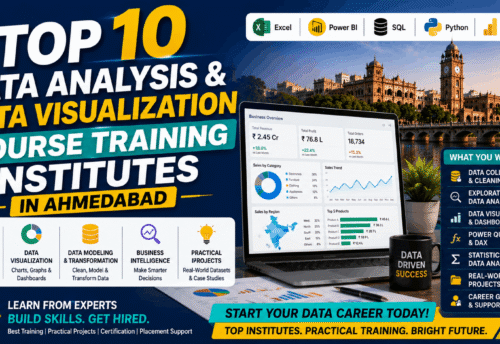
Professional Data Analyst Training in Ahmedabad for Beginners
The demand for data analysts is growing rapidly across India. Businesses today rely on data to make smart decisions, improve performance, and predict future trends. Because of this, data analytics has become one of the most promising career paths for beginners and career switchers.
If you are searching for a career that offers high salary potential, job security, and growth opportunities, enrolling in professional data analyst training in Ahmedabad can be a smart decision.
This beginner-friendly guide explains what data analytics is, why it is in demand, what skills you need, and how professional training can help you start your career confidently.
Why Data Analytics is a High-Demand Career
Data is called the “new oil” of the digital economy. Every company generates data from:
- Websites and mobile apps
- Sales and customer behavior
- Marketing campaigns
- Financial transactions
- Social media platforms
Organizations need skilled professionals who can convert raw data into useful insights. This is where data analysts play a key role.
Career Benefits of Becoming a Data Analyst
- High demand across industries
- Excellent salary packages
- Remote and freelance opportunities
- Fast career growth
- Opportunities in India and abroad
Industries hiring data analysts include:
- IT & Software
- Finance & Banking
- Healthcare
- E-commerce
- Marketing & Advertising
- Manufacturing
For beginners, the right training program can make entry into this field much easier.
What Does a Data Analyst Do?
A data analyst collects, cleans, analyzes, and visualizes data to help businesses make decisions.
Typical Job Responsibilities
- Collecting and organizing data
- Cleaning and preparing datasets
- Analyzing trends and patterns
- Creating dashboards and reports
- Helping companies make data-driven decisions
In simple terms, a data analyst turns numbers into meaningful stories.
Skills You Learn in Data Analyst Training
A professional training program focuses on job-ready skills. Beginners do not need coding experience to start.
Core Skills Covered
1. Microsoft Excel for Data Analysis
Excel is the foundation of analytics. You will learn:
- Data cleaning
- Pivot tables
- Charts and dashboards
- Data visualization basics
2. SQL (Structured Query Language)
SQL helps you work with databases.
You will learn:
- Data extraction
- Filtering and sorting
- Joining tables
- Writing queries for analysis
3. Python for Data Analysis
Python is the most popular language for analytics.
Key topics include:
- Pandas and NumPy
- Data manipulation
- Automation
- Exploratory data analysis
4. Power BI & Data Visualization
Visualization helps businesses understand insights quickly.
You will learn:
- Interactive dashboards
- KPI tracking
- Business reports
- Data storytelling
5. Statistics & Analytics Concepts
Understanding data requires basic statistics:
- Mean, median, mode
- Correlation and trends
- Forecasting basics
These skills make you job-ready for entry-level data roles.
How Generative AI is Transforming Data Analytics
Generative AI is revolutionizing how data analysts work. Today, analysts can use AI tools to automate repetitive tasks and speed up insights.
AI tools can now:
- Generate SQL queries automatically
- Clean and structure messy data
- Suggest visualizations
- Detect trends faster than manual analysis
This means beginners can become productive much faster compared to traditional learning methods.
How AI Tools Help Students Learn Data Analytics Faster
Learning analytics used to take years. Now, AI-powered platforms make learning interactive and practical.
Students can use AI to:
- Practice real-world datasets
- Get instant coding help
- Generate reports automatically
- Understand complex concepts easily
This AI-assisted learning approach makes data analytics more accessible for beginners and career switchers.
Who Should Join Data Analyst Training?
This course is ideal for:
- Students and fresh graduates
- Working professionals wanting a career switch
- Commerce and non-technical students
- Business owners wanting data skills
- Marketing and finance professionals
No prior coding experience is required. Basic computer knowledge is enough to start.
Career Opportunities After Completing Training
After completing professional training, you can apply for roles such as:
- Junior Data Analyst
- Business Analyst
- MIS Executive
- Reporting Analyst
- Data Coordinator
- Power BI Developer (Entry Level)
With experience, you can grow into:
- Senior Data Analyst
- Data Scientist
- Analytics Manager
Why Choose Professional Training Instead of Self-Learning?
Self-learning is possible, but structured training offers clear advantages.
Benefits of Professional Training
- Step-by-step beginner roadmap
- Real-world projects
- Expert mentorship
- Doubt-solving sessions
- Certification support
- Placement assistance
Structured learning reduces confusion and speeds up career growth.
Start Your Data Career with DMG Institute
If you want job-ready skills, practical learning, and career support, join professional training at DMG Institute.
What Makes DMG Institute Special?
- Beginner-friendly training
- Practical projects
- Industry-focused curriculum
- Certification guidance
- Career support
👉 Enroll today: https://tallyprimecourse.com
Conclusion
Data analytics is one of the fastest-growing careers in today’s digital world. With the rise of AI and data-driven businesses, the demand for skilled data analysts will continue to increase.
For beginners, the right training can open doors to exciting opportunities and high-paying jobs. By learning tools like Excel, SQL, Python, and Power BI, you can build a strong foundation and start your journey confidently.
If you are serious about building a future-proof career, now is the best time to start your data analytics journey.
FAQ Section
1. Is data analyst a good career for beginners?
Yes. It is one of the best entry-level tech careers with high demand and strong salary growth.
2. Do I need coding knowledge to become a data analyst?
No. You can start with Excel and SQL. Python is taught from beginner level during training.
3. What is the salary of a data analyst in India?
Freshers can earn ₹3–6 LPA, and experienced analysts can earn ₹10–20 LPA or more.
4. How long does it take to learn data analytics?
Typically 3–6 months with structured training and practice.
5. Which tools are most important for data analysts?
Excel, SQL, Python, Power BI, and basic statistics are the most important tools.



Leave a Comment