
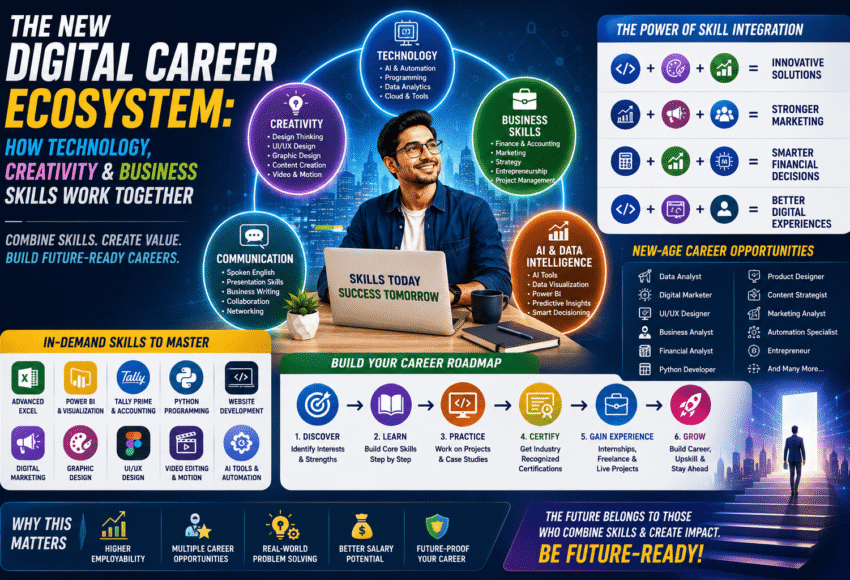
The New Digital Career Ecosystem: How Technology, Creativity & Business Skills Work Together (2026 Career Guide)
The world of work has entered a new era where professional success depends on more than mastering a single subject. Artificial Intelligence (AI), automation, cloud technologies, digital transformation, and data-driven decision-making have reshaped how businesses operate. As a result, companies increasingly seek professionals who can combine technology, creativity, business knowledge, communication, and problem-solving skills.
Today’s most successful employees are no longer defined solely by their degrees or job titles. Instead, they are recognized for their ability to collaborate across departments, understand customer needs, leverage AI tools, analyze data, and create innovative solutions.
Whether your goal is to become a Data Analyst, Digital Marketer, Accountant, UI/UX Designer, Graphic Designer, Website Developer, Python Programmer, Motion Graphics Artist, Business Analyst, or Finance Professional, understanding the new digital career ecosystem will help you build a future-ready and adaptable career.
This guide explores how AI, Tally Prime, Advanced Excel, Power BI, Python Programming, Digital Marketing, UI/UX Design, Graphic Design, Motion Graphics, Website Development, FinTech, Spoken English, Business Communication, and Government-Certified professional courses complement one another to unlock broader career opportunities in 2026.
Understanding the New Digital Career Ecosystem
The digital economy has blurred the boundaries between traditional professions. Marketing relies on analytics, finance uses AI-powered reporting, designers collaborate with developers, and software teams work closely with business strategists.
Instead of operating in isolated roles, professionals now contribute within an interconnected ecosystem where multiple skills create greater value.
This ecosystem is built on five key pillars:
- Technology
- Artificial Intelligence
- Creativity
- Business Knowledge
- Communication
Professionals who develop expertise across these areas are better prepared for evolving industry demands.
Pillar 1: Technology Powers Every Industry
Technology is the foundation of today’s digital workplace.
Essential technical skills include:
- Python Programming
- Website Design & Development
- Advanced Excel
- Power BI
- Data Analytics
- Cloud-based collaboration tools
- Automation platforms
Career Opportunities
- Software Developer
- Data Analyst
- Website Developer
- Business Intelligence Executive
- Automation Specialist
Pillar 2: AI Makes Professionals More Productive
Artificial Intelligence has become a workplace assistant rather than a replacement for human expertise.
Professionals use AI to:
- Automate repetitive tasks
- Generate reports
- Analyze business data
- Create content drafts
- Improve customer support
- Increase productivity
Learning AI tools helps professionals work faster while focusing on strategic thinking and innovation.
Pillar 3: Creativity Drives Innovation
Technology alone cannot build memorable customer experiences or compelling brands.
Creative professionals contribute through:
- Graphic Design
- UI/UX Design
- Motion Graphics
- Video Editing
- Branding
- Storytelling
These skills remain highly valuable because creativity, empathy, and originality continue to rely on human insight.
Pillar 4: Business Knowledge Creates Impact
Understanding how businesses operate allows professionals to connect technical work with organizational goals.
Important business skills include:
- Accounting
- Finance
- FinTech
- Marketing
- Project Management
- Customer Experience
- Strategic Planning
Professionals who understand business priorities often make stronger decisions and deliver greater value.
Pillar 5: Communication Connects Everything
No matter how advanced your technical abilities are, success depends on communicating ideas effectively.
Develop skills in:
- Spoken English
- Business Communication
- Presentation Skills
- Professional Email Writing
- Team Collaboration
- Client Interaction
Strong communication enables professionals to explain ideas, influence decisions, and work efficiently across teams.
How Different Skills Work Together
Finance + Technology
Learn
- Tally Prime
- Advanced Excel
- Power BI
- AI Productivity Tools
Career Roles
- Accountant
- Financial Analyst
- MIS Executive
Technology improves reporting, while finance expertise supports better business decisions.
Data Analytics + AI + Business
Learn
- Excel
- Python
- Power BI
- Data Visualization
- AI Tools
Career Roles
- Data Analyst
- Business Analyst
- Reporting Specialist
Analytics transforms raw data into actionable insights for organisations.
Digital Marketing + Creativity + AI
Learn
- SEO
- Google Ads
- Social Media Marketing
- AI Content Tools
- Analytics
Career Roles
- Digital Marketing Executive
- SEO Specialist
- Performance Marketing Executive
Successful campaigns combine creativity with measurable performance.
UI/UX Design + Website Development
Learn
- Figma
- User Research
- HTML
- CSS
- WordPress
Career Roles
- UI Designer
- UX Designer
- Front-End Developer
Design and development work together to create user-friendly digital experiences.
Graphic Design + Motion Graphics + Video Editing
Learn
- Photoshop
- Illustrator
- After Effects
- Premiere Pro
- AI Design Tools
Career Roles
- Graphic Designer
- Motion Graphics Artist
- Multimedia Designer
Modern brands require visual content across websites, advertising, and social media.
Python + Automation + AI
Learn
- Python Programming
- APIs
- Automation
- AI Integration
Career Roles
- Python Developer
- Automation Engineer
- AI Support Specialist
Automation increases efficiency while allowing professionals to focus on complex challenges.
Why Skill Stacking Is the Future
Skill stacking means combining complementary abilities rather than relying on a single specialization.
Examples include:
- Advanced Excel + Power BI + AI
- Tally Prime + Finance + Analytics
- Python + Data Analytics + AI
- Digital Marketing + SEO + AI
- UI/UX Design + Website Development
- Graphic Design + Motion Graphics + AI
- Spoken English + Business Communication + Leadership
This approach increases versatility and opens multiple career pathway
Practical Experience Completes the Ecosystem
Employers value candidates who can demonstrate real-world capabilities.
Build a portfolio that includes:
- Interactive dashboards
- Financial reports
- Websites
- Marketing campaigns
- Mobile app prototypes
- Graphic design projects
- Motion graphics videos
- Python automation tools
Hands-on experience bridges the gap between learning and employment.
The Role of Government-Certified Professional Courses
Government-certified, industry-oriented programs help learners gain structured knowledge and practical exposure.
Look for courses that include:
- Hands-on software training
- Live projects
- Portfolio development
- Industry-standard tools
- Career guidance
- Certification aligned with current industry needs
Why Ahmedabad Is Emerging as a Digital Skills Hub
Ahmedabad has become a strong destination for career-focused education due to growth in:
- Information Technology
- Finance & FinTech
- Digital Marketing
- Manufacturing
- Creative Design
- Startups
- Professional Training
Students and professionals benefit from internships, practical learning, and exposure to industry-relevant technologies.
Common Mistakes to Avoid
Learning Only One Skill
Combining technical, creative, and business skills creates more career opportunities.
Ignoring AI
AI literacy improves productivity across nearly every profession.
Weak Communication
Effective communication strengthens teamwork, leadership, and client relationships.
No Portfolio
Practical projects demonstrate your abilities more effectively than theoretical knowledge alone.
Stopping After Certification
Continuous learning is essential as technology and industry requirements continue to evolve.
The Digital Career Ecosystem Framework
| Stage | Focus | Outcome |
|---|---|---|
| Stage 1 | Build Core Technical Skills | Professional Foundation |
| Stage 2 | Learn AI & Automation Tools | Higher Productivity |
| Stage 3 | Develop Business Knowledge | Better Decision-Making |
| Stage 4 | Strengthen Creativity & Communication | Cross-Functional Expertise |
| Stage 5 | Complete Practical Projects | Professional Portfolio |
| Stage 6 | Earn Industry Certifications | Career Credibility |
| Stage 7 | Continue Learning | Long-Term Career Growth |
Future Career Opportunities
Professionals who combine technology, creativity, and business knowledge can pursue roles such as:
- Data Analyst
- Business Analyst
- Financial Analyst
- Accountant
- Digital Marketing Executive
- SEO Specialist
- UI Designer
- UX Designer
- Graphic Designer
- Motion Graphics Designer
- Website Developer
- Python Developer
- Automation Specialist
- Business Development Executive
- AI Productivity Consultant
Frequently Asked Questions (FAQs)
1. What is the digital career ecosystem?
The digital career ecosystem is an interconnected workplace where technology, AI, creativity, business knowledge, and communication work together to solve business challenges and create value.
2. Why are multiple skills important in 2026?
Modern employers seek professionals who can collaborate across functions, adapt to technological change, and contribute beyond a single area of expertise.
3. How does AI fit into the digital workplace?
AI assists with automation, research, reporting, analytics, and productivity, enabling professionals to focus on strategic thinking, creativity, and decision-making.
4. What is skill stacking?
Skill stacking is the practice of combining complementary skills—such as Data Analytics with Python or UI/UX Design with Website Development—to improve employability and career flexibility.
5. Why are practical projects important?
Projects demonstrate how you apply knowledge in real-world situations, helping employers evaluate your abilities beyond certifications.
6. How do government-certified courses support career growth?
These programs provide structured learning, practical assignments, industry-standard tools, and recognized credentials that can strengthen your professional profile.
7. Why is Ahmedabad a growing center for digital careers?
Ahmedabad has expanding opportunities in IT, finance, manufacturing, digital marketing, creative industries, startups, and professional education, making it an excellent location for skill development.
8. How can I build a future-ready career?
Develop strong technical expertise, learn AI tools, strengthen communication, understand business fundamentals, complete practical projects, earn relevant certifications, and continue learning throughout your career.
Conclusion
The future of work is no longer defined by isolated expertise. Success in 2026 requires professionals who can combine technology, Artificial Intelligence, creativity, business knowledge, and communication into a unified skill set.
Whether your ambition is in Finance, Data Analytics, Digital Marketing, UI/UX Design, Graphic Design, Website Development, Python Programming, Motion Graphics, or AI-enabled business solutions, embracing the digital career ecosystem will help you stay competitive and adaptable.
Start by building a strong technical foundation, integrate AI into your workflow, strengthen your communication skills, create practical projects, and earn industry-relevant certifications. By continuously expanding your capabilities, you can position yourself for long-term success in a rapidly evolving digital economy.
Leave a Comment