
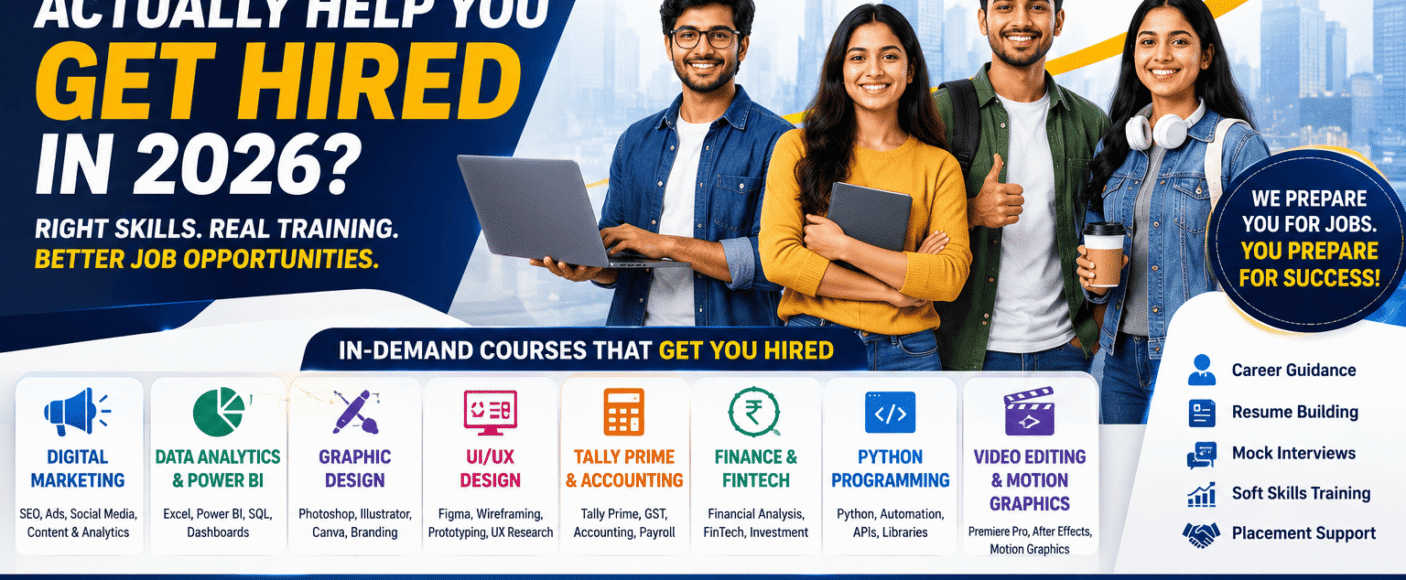
100% Job Assistance Courses: What Skills Actually Help You Get Hired in 2026? | Complete Career Guide
Every year, thousands of students and working professionals search for “100% job guarantee” or “100% placement courses.” While many institutes advertise placement support, the reality is that no legitimate training institute can guarantee employment, since hiring decisions ultimately depend on employers and candidates.
What quality institutes can genuinely offer is job assistance—including career guidance, resume preparation, interview coaching, portfolio development, internship opportunities, and employer connections.
In 2026, employers are not just looking for certificates. They want candidates who can demonstrate practical skills, problem-solving ability, communication, adaptability, and real-world project experience.
This guide explains what job assistance really means, the skills that improve employability, and the professional courses that can help you prepare for today’s competitive job market.
What Does “100% Job Assistance” Really Mean?
Job assistance refers to services that support learners throughout their employment journey.
These may include:
- Resume and LinkedIn profile guidance
- Career counselling
- Mock interviews
- Soft skills training
- Portfolio development
- Internship opportunities
- Industry projects
- Employer networking
- Placement support
- Job interview referrals (where available)
Important: Job assistance is different from a job guarantee. Employment depends on your skills, interview performance, market demand, and employer requirements.
What Employers Actually Look for in 2026
Recruiters evaluate candidates based on much more than academic qualifications.
Technical Skills
- AI Literacy
- Data Analysis
- Digital Tools
- Industry Software
- Business Applications
- Technical Knowledge
Practical Experience
- Live Projects
- Case Studies
- Internship Experience
- Portfolio
- Freelance Work
Professional Skills
- Communication
- Teamwork
- Problem Solving
- Adaptability
- Time Management
- Leadership
Personal Qualities
- Positive Attitude
- Continuous Learning
- Professionalism
- Reliability
- Willingness to Learn
Top Skills That Increase Employability in 2026
1. Artificial Intelligence (AI) Literacy
AI has become a valuable workplace skill across industries.
Learn
- AI Productivity Tools
- Prompt Engineering
- AI Content Creation
- Workflow Automation
- AI Research Tools
Why Employers Value It
Professionals who use AI effectively can improve efficiency while focusing on higher-value work.
2. Data Analytics & Business Intelligence
Businesses increasingly rely on data to make decisions.
Learn
- Advanced Excel
- Power BI
- Dashboard Design
- Data Visualization
- Reporting
- Basic SQL
- Python (for advanced roles)
Career Opportunities
- Data Analyst
- MIS Executive
- Reporting Analyst
- Business Analyst
3. Digital Marketing
As businesses continue expanding online, demand remains strong for digital marketing professionals.
Skills
- SEO
- Google Ads
- Meta Ads
- Social Media Marketing
- Content Marketing
- Email Marketing
- Analytics
- AI Marketing Tools
Career Roles
- Digital Marketing Executive
- SEO Specialist
- Performance Marketer
- Social Media Manager
4. Graphic Design
Visual communication remains essential across industries.
Learn
- Photoshop
- Illustrator
- Canva
- Adobe Firefly
- Branding
- Typography
Career Opportunities
- Graphic Designer
- Brand Designer
- Creative Designer
5. UI/UX Design
User experience is a key differentiator for digital products.
Learn
- Figma
- User Research
- Wireframing
- Prototyping
- Design Systems
Career Opportunities
- UI Designer
- UX Designer
- Product Designer
6. Advanced Excel
Excel remains a core business skill.
Learn
- Pivot Tables
- Power Query
- Dashboards
- Business Reports
- Data Analysis
Career Opportunities
- MIS Executive
- Operations Executive
- Accounts Executive
7. Python Programming
Python continues to be widely used for automation, analytics, and software development.
Learn
- Python Basics
- APIs
- Automation
- Data Processing
Career Opportunities
- Python Developer
- Automation Engineer
- Junior Software Developer
8. Tally Prime & GST
Accounting professionals continue to be in demand.
Learn
- GST
- Payroll
- Inventory
- Banking
- Taxation
Career Opportunities
- Accountant
- Accounts Executive
- GST Executive
9. Account & Finance
Finance professionals support organisations in budgeting, reporting, compliance, and analysis.
Learn
- Financial Accounting
- Banking
- Taxation
- Payroll
- Reporting
Career Opportunities
- Finance Executive
- Accounts Officer
- Audit Assistant
10. FinTech
Digital finance continues to expand.
Learn
- Digital Banking
- Investment Basics
- Financial Analytics
- FinTech Applications
Career Opportunities
- FinTech Executive
- Financial Analyst
- Banking Associate
11. Website Design & Development
Businesses require modern websites to reach customers.
Learn
- WordPress
- Responsive Design
- Basic HTML & CSS
- SEO-Friendly Websites
Career Opportunities
- Website Designer
- WordPress Executive
12. Multimedia Animation & Motion Graphics
Creative industries continue to demand engaging visual content.
Learn
- Motion Graphics
- 2D Animation
- Storyboarding
- Visual Effects
Career Opportunities
- Animator
- Motion Graphics Designer
13. Video Editing & AI Filmmaking
Video-first marketing has increased demand for editors and content creators.
Learn
- Premiere Pro
- After Effects
- DaVinci Resolve
- AI Video Tools
Career Opportunities
- Video Editor
- Digital Filmmaker
- Content Creator
14. Spoken English & Business Communication
Strong communication improves employability across almost every profession.
Learn
- Spoken English
- Presentation Skills
- Interview Preparation
- Public Speaking
- Business Communication
Career Benefits
Useful in customer service, management, sales, marketing, HR, and leadership roles.
Why Practical Projects Matter
Employers often prefer candidates who can demonstrate their skills.
Examples include:
- Marketing Campaigns
- Design Portfolios
- Dashboards
- Websites
- Programming Projects
- Financial Reports
- Video Productions
- Case Studies
A portfolio helps employers assess your practical capabilities.
Resume + Portfolio + Interview = Better Hiring Chances
To improve employability:
Build a Strong Resume
Highlight relevant skills, certifications, internships, and projects.
Create a Portfolio
Showcase practical work completed during training.
Prepare for Interviews
Practise technical questions, communication, and behavioural interviews.
Why Soft Skills Matter
Technical expertise alone is not enough.
Employers also seek:
- Communication
- Confidence
- Teamwork
- Leadership
- Adaptability
- Time Management
- Emotional Intelligence
- Critical Thinking
These skills can influence hiring decisions, especially for customer-facing and collaborative roles.
Best Course Combinations for Better Employability
| Combination | Career Advantage |
|---|---|
| Digital Marketing + AI Tools | Modern marketing workflows |
| Advanced Excel + Power BI | Business analytics and reporting |
| Python + Data Analytics | Strong analytical capabilities |
| UI/UX + Website Design | End-to-end digital product skills |
| Graphic Design + Motion Graphics | Advanced visual content creation |
| Tally Prime + Advanced Excel | Efficient accounting and reporting |
| Finance + Data Analytics | Financial insights and reporting |
| Spoken English + Interview Skills | Better communication and confidence |
How to Choose a Job-Oriented Course
Before enrolling, consider:
Updated Curriculum
Choose programmes covering current tools, AI applications, and industry trends.
Practical Training
Look for live projects, assignments, and case studies.
Industry-Relevant Certification
Understand who issues the certification and its relevance.
Career Support
Check whether the institute offers:
- Resume guidance
- Mock interviews
- Career counselling
- Internship support
- Placement assistance
Experienced Trainers
Faculty with practical industry experience can provide valuable insights.
Why Ahmedabad Is a Strong Career Destination
Ahmedabad offers:
- Growing IT companies
- Startup ecosystem
- Manufacturing industries
- Finance and banking opportunities
- Digital agencies
- Affordable professional education
- Increasing demand for skilled professionals
These factors create opportunities across multiple career domains.
Common Misconceptions
Myth 1: A Certificate Alone Gets You Hired
Reality: Employers generally evaluate skills, practical experience, communication, and interview performance—not certificates alone.
Myth 2: AI Will Replace Every Job
Reality: AI is changing how people work. Professionals who learn AI-assisted tools can improve productivity and remain competitive.
Myth 3: Placement Assistance Means Guaranteed Employment
Reality: Placement assistance supports your job search, but hiring decisions are made by employers based on their recruitment process and requirements.
Career Roadmap to Improve Employability
Step 1
Choose a career path aligned with your interests.
Step 2
Complete an industry-focused professional course.
Step 3
Develop practical projects and a portfolio.
Step 4
Improve communication and interview skills.
Step 5
Gain internship or freelance experience.
Step 6
Apply consistently and continue learning.
Frequently Asked Questions (FAQs)
1. What does 100% job assistance mean?
It usually refers to career support services such as resume guidance, interview preparation, portfolio development, internships, and placement assistance. It should not be interpreted as a guaranteed job offer.
2. Can any institute guarantee a job?
No reputable institute can guarantee employment because hiring decisions are made by employers. Institutes can provide training and career support to improve employability.
3. Which skills are most in demand in 2026?
Artificial Intelligence literacy, Data Analytics, Digital Marketing, UI/UX Design, Graphic Design, Advanced Excel, Python Programming, FinTech, Tally Prime, and strong communication skills are among the most sought-after.
4. Do employers value practical projects?
Yes. Real-world projects, internships, portfolios, and case studies help demonstrate your ability to apply skills in practical situations.
5. Can working professionals join job-oriented courses?
Yes. Many institutes offer evening, weekend, hybrid, and online learning options for working professionals.
6. Is AI knowledge useful in non-technical careers?
Yes. AI tools are increasingly used in marketing, finance, design, administration, education, and many other fields.
7. Why are communication skills important?
Strong communication supports interviews, teamwork, leadership, customer interaction, and workplace collaboration.
8. Is Ahmedabad a good place for professional training?
Yes. Ahmedabad offers a growing business environment, expanding technology sector, and a wide range of industry-focused training opportunities.
9. Which course is best after graduation?
The best course depends on your interests and career goals. Popular choices include Data Analytics, Digital Marketing, UI/UX Design, Graphic Design, Python Programming, Tally Prime, Finance, and AI-related courses.
10. How can I improve my chances of getting hired?
Focus on building practical skills, completing projects, creating a strong portfolio, improving communication, preparing for interviews, and continuously updating your knowledge.
Conclusion
In 2026, getting hired is about much more than earning a certificate. Employers are looking for professionals who can demonstrate practical skills, solve real-world problems, communicate effectively, and adapt to changing technologies.
Professional courses in Artificial Intelligence, Data Analytics, Digital Marketing, UI/UX Design, Graphic Design, Advanced Excel, Tally Prime, Account & Finance, FinTech, Python Programming, Website Development, Multimedia Animation, Motion Graphics, Video Editing, Digital AI Filmmaking, and Spoken English can help you build a strong foundation for a successful career when paired with hands-on experience and continuous learning.
Rather than searching for a “guaranteed job,” choose a training programme that offers quality education, practical exposure, portfolio development, career guidance, and placement assistance. By investing in relevant skills and staying adaptable, you can significantly improve your employability and prepare for long-term career success.
Leave a Comment