
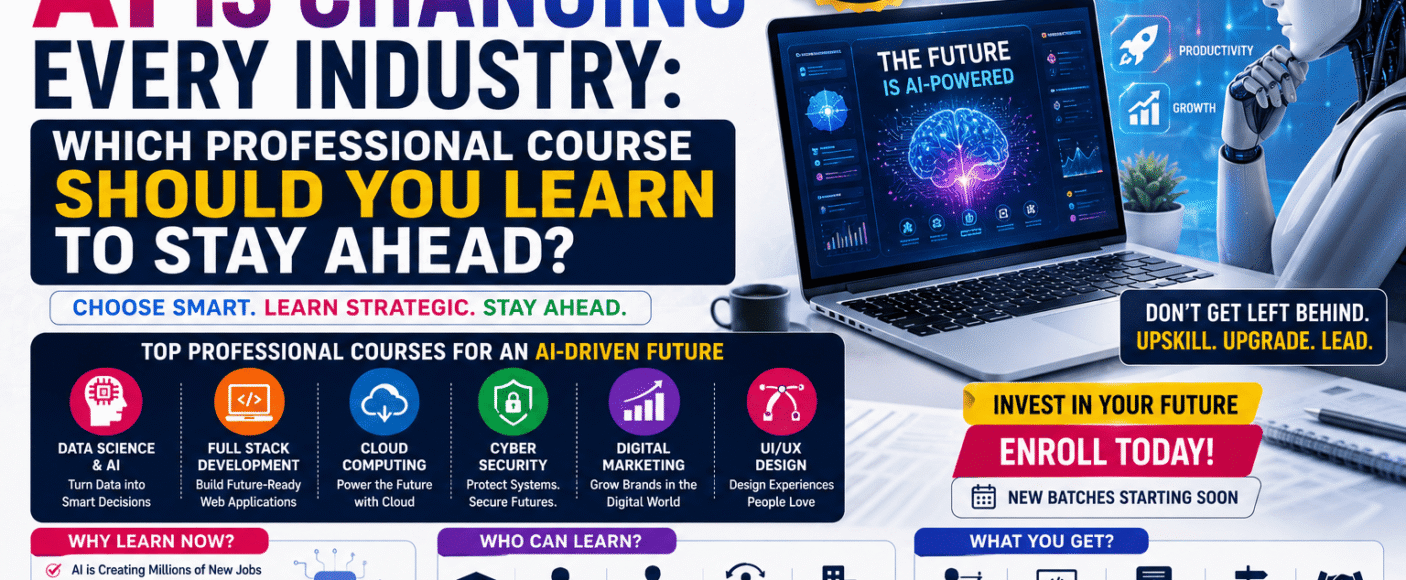
AI Is Changing Every Industry: Which Professional Course Should You Learn to Stay Ahead? (2026 Career Guide)
Artificial Intelligence (AI) is no longer limited to technology companies. It is reshaping industries such as healthcare, finance, education, manufacturing, retail, media, marketing, logistics, banking, and customer service. Businesses are increasingly using AI to automate repetitive tasks, analyse large volumes of data, personalise customer experiences, and improve productivity.
As a result, employers are looking for professionals who not only understand their field but also know how to work effectively with AI-powered tools.
The key question in 2026 is no longer “Will AI replace jobs?” Instead, it is “Which skills should I learn to stay relevant in an AI-driven workplace?”
This guide explores how AI is changing different industries, the professional courses that can help you stay competitive, and the practical skills employers value most.
Why AI Skills Matter in 2026
AI is changing the way organisations operate by improving efficiency, supporting decision-making, and enabling innovation.
Professionals who understand AI-assisted workflows can:
- Improve productivity
- Automate repetitive tasks
- Make data-driven decisions
- Create better customer experiences
- Work more efficiently with modern software
- Adapt to evolving workplace technologies
Learning AI-related skills is becoming valuable across many professions—not just software development.
Industries Being Transformed by AI
Marketing & Advertising
AI supports content creation, campaign optimisation, audience analysis, and performance reporting.
Professionals with AI knowledge can work more efficiently while focusing on strategy and creativity.
Finance & Accounting
AI helps automate bookkeeping, fraud detection, financial forecasting, invoice processing, and reporting.
Finance professionals who combine accounting expertise with AI and analytics can improve business decision-making.
Healthcare
Healthcare organisations use AI for medical imaging support, appointment management, patient data analysis, and administrative efficiency.
AI assists professionals rather than replacing clinical judgement.
Education
Educational institutions use AI for personalised learning, automated assessments, student engagement, and administrative support.
Teachers and trainers increasingly use AI to enhance learning experiences.
Manufacturing
AI supports predictive maintenance, quality control, inventory optimisation, and production planning.
Manufacturers require professionals who can understand digital tools and data.
Retail & E-commerce
AI enables personalised recommendations, demand forecasting, customer service chatbots, and inventory management.
Businesses seek professionals who understand digital commerce and AI-enabled marketing.
Professional Courses That Complement AI
1. Generative AI & AI Productivity Tools
What You’ll Learn
- Prompt Engineering
- AI Content Creation
- AI Image Generation
- AI Video Creation
- AI Research Tools
- Workflow Automation
- AI Productivity Applications
Career Opportunities
- AI Productivity Specialist
- AI Content Creator
- Prompt Engineer
- Automation Consultant
- AI Marketing Assistant
Why Learn It?
AI literacy is becoming a valuable skill across industries and job functions.
2. Data Analytics & Data Visualization
AI depends on high-quality data, making analytics one of the fastest-growing career fields.
Learn
- Advanced Excel
- Power BI
- Python (Optional for advanced roles)
- SQL Basics
- Dashboard Design
- Data Storytelling
Career Opportunities
- Data Analyst
- Business Analyst
- Reporting Analyst
- BI Executive
- MIS Executive
3. Digital Marketing
AI is changing how campaigns are planned, executed, and measured.
Learn
- SEO
- Google Ads
- Social Media Marketing
- Content Marketing
- Email Marketing
- AI Marketing Tools
- Analytics
Career Opportunities
- Digital Marketing Executive
- SEO Specialist
- Social Media Manager
- Performance Marketing Executive
4. Graphic Design
AI can generate design concepts, but human creativity remains essential for branding, storytelling, and visual communication.
Learn
- Adobe Photoshop
- Illustrator
- Canva
- Adobe Firefly
- Branding
- Typography
- Creative Strategy
Career Opportunities
- Graphic Designer
- Brand Designer
- Creative Designer
- Visual Communication Specialist
5. UI/UX Design
AI-powered products still require intuitive, user-friendly interfaces.
Learn
- Figma
- User Research
- Wireframing
- Prototyping
- Design Systems
- User Testing
Career Opportunities
- UI Designer
- UX Designer
- Product Designer
- Interaction Designer
6. Python Programming
Python remains one of the most widely used languages for AI, automation, and data processing.
Learn
- Python Fundamentals
- Automation
- APIs
- Data Handling
- AI Libraries (for advanced learners)
Career Opportunities
- Python Developer
- Automation Engineer
- Junior AI Developer
- Software Developer
7. Advanced Excel
Excel continues to be a core business tool for reporting, analysis, and decision-making.
Learn
- Pivot Tables
- Power Query
- Advanced Formulas
- Dashboards
- Data Cleaning
Career Opportunities
- MIS Executive
- Operations Executive
- Business Coordinator
- Reporting Executive
8. Tally Prime & Modern Accounting
Accounting software increasingly integrates automation and AI-supported workflows.
Learn
- Tally Prime
- GST
- Payroll
- Banking
- Inventory
- Financial Reporting
Career Opportunities
- Accountant
- Accounts Executive
- GST Executive
- Finance Officer
9. FinTech & Digital Finance
Financial technology continues to evolve through AI, automation, and digital banking.
Learn
- Financial Analytics
- Digital Payments
- Investment Fundamentals
- FinTech Applications
- AI in Finance
Career Opportunities
- FinTech Executive
- Financial Analyst
- Banking Associate
- Investment Consultant
10. Website Design & Development
AI tools simplify many development tasks, but businesses still need professionals to plan, customise, and manage websites.
Learn
- WordPress
- Responsive Design
- Basic HTML & CSS
- Website Optimisation
- SEO Integration
Career Opportunities
- Website Designer
- WordPress Developer
- Front-End Designer
11. Multimedia Animation & Motion Graphics
AI accelerates production, but storytelling, creativity, and artistic direction remain human strengths.
Learn
- Motion Graphics
- 2D & 3D Animation
- Storyboarding
- Visual Effects
- AI-Assisted Animation Tools
Career Opportunities
- Animator
- Motion Graphics Designer
- Multimedia Artist
12. Video Editing & AI Filmmaking
AI is changing editing workflows, script generation, subtitling, and content production.
Learn
- Adobe Premiere Pro
- After Effects
- DaVinci Resolve
- AI Video Tools
- Colour Grading
- Storytelling
Career Opportunities
- Video Editor
- AI Video Creator
- Digital Filmmaker
- Content Producer
13. Spoken English & Business Communication
As AI handles routine tasks, human communication becomes even more valuable.
Learn
- Spoken English
- Public Speaking
- Business Communication
- Presentation Skills
- Interview Preparation
Career Benefits
Communication remains essential for leadership, teamwork, sales, client interaction, and management.
AI Will Change Jobs—Not Eliminate Every Role
A common misconception is that AI will replace all professionals.
In reality, AI is more likely to:
- Automate repetitive work
- Increase productivity
- Support decision-making
- Improve efficiency
- Create new specialised roles
- Change how existing jobs are performed
Professionals who learn to work alongside AI are generally better positioned for future opportunities.
The Skills Employers Want Beyond AI
Technical knowledge is important, but employers also value:
- Critical Thinking
- Creativity
- Communication
- Problem Solving
- Collaboration
- Adaptability
- Leadership
- Emotional Intelligence
- Time Management
- Continuous Learning
These human-centred skills complement AI rather than compete with it.
Why Ahmedabad Is Becoming an AI Learning Hub
Ahmedabad is emerging as a destination for future-ready education because of:
- Growing IT and software companies
- Expanding startup ecosystem
- Manufacturing innovation
- Financial services growth
- Digital businesses
- Affordable professional training
- Demand for AI-enabled professionals
- Career-focused learning institutes
How to Choose the Right AI-Ready Course
Before enrolling, ask yourself:
What is my career goal?
Choose a course aligned with your interests and long-term aspirations.
Does the course include AI applications?
Look for programmes that demonstrate how AI is used within the profession.
Is there practical training?
Hands-on projects, case studies, and portfolio development are valuable for building real-world skills.
Is the curriculum regularly updated?
AI technologies evolve quickly, so current content is essential.
Does the institute provide career support?
Resume guidance, interview preparation, and placement assistance can help you transition into the workforce.
AI Career Roadmap
Step 1
Choose your primary career field (Marketing, Design, Analytics, Finance, Development, etc.).
Step 2
Learn the core tools and practical workflows used in that profession.
Step 3
Develop AI literacy by understanding AI-powered applications relevant to your field.
Step 4
Build a portfolio with real-world projects that demonstrate both technical and AI-assisted skills.
Step 5
Continue learning as AI technologies evolve.
Frequently Asked Questions (FAQs)
1. Will AI replace all jobs?
No. AI is expected to automate certain tasks and reshape many roles, but human skills such as creativity, communication, judgement, and problem-solving remain essential.
2. Which professional course is best for the AI era?
Courses in Data Analytics, Digital Marketing, Python Programming, UI/UX Design, Graphic Design, FinTech, Advanced Excel, Website Development, and Generative AI Tools all complement AI-driven workplaces.
3. Do I need coding to work with AI?
Not always. Many AI-powered tools for marketing, design, content creation, analytics, and productivity can be used without programming knowledge.
4. Can Commerce students learn AI-related skills?
Yes. Commerce students can combine AI tools with Finance, Tally Prime, Advanced Excel, Data Analytics, Digital Marketing, and FinTech.
5. Is AI useful for Graphic Designers and Digital Marketers?
Yes. AI can assist with brainstorming, content generation, image creation, campaign optimisation, and repetitive design tasks, allowing professionals to focus on strategy and creativity.
6. Why should I learn AI alongside my profession?
AI literacy can improve efficiency, expand career opportunities, and help professionals adapt to changing workplace expectations.
7. Which industries are hiring AI-aware professionals?
Technology, finance, healthcare, education, manufacturing, retail, marketing, media, consulting, and logistics are all integrating AI into their operations.
8. Are government-certified professional courses valuable for AI careers?
Recognised certifications combined with practical skills, updated curriculum, and real-world projects can strengthen your professional profile.
9. Is Ahmedabad a good place to learn AI-related skills?
Ahmedabad offers a growing ecosystem of technology companies, startups, professional training institutes, and businesses adopting AI-enabled solutions.
10. How can I future-proof my career?
Focus on continuous learning, practical experience, AI literacy, communication skills, and building expertise in your chosen profession.
Conclusion
Artificial Intelligence is reshaping the workplace, but it is also creating new opportunities for professionals who are willing to learn and adapt. Rather than replacing every role, AI is becoming a powerful tool that supports better decision-making, faster workflows, and greater innovation.
Whether your interests lie in Data Analytics, Digital Marketing, Graphic Design, UI/UX Design, Python Programming, Advanced Excel, Tally Prime, Finance, Website Development, Multimedia Animation, Motion Graphics, Video Editing, Digital AI Filmmaking, Spoken English, or Generative AI Tools, combining your core expertise with AI skills can make you more valuable in today’s job market.
The future belongs to professionals who embrace lifelong learning, develop practical experience, and understand how to work effectively alongside emerging technologies. By choosing the right professional course and continuously upgrading your skills, you can stay ahead in an AI-driven world and build a resilient, rewarding career.

Leave a Comment