
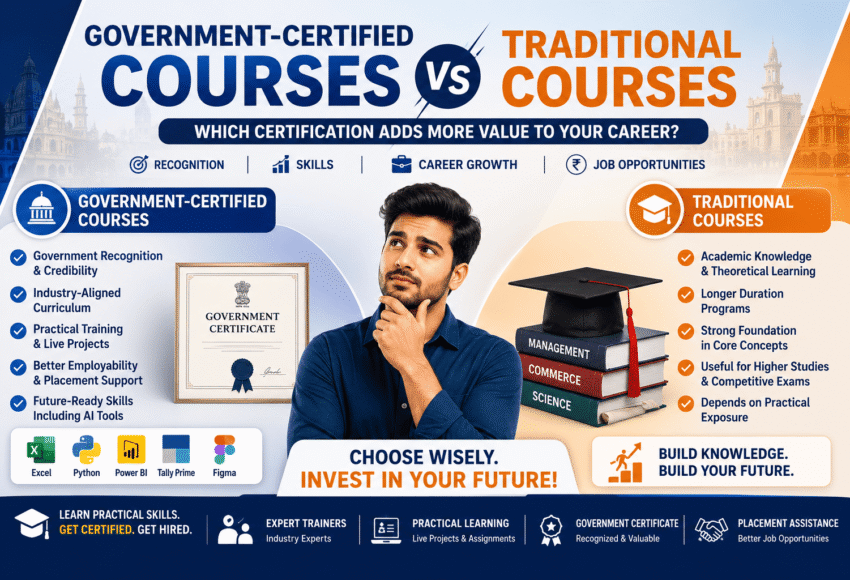
Government-Certified Courses vs Traditional Courses: Which Certification Adds More Value to Your Career? (2026 Guide)
In today’s competitive job market, employers are looking beyond academic degrees. They increasingly value candidates who possess industry-ready skills, practical experience, recognised certifications, and the ability to contribute from day one.
This shift has led many students and working professionals to ask an important question:
Should I choose a Government-Certified Course or a Traditional Course?
The answer depends on your career goals, the quality of the training, the recognition of the certification, and whether the course equips you with practical, job-ready skills.
This guide compares Government-Certified Courses vs Traditional Courses based on recognition, curriculum, industry demand, career opportunities, salary potential, and long-term value to help you make an informed decision in 2026.
What is a Government-Certified Course?
A Government-Certified Course is a professional training programme that awards a certificate issued, approved, recognised, or aligned with a government body, statutory authority, university, or recognised skill-development framework (depending on the programme).
These courses typically focus on:
- Practical Skill Development
- Industry-Oriented Learning
- Career Readiness
- Professional Certification
- Technical Competencies
- Employability Skills
Examples include professional training in:
- Digital Marketing
- Tally Prime & Accounting
- Advanced Excel
- Data Analytics
- Python Programming
- UI/UX Design
- Graphic Design
- Website Development
- Multimedia & Animation
- Spoken English & Business Communication
Note: Always verify the issuing authority and the type of government recognition before enrolling, as recognition varies between programmes.
What is a Traditional Course?
Traditional courses usually refer to diploma, undergraduate, or postgraduate academic programmes offered through schools, colleges, and universities.
These programmes generally focus on:
- Academic Knowledge
- Subject Fundamentals
- Theoretical Concepts
- Long-Term Education
- Degree Qualifications
- Research-Oriented Learning
Examples include:
- B.Com
- BBA
- BCA
- BA
- B.Sc.
- MBA
- M.Com
- MCA
Traditional education provides a strong academic foundation but may require additional professional skill training depending on career goals.
Government-Certified Courses vs Traditional Courses: Quick Comparison
| Feature | Government-Certified Courses | Traditional Courses |
|---|---|---|
| Primary Focus | Practical & Industry Skills | Academic Education |
| Duration | Short to Medium Term | 3–5 Years (typically) |
| Practical Training | High | Varies by institution |
| Industry Tools | Latest Software & Technologies | May vary |
| Live Projects | Common | Limited in many programmes |
| Internship Focus | Frequently Included | Depends on curriculum |
| Placement Support | Often Available | Varies |
| Skill-Based Learning | High | Moderate |
| Career Switching | Easier | Often Requires Additional Training |
| Continuous Updates | Usually Updated More Frequently | Revision cycles may be slower |
Why Employers Value Practical Skills
Modern organisations increasingly seek candidates who can solve problems, use industry-standard tools, and adapt quickly.
They often look for:
- Practical Experience
- Portfolio or Project Work
- Software Proficiency
- Communication Skills
- Critical Thinking
- Team Collaboration
- Adaptability
- AI Literacy
- Problem-Solving Ability
- Continuous Learning
This is why many candidates combine academic education with professional certification.
Advantages of Government-Certified Courses
1. Industry-Focused Curriculum
Professional certification courses are generally designed to teach practical, workplace-relevant skills.
Examples include:
- SEO
- Google Ads
- Power BI
- Python
- Figma
- Adobe Creative Cloud
- Tally Prime
- AI Productivity Tools
2. Faster Career Readiness
Most professional programmes focus on preparing learners for employment in a shorter period through:
- Live Projects
- Case Studies
- Practical Assignments
- Portfolio Building
- Interview Preparation
3. Updated Learning
Technology evolves rapidly.
Government-recognised and industry-focused professional programmes often update their curriculum more frequently to reflect:
- Artificial Intelligence
- Automation
- Data Analytics
- Cloud Technologies
- Digital Marketing Trends
- Cybersecurity Awareness
4. Better Practical Exposure
Students commonly work on:
- Real Business Projects
- Simulated Client Assignments
- Software Tools
- Team Projects
- Industry Case Studies
Practical experience helps build confidence and job readiness.
Advantages of Traditional Courses
Traditional education remains valuable because it provides:
- Strong Academic Foundation
- Subject Expertise
- Analytical Thinking
- Research Skills
- Eligibility for Higher Education
- Recognition for Many Government and Regulated Roles
For professions such as medicine, law, engineering, teaching, and chartered accountancy, formal academic qualifications remain essential.
Which Option Offers Better Career Opportunities?
Rather than treating these options as competitors, many successful professionals combine both.
Traditional Degree + Professional Certification
Example combinations:
| Academic Qualification | Professional Certification |
|---|---|
| B.Com | Tally Prime + Advanced Excel + Data Analytics |
| BBA | Digital Marketing + AI Tools |
| BCA | Python + Website Development + UI/UX |
| BA | Graphic Design + Motion Graphics |
| B.Sc. | Data Analytics + Power BI + Python |
This combination often strengthens both theoretical understanding and practical capability.
Salary Comparison
Salary depends on:
- Skills
- Experience
- Industry
- Portfolio
- Location
- Employer
- Communication Ability
Candidates who combine recognised education with practical skills are often more competitive in the job market.
Government Certification: Common Myths
Myth 1: Government Certification Guarantees a Job
Reality: No certification guarantees employment. Hiring decisions depend on skills, experience, interview performance, and market demand.
Myth 2: Degrees Are No Longer Important
Reality: Degrees remain valuable for many careers and higher education pathways. Professional certifications complement rather than replace them in many fields.
Myth 3: One Certificate Is Enough
Reality: Continuous learning is increasingly important. Technology, AI, and industry practices evolve regularly, making ongoing upskilling essential.
Why Ahmedabad is a Growing Skill Development Hub
Ahmedabad has become an attractive destination for professional training due to:
- Expanding IT Sector
- Manufacturing Growth
- FinTech Companies
- Startup Ecosystem
- Digital Businesses
- Affordable Education
- Corporate Hiring
- Entrepreneurial Opportunities
These developments have increased demand for job-oriented skill training.
In-Demand Government-Certified Professional Courses
Popular skill-development areas include:
- Digital Marketing
- Advanced Excel
- Tally Prime
- Data Analytics
- Power BI
- Python Programming
- UI/UX Design
- Graphic Design
- Motion Graphics
- Video Editing
- AI Tools
- Website Development
- Spoken English
- Business Communication
- FinTech
How to Choose the Right Course
Before enrolling, consider:
Verify Recognition
Understand who issues the certificate and whether it is recognised by relevant authorities or industry.
Check the Curriculum
Look for practical, updated content that includes current tools and technologies.
Evaluate Trainers
Choose institutes with experienced faculty and industry exposure.
Look for Hands-On Learning
Practical assignments, live projects, and internships help develop job-ready skills.
Assess Career Support
Placement guidance, interview preparation, and portfolio development can add significant value.
Future Scope in 2026
Employers increasingly seek professionals who combine:
- Academic Knowledge
- Practical Skills
- AI Awareness
- Digital Literacy
- Business Communication
- Adaptability
- Critical Thinking
- Industry Certifications
Candidates with this balanced skill set are well-positioned for future career opportunities.
Frequently Asked Questions (FAQs)
1. Are Government-Certified Courses better than Traditional Courses?
Neither is universally better. Government-certified professional courses emphasise practical, job-oriented skills, while traditional courses provide academic depth. For many careers, combining both offers the strongest foundation.
2. Are Government-Certified Courses recognised by employers?
Recognition depends on the issuing authority, the credibility of the training provider, and the relevance of the skills taught. Always verify certification details before enrolling.
3. Can I get a job with only a Government-Certified Course?
In many skill-based industries such as digital marketing, design, IT support, and software tools, practical skills and portfolios can be highly important. However, hiring requirements vary by employer and role.
4. Should college students also pursue professional certifications?
Yes. Professional certifications can complement academic studies by adding practical, industry-relevant skills and improving employability.
5. Which industries value professional certifications?
IT, digital marketing, finance, accounting, analytics, design, media, e-commerce, manufacturing, and many technology-driven industries frequently value practical certifications.
6. Do Government-Certified Courses include internships?
Some programmes include internships or live projects, while others do not. Check the institute’s curriculum before enrolling.
7. Are online Government-Certified Courses valid?
Validity depends on the issuing organisation and the recognition of the certification. Review the course provider’s credentials and industry acceptance.
8. How can I verify a certification?
Check the official details provided by the issuing authority or training organisation, including accreditation, recognition, and certificate verification methods where available.
9. Which certification is best after the 12th?
The best choice depends on your interests. Popular options include Digital Marketing, Data Analytics, Tally Prime, Advanced Excel, Python, UI/UX Design, Graphic Design, Website Development, and Spoken English.
10. Can working professionals benefit from certification courses?
Yes. Short-term professional certifications are often used for upskilling, career advancement, role transitions, and keeping pace with new technologies.
Conclusion
The question is no longer Government-Certified Course or Traditional Course—it is how to combine academic learning with practical skills to build a successful career.
Traditional education provides theoretical knowledge, discipline, and recognised qualifications, while government-recognised and industry-focused certification programmes help learners develop practical expertise with current tools, technologies, and workplace practices.
In 2026, employers increasingly value professionals who can demonstrate technical competence, real-world experience, communication skills, adaptability, and continuous learning. By choosing quality training, verifying certification recognition, and building a portfolio of practical work, students and working professionals can strengthen their employability and prepare for long-term career growth.
Leave a Comment