
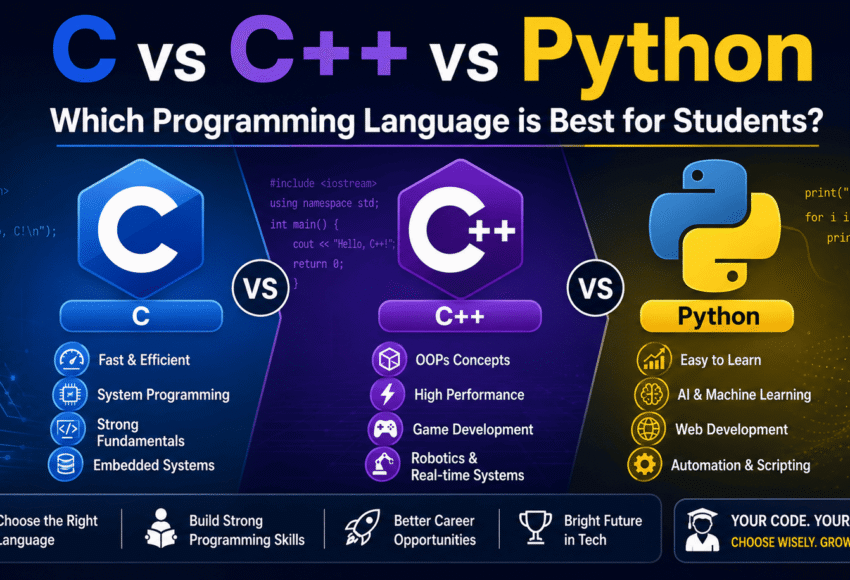
C vs C++ vs Python: Which Programming Language is Best for Students in 2026?
Choosing your first programming language is one of the most important decisions for any student starting a career in technology. Three of the most popular programming languages—C, C++, and Python—each offer unique advantages depending on your career goals. While C builds strong programming fundamentals, C++ introduces object-oriented programming and high-performance software development, and Python is widely used for Artificial Intelligence (AI), Data Science, Automation, and Web Development.
In this comprehensive guide, we’ll compare C vs C++ vs Python based on difficulty, career opportunities, salary, industry demand, learning curve, and future scope to help students choose the best programming language in 2026.
Why Choosing the Right Programming Language Matters
Learning the right programming language helps students:
- Build strong coding fundamentals
- Develop problem-solving skills
- Prepare for technical interviews
- Explore multiple career opportunities
- Learn advanced technologies more easily
- Stay competitive in today’s technology-driven job market
The best language depends on your learning objectives and long-term career plans.
What is C Programming?
C is one of the oldest and most influential programming languages. It focuses on procedural programming and provides direct access to system memory, making it ideal for understanding how computers work.
Best For
- Programming beginners
- Computer Science students
- Embedded Systems
- Operating Systems
- System Programming
- Competitive Programming
Advantages
- Strong programming fundamentals
- Fast execution speed
- Efficient memory management
- Excellent for learning Data Structures and Algorithms
- Foundation for many modern languages
Limitations
- No built-in Object-Oriented Programming
- Manual memory management
- More complex than Python for beginners
What is C++ Programming?
C++ is an extension of C that supports both procedural and Object-Oriented Programming (OOP). It is widely used in industries requiring high-performance software.
Best For
- Software Development
- Game Development
- Robotics
- Embedded Systems
- Financial Software
- High-Performance Computing
Advantages
- Object-Oriented Programming
- High execution speed
- Standard Template Library (STL)
- Industry-wide adoption
- Excellent for coding interviews
Limitations
- Steeper learning curve
- Complex syntax for beginners
- Manual memory management in many scenarios
What is Python Programming?
Python is a beginner-friendly, high-level programming language known for its simple syntax and extensive library ecosystem.
Best For
- Artificial Intelligence
- Machine Learning
- Data Science
- Web Development
- Automation
- Cybersecurity
- Cloud Computing
Advantages
- Easy to learn
- Simple syntax
- Huge community support
- Large collection of libraries
- Rapid application development
Limitations
- Slower execution compared to C and C++
- Less suitable for low-level system programming
- Higher memory consumption
C vs C++ vs Python: Detailed Comparison
| Feature | C | C++ | Python |
|---|---|---|---|
| Learning Difficulty | Moderate | Moderate to High | Easy |
| Programming Style | Procedural | Procedural + OOP | Object-Oriented & Functional |
| Speed | ⭐⭐⭐⭐⭐ | ⭐⭐⭐⭐⭐ | ⭐⭐⭐ |
| Beginner Friendly | Yes | Moderate | Excellent |
| Memory Management | Manual | Manual/Automatic | Automatic |
| Object-Oriented Programming | No | Yes | Yes |
| AI & Machine Learning | Limited | Moderate | Excellent |
| Web Development | Limited | Limited | Excellent |
| Game Development | Basic | Excellent | Moderate |
| Embedded Systems | Excellent | Excellent | Limited |
| System Programming | Excellent | Excellent | Limited |
| Data Science | Limited | Limited | Excellent |
| Job Opportunities | High | Very High | Extremely High |
Which Programming Language is Best for Different Career Goals?
Choose C If You Want To Become
- Embedded Systems Engineer
- System Programmer
- Firmware Developer
- Operating System Developer
- Electronics Engineer
Choose C++ If You Want To Become
- Software Engineer
- Game Developer
- Robotics Engineer
- Automotive Software Engineer
- High-Performance Computing Developer
Choose Python If You Want To Become
- AI Engineer
- Machine Learning Engineer
- Data Scientist
- Web Developer
- Automation Engineer
- DevOps Engineer
- Cybersecurity Analyst
Career Opportunities After Learning Each Language
Career Opportunities in C
- Embedded Systems Engineer
- Firmware Developer
- Device Driver Developer
- System Programmer
- IoT Developer
Average Salary (India)
₹3.5 LPA – ₹10 LPA
Career Opportunities in C++
- Software Developer
- Game Developer
- Robotics Engineer
- Automotive Software Engineer
- Financial Software Developer
Average Salary (India)
₹5 LPA – ₹18 LPA
Career Opportunities in Python
- AI Engineer
- Machine Learning Engineer
- Data Scientist
- Backend Developer
- Automation Engineer
- Cloud Engineer
Average Salary (India)
₹5 LPA – ₹20+ LPA
Which Language is Easier for Beginners?
C
- Moderate difficulty
- Best for understanding programming fundamentals
- Requires more practice
C++
- Slightly more difficult than C
- Ideal after learning programming basics
- Excellent for software engineering careers
Python
- Easiest language for beginners
- Clean syntax
- Faster learning curve
- Ideal for first-time programmers
Winner for Beginners: Python
Which Language Has Better Career Opportunities?
All three languages offer excellent career opportunities, but they serve different industries.
| Career Goal | Best Language |
|---|---|
| Software Engineering | C++ |
| Artificial Intelligence | Python |
| Data Science | Python |
| Robotics | C++ |
| Embedded Systems | C |
| Game Development | C++ |
| Automation | Python |
| Web Development | Python |
| Cybersecurity | Python + C |
| Competitive Programming | C++ |
Which Language Should Students Learn First?
A recommended roadmap for students is:
Step 1
Learn C Programming to build strong programming fundamentals.
Step 2
Move to C++ to understand Object-Oriented Programming, Data Structures, and Algorithms.
Step 3
Learn Python to explore AI, Machine Learning, Automation, Data Science, and Web Development.
This sequence gives students a balanced foundation and broad career flexibility.
Skills to Learn Along with Programming
To increase employability, students should also learn:
- Data Structures & Algorithms
- SQL & Database Management
- Git & GitHub
- Linux Basics
- Object-Oriented Programming
- Problem Solving
- Communication Skills
- Software Development Projects
Future Scope of C, C++ & Python
All three languages continue to play critical roles in the technology industry.
C
- Embedded Systems
- IoT
- Operating Systems
- Firmware Development
C++
- Game Development
- Robotics
- High-Performance Computing
- Financial Systems
- Automotive Software
Python
- Artificial Intelligence
- Machine Learning
- Data Science
- Cloud Computing
- Automation
- Cybersecurity
- Generative AI
Learning more than one programming language provides the greatest career flexibility.
Frequently Asked Questions (FAQs)
Which programming language is best for beginners?
Python is generally the easiest programming language for beginners due to its simple syntax. However, students pursuing Computer Science or Software Engineering benefit greatly from learning C first to build strong fundamentals.
Should I learn C before Python?
If your goal is to understand programming concepts deeply and prepare for technical interviews, learning C first is highly recommended. If your goal is to start building applications quickly, Python is an excellent starting point.
Is C++ better than Python?
It depends on your career goals. C++ is ideal for high-performance software, gaming, robotics, and system programming, while Python is better suited for AI, Machine Learning, Data Science, automation, and web development.
Which language offers the highest salary?
Python-related roles in AI, Machine Learning, and Data Science often command some of the highest salaries. However, experienced C++ developers in finance, gaming, and systems programming are also highly compensated.
Can I learn all three languages?
Yes. Learning C, C++, and Python creates a versatile skill set and significantly expands career opportunities across software engineering, AI, embedded systems, and automation.
Which language is best for placement interviews?
C++ is widely preferred for coding interviews because of its performance and extensive Standard Template Library (STL), making it ideal for solving Data Structures and Algorithms problems.
Which programming language has the best future?
All three languages have a strong future. Python is expected to continue leading AI and automation, while C and C++ will remain essential for operating systems, embedded systems, gaming, robotics, and high-performance applications.
Conclusion
There is no single “best” programming language for every student. The right choice depends on your career aspirations and interests. C provides the strongest foundation in programming and computer science fundamentals. C++ builds on that knowledge with object-oriented programming and is the preferred choice for software engineering, gaming, and robotics. Python stands out for its simplicity and dominance in AI, Machine Learning, Data Science, automation, and web development.
For students who want long-term career success, the ideal learning path is C → C++ → Python. This progression develops strong programming fundamentals, advanced software engineering skills, and expertise in modern technologies, preparing you for diverse and high-paying opportunities in the technology industry throughout 2026 and beyond.



Leave a Comment