
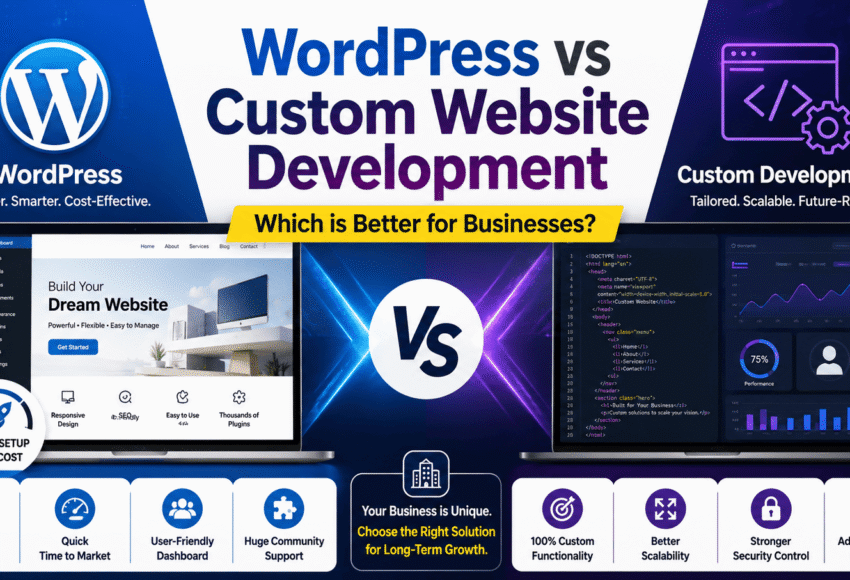
WordPress vs Custom Website Development: Which is Better for Businesses? (2026 Complete Guide)
WordPress vs Custom Website Development: Which is Better for Businesses?
A business website is more than just an online presence—it’s a marketing tool, sales channel, customer support platform, and brand identity. One of the biggest decisions businesses face is whether to build a website using WordPress or invest in custom website development. Both approaches have advantages, and the right choice depends on your goals, budget, timeline, scalability needs, and technical requirements. This guide compares WordPress and custom website development across key factors such as cost, performance, security, SEO, flexibility, maintenance, and long-term business value, helping you choose the best solution for your organisation.
What is WordPress website development?
WordPress is an open-source content management system (CMS) that enables businesses to create and manage websites without building everything from scratch. With thousands of themes, plugins, and integrations, WordPress can power:
- Business websites
- Blogs
- eCommerce stores
- Educational portals
- Portfolio websites
- Booking websites
- Membership platforms
- News portals
WordPress is ideal for businesses that want a fast, flexible, and cost-effective solution.
What is Custom Website Development?
Custom website development involves building a website specifically for your business requirements using programming languages and frameworks. Developers typically use technologies such as:
- HTML5
- CSS3
- JavaScript
- PHP
- Python
- Node.js
- React
- Angular
- Laravel
- ASP.NET
- MySQL or PostgreSQL
Every feature, workflow, and user experience is designed according to business needs.
WordPress vs Custom Website Development: Quick Comparison
| Feature | WordPress | Custom Development |
|---|---|---|
| Development Time | Fast | Longer |
| Initial Cost | Low | High |
| Maintenance | Easy | Requires developers |
| Customization | High | Unlimited |
| SEO Features | Excellent | Depends on implementation |
| Security | Strong with best practices | Can be highly secure if developed correctly |
| Performance | Excellent with optimisation. | Can be optimized to very high levels |
| Scalability | Suitable for most businesses | Ideal for highly complex platforms |
| Ease of Content Updates | Very easy | Often requires a custom admin interface |
| Technical Knowledge | Minimal for daily management | Higher technical expertise required |
1. Development Cost
WordPress
WordPress significantly reduces development costs because many features already exist through themes and plugins. Typical expenses include:
- Domain
- Hosting
- Premium theme (optional)
- Premium plugins (optional)
- Development and customization
This makes WordPress attractive for startups and small to medium-sized businesses.
Custom Development
Custom websites require:
- UI/UX design
- Front-end development
- Back-end development
- Database architecture
- Testing
- Deployment
- Ongoing maintenance
While the investment is higher, businesses receive a solution tailored to their exact requirements.
Winner: WordPress for cost-effectiveness.
2. Development Time
WordPress
A professional business website can often be completed within days or weeks, depending on complexity.
Custom Development
A custom solution usually takes weeks or months because every feature is designed, coded, tested, and refined from the ground up.
Winner: WordPress for faster delivery.
3. Customization
WordPress
WordPress offers extensive customisation through themes, plugins, page builders, and custom code. It works exceptionally well for most business websites.
Custom Development
Custom development offers complete control over:
- Design
- User experience
- Business workflows
- Integrations
- Dashboards
- Automation
- Advanced functionality
Winner: Custom Development.
4. SEO Performance
WordPress
WordPress is highly SEO-friendly with features such as:
- Clean URL structures
- Meta tag management
- XML sitemaps
- Image optimization
- Schema support
- Fast-loading themes
- SEO plugins
Custom Development
A well-built custom website can achieve outstanding SEO performance, but it requires experienced developers to implement technical SEO correctly.
Winner: WordPress for ease of SEO implementation.
5. Website Performance
Website speed depends more on code quality, hosting, caching, image optimisation, and server configuration than on the platform itself. Both WordPress and custom websites can deliver excellent performance when optimised.
Winner: Tie.
6. Security
WordPress
WordPress is secure when businesses:
- Keep WordPress core updated
- Update plugins and themes regularly
- Use reputable extensions
- Enable SSL
- Implement backups
- Apply security best practices
Custom Development
Custom websites reduce reliance on third-party plugins but still require secure coding, regular testing, updates, and monitoring.
Winner: Tie when maintained properly.
7. Scalability
WordPress
WordPress can scale from small business websites to large enterprise platforms with proper hosting and optimisation.
Custom Development
Custom applications are ideal for businesses with:
- Complex workflows
- Large user bases
- Enterprise integrations
- Specialized business logic
- High transaction volumes
Winner: Custom development for highly specialised enterprise systems.
8. Ease of Content Management
One of WordPress’s biggest advantages is its intuitive dashboard. Business owners can:
- Publish blog posts
- Update pages
- Upload images
- Add products
- Manage users
- Edit menus
without relying on developers for everyday changes. Custom-built websites often require a bespoke admin interface, which may offer more control but can also increase complexity.
Winner: WordPress.
Which Businesses Should Choose WordPress?
WordPress is an excellent fit for:
- Startups
- Small and medium-sized businesses
- Corporate websites
- Educational institutions
- Healthcare providers
- Restaurants
- Hotels
- NGOs
- Real estate agencies
- Service-based businesses
- Personal brands
- eCommerce stores using WooCommerce
Which Businesses Should Choose Custom Development?
Custom development is often the better option for organizations that need:
- Enterprise software
- SaaS platforms
- Banking and fintech applications
- Healthcare systems with specialized workflows
- Logistics and supply chain platforms
- Large marketplaces
- Custom CRM or ERP systems
- AI-powered applications
- Complex internal portals
Advantages of WordPress
- Faster deployment
- Lower development costs
- User-friendly interface
- Strong SEO capabilities
- Large ecosystem of plugins
- Thousands of themes
- Easy maintenance
- Excellent community support
- Flexible for most business websites
Advantages of Custom Website Development
- Fully tailored functionality
- Unique user experience
- Complete design freedom
- Greater control over business logic
- Optimized for complex requirements
- Easier integration with proprietary systems
- No dependency on unnecessary plugins
Common Misconceptions
“WordPress is only for blogs.”
False. WordPress powers business websites, enterprise portals, online stores, educational platforms, and membership sites.
“Custom websites are always faster.”
Not necessarily. Performance depends on architecture, optimization, hosting, and code quality—not just the development approach.
“WordPress is not secure.”
Incorrect. A properly maintained WordPress website can be highly secure and reliable.
Future Trends
Modern businesses are increasingly adopting:
- AI-powered website assistants
- Headless WordPress architectures
- Progressive Web Apps (PWAs)
- API-driven integrations
- Cloud-native hosting
- Advanced personalization
- Automation workflows
- AI-assisted content management
Both WordPress and custom development continue to evolve, enabling organizations to build faster, smarter, and more scalable digital experiences.
Frequently Asked Questions (FAQs)
1. Which is better for small businesses: WordPress or custom development?
For most small businesses, WordPress offers the best balance of affordability, flexibility, ease of use, and speed of deployment.
2. Is WordPress suitable for large businesses?
Yes. With proper architecture, hosting, security, and optimization, WordPress can support large organizations and high-traffic websites.
3. When should I choose custom website development?
Choose custom development when your business requires highly specialized workflows, enterprise integrations, or functionality that cannot be efficiently achieved with a CMS.
4. Which option is more SEO-friendly?
Both can perform well, but WordPress provides built-in advantages and mature SEO tools that simplify optimization for most businesses.
5. Which is more secure?
Security depends on maintenance and development practices. Both WordPress and custom websites can be highly secure when managed correctly.
6. Is WordPress more affordable?
Yes. WordPress generally requires a lower initial investment and lower ongoing maintenance costs than fully custom development.
7. Can I migrate from WordPress to a custom website later?
Yes. Many businesses begin with WordPress to validate their ideas and later transition to a custom platform as their requirements become more complex.
Conclusion
There is no universal winner in the WordPress vs custom website development debate. The best choice depends on your business goals, budget, timeline, and technical requirements.
For most startups, small businesses, service providers, educational organizations, and growing companies, WordPress delivers exceptional value through faster development, lower costs, strong SEO, and easy content management.
For enterprises, SaaS platforms, or businesses with highly specialized workflows, custom website development offers unmatched flexibility, scalability, and control.
Before making a decision, evaluate your current needs as well as your long-term growth plans. Choosing the right platform today will help create a secure, scalable, and future-ready digital presence that supports your business for years to come.



Leave a Comment