
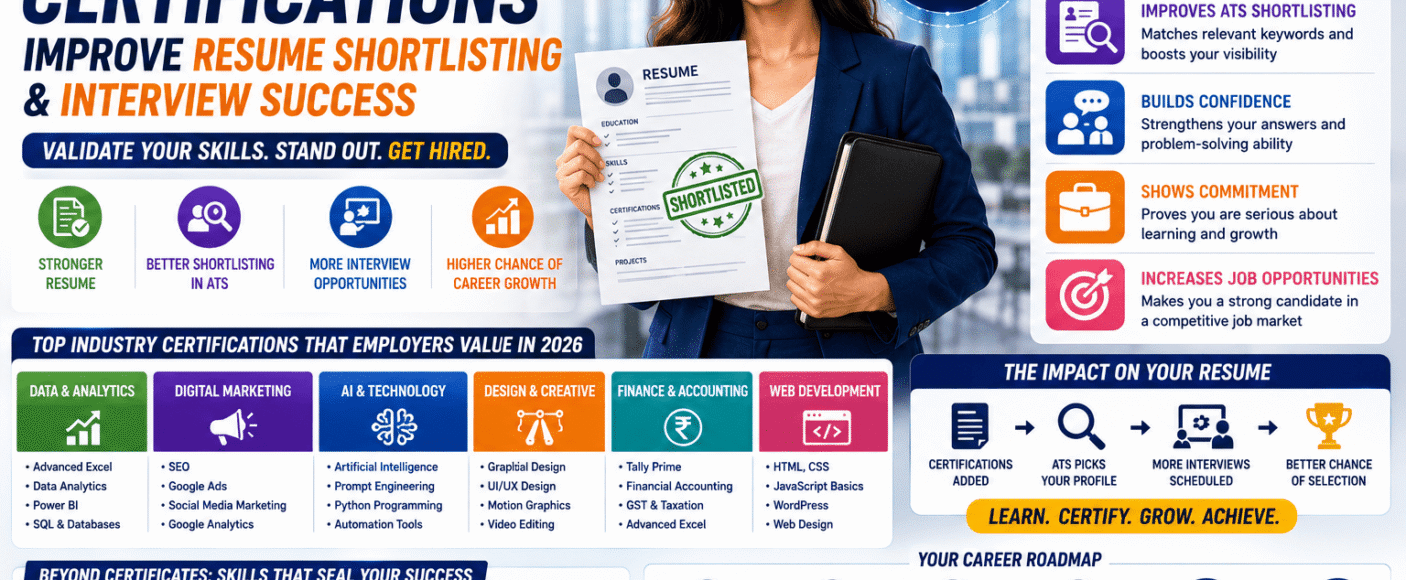
How Industry Certifications Improve Resume Shortlisting and Interview Success (2026 Career Guide)
In today’s competitive hiring environment, earning a degree alone may not always be enough to stand out. Recruiters increasingly look for candidates who can demonstrate practical skills, industry knowledge, and a commitment to continuous learning. One way candidates showcase these qualities is through relevant industry certifications.
Professional certifications can help validate your knowledge, strengthen your resume, support ATS (Applicant Tracking System) keyword matching, and provide discussion points during interviews. Whether you are pursuing a career in Artificial Intelligence, Data Analytics, Digital Marketing, Finance, Tally Prime, Advanced Excel, UI/UX Design, Graphic Design, Website Development, Python Programming, Motion Graphics, Video Editing, or Business Communication, the right certification can complement your education and practical experience.
This guide explains how industry certifications contribute to resume shortlisting and interview preparation while outlining the skills employers value in 2026.
Why Certifications Matter in Today’s Job Market
Recruitment has evolved significantly over the past few years. Many organizations use structured hiring processes that evaluate candidates based on education, practical experience, technical skills, and relevant certifications.
Professional certifications can help demonstrate that you have invested time in learning industry-relevant tools and concepts.
Benefits include:
- Demonstrates commitment to learning
- Supports professional credibility
- Highlights specialized knowledge
- Reinforces technical skills
- Complements academic qualifications
- Encourages continuous skill development
While certifications alone do not guarantee employment, they can strengthen an overall candidate profile when combined with practical experience and strong communication skills.
How Recruiters Evaluate Resumes
Recruiters generally review resumes for several key factors:
- Educational qualifications
- Relevant technical skills
- Practical projects
- Internship experience
- Work experience
- Industry certifications
- Communication abilities
- Portfolio or GitHub (where applicable)
- Career progression
A balanced resume that combines education, practical work, and certifications often provides a more complete picture of a candidate’s capabilities.
Understanding ATS (Applicant Tracking Systems)
Many organizations use Applicant Tracking Systems (ATS) to organize and filter applications.
ATS software may identify resumes containing relevant:
- Skills
- Job titles
- Software knowledge
- Certifications
- Industry keywords
Including accurate and relevant certification names alongside your demonstrated skills can help ensure your resume aligns more closely with the job description. However, ATS ranking depends on multiple factors, and there is no guarantee that certifications alone will improve results.
Ways Industry Certifications Strengthen Your Resume
1. Demonstrate Practical Learning
Professional certifications often include hands-on assignments, case studies, or projects that complement theoretical education.
Recruiters appreciate candidates who can explain how they applied what they learned.
2. Highlight Current Industry Knowledge
Technology evolves quickly.
Certifications help demonstrate familiarity with modern tools such as:
- Artificial Intelligence
- Data Analytics
- Power BI
- Advanced Excel
- SEO
- Digital Marketing
- Python
- UI/UX Design
- Graphic Design
3. Showcase Continuous Learning
Recruiters value professionals who actively upgrade their knowledge.
Continuous learning reflects adaptability and a willingness to grow with industry changes.
4. Support Career Transitions
Candidates changing careers can use certifications to build foundational knowledge in a new field.
For example:
- Commerce → Data Analytics
- Arts → Graphic Design
- Science → Digital Marketing
- Finance → FinTech
- Marketing → AI Tools
5. Improve Confidence During Interviews
Completing certification programmes often provides practical examples, projects, and problem-solving experiences that can strengthen interview discussions.
Certifications That Complement Different Career Paths
Artificial Intelligence & Generative AI
Learn
- AI Productivity Tools
- Prompt Engineering
- Workflow Automation
- Responsible AI Practices
Career Areas
- AI Operations
- Automation Support
- Digital Transformation
Data Analytics
Learn
- Advanced Excel
- Power BI
- Data Visualization
- Business Reporting
Career Areas
- Data Analyst
- MIS Executive
- Business Analyst
Digital Marketing
Learn
- SEO
- Google Ads
- Social Media Marketing
- Analytics
- Content Marketing
Career Areas
- Digital Marketing Executive
- SEO Specialist
- Performance Marketer
Finance & Accounting
Learn
- Tally Prime
- GST
- Payroll
- Financial Reporting
- Advanced Excel
Career Areas
- Accountant
- Accounts Executive
- Finance Executive
UI/UX Design
Learn
- Figma
- User Research
- Wireframing
- Prototyping
Career Areas
- UI Designer
- UX Designer
- Product Designer
Graphic Design
Learn
- Adobe Photoshop
- Illustrator
- Branding
- Visual Communication
Career Areas
- Graphic Designer
- Visual Designer
- Brand Designer
Website Design & Development
Learn
- HTML
- CSS
- WordPress
- Responsive Design
Career Areas
- Website Developer
- Front-End Developer
Python Programming
Learn
- Python Fundamentals
- Automation
- APIs
- Problem Solving
Career Areas
- Python Developer
- Automation Engineer
Motion Graphics & Video Editing
Learn
- After Effects
- Premiere Pro
- Motion Graphics
- Storytelling
Career Areas
- Motion Graphics Designer
- Video Editor
- Multimedia Designer
Spoken English & Business Communication
Learn
- Public Speaking
- Email Writing
- Presentation Skills
- Interview Communication
Career Areas
Useful across all industries and professional roles.
How Certifications Help During Interviews
Interviewers often ask candidates about:
- Practical projects
- Software proficiency
- Real-world problem solving
- Industry knowledge
- Learning experiences
Certification programmes that include projects or case studies can provide useful examples to discuss during interviews.
Building a Resume That Stands Out
Along with certifications, include:
- Technical skills
- Internship experience
- Live projects
- Freelance work
- Portfolio links
- AI literacy
- Communication skills
- Quantifiable achievements
Remember that a resume should accurately reflect your abilities and experiences.
Importance of Practical Projects
Certifications become more valuable when supported by hands-on work.
Examples include:
- Data dashboards
- Marketing campaigns
- Graphic design portfolios
- Website projects
- Python applications
- Financial reports
- Motion graphics videos
Employers often appreciate seeing practical outcomes rather than only course completion.
Soft Skills That Complement Certifications
Recruiters also evaluate:
- Communication
- Teamwork
- Leadership
- Critical Thinking
- Time Management
- Adaptability
- Professional Ethics
- Emotional Intelligence
These skills help professionals succeed in collaborative work environments.
Common Resume Mistakes to Avoid
Listing Certifications Without Relevant Skills
Only include certifications that genuinely support your career objectives and that you can discuss confidently.
Ignoring Practical Experience
Projects, internships, and portfolios often demonstrate applied knowledge more effectively than certificates alone.
Overloading the Resume
Focus on relevant certifications instead of listing every short course completed.
Failing to Update Skills
Industries evolve quickly. Keep your knowledge and certifications current where appropriate.
Why Ahmedabad Is a Good Place for Skill Development
Ahmedabad has become a growing centre for:
- Information Technology
- Financial Services
- Digital Marketing
- Manufacturing
- Creative Design
- Startups
- Professional Training
Learners can find opportunities to combine classroom learning with practical industry exposure.
How to Choose the Right Certification
Before enrolling, consider:
Industry Relevance
Select certifications aligned with your career goals and current market demand.
Practical Curriculum
Look for programmes that include:
- Live Projects
- Assignments
- Portfolio Development
- Industry Software
Updated Content
Choose courses that reflect current tools, workflows, and AI-enabled practices.
Career Support
Value-added services may include:
- Resume Guidance
- Mock Interviews
- Internship Opportunities
- Placement Assistance
Frequently Asked Questions (FAQs)
1. Do industry certifications guarantee a job?
No. Certifications strengthen your profile but employment decisions also depend on experience, technical skills, interview performance, communication, and role requirements.
2. Do recruiters value certifications?
Relevant certifications can demonstrate ongoing learning and familiarity with industry tools, particularly when supported by practical projects and experience.
3. Can certifications improve ATS performance?
Including relevant certification names and skills that accurately match job requirements may help your resume align with ATS keyword searches, although ATS evaluation depends on many factors.
4. Which certifications are valuable in 2026?
AI, Data Analytics, Advanced Excel, Power BI, Digital Marketing, Finance, Tally Prime, UI/UX Design, Graphic Design, Website Development, Python Programming, Motion Graphics, Video Editing, and Business Communication remain relevant across many industries.
5. Should freshers earn certifications?
Certifications can help freshers demonstrate additional skills beyond their academic qualifications, especially when paired with internships or projects.
6. Are practical projects more important than certificates?
Projects and certifications complement each other. Practical work demonstrates how you apply your knowledge in real-world situations.
7. Is Ahmedabad a good city for professional certification courses?
Ahmedabad offers a growing ecosystem of professional training institutes, IT companies, financial services, startups, and creative industries that support skill development.
8. How do I select the right certification?
Choose programmes that match your career goals, include practical learning, use industry-standard tools, and support continuous skill development.
Conclusion
Industry certifications can play a valuable role in strengthening your resume, supporting ATS compatibility, and helping you discuss practical knowledge during interviews. However, certifications are most effective when combined with technical expertise, practical projects, communication skills, and continuous learning.
Whether you plan to build a career in Artificial Intelligence, Data Analytics, Advanced Excel, Digital Marketing, Finance, Tally Prime, UI/UX Design, Graphic Design, Website Development, Python Programming, Motion Graphics, Video Editing, or Business Communication, selecting relevant certifications can help you stay aligned with evolving industry expectations.
Remember that long-term career success comes from consistently applying your knowledge, building a strong portfolio, developing professional skills, and staying adaptable in an ever-changing workplace.
Leave a Comment