
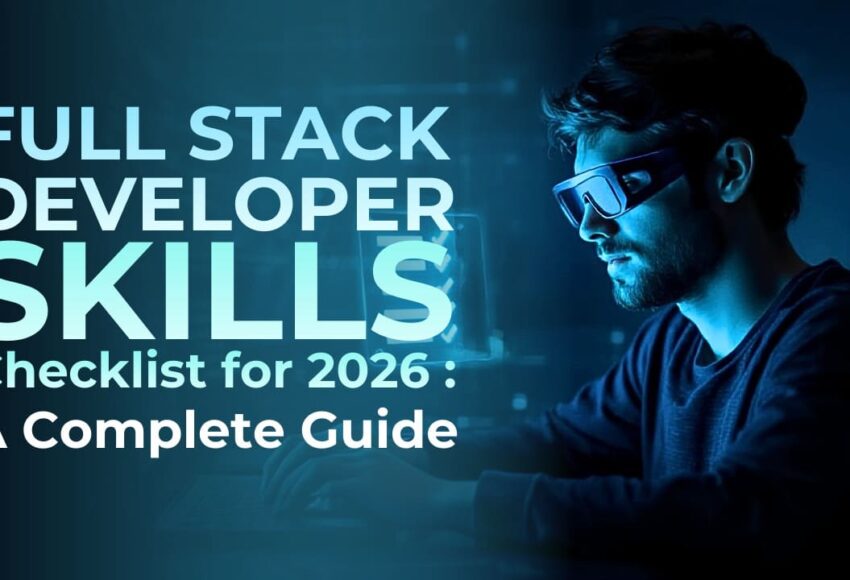
Full Stack Developer Skills Checklist for 2026
Are you ready to become a full stack developer in 2026 but unsure which skills actually matter?
The tech industry evolves rapidly, and yesterday’s essential skills can quickly become outdated. Companies now expect developers to have broader expertise across both frontend and backend technologies.
This complete full stack developer skills checklist explains the most important skills you should learn in 2026. From core programming languages to deployment tools, this guide will help you build a career-ready skill set that employers actively seek.
Frontend Development Skills
Core Web Technologies
HTML5 and CSS3 remain the foundation of every web application. Developers should understand semantic HTML for accessibility and modern CSS techniques such as Flexbox and Grid.
Responsive design is also essential to ensure applications work smoothly across mobile, tablet, and desktop devices.
Learning CSS tools like SASS or modern frameworks like Tailwind CSS can improve development efficiency and maintain clean styling systems.
JavaScript proficiency is critical for full stack developers. You should understand ES6 and modern JavaScript features such as:
- Arrow functions
- Destructuring
- Promises
- Async/Await
- Modules
Strong knowledge of DOM manipulation, event handling, and browser APIs forms the practical base for frontend development.
Frontend Frameworks and Libraries
React continues to dominate the frontend ecosystem in 2026.
Developers should understand:
- Component lifecycle
- React Hooks
- State management using Context API or Redux
- React Router for navigation
- Performance optimization techniques
While React is widely used, familiarity with other frameworks can increase job opportunities.
Angular is often used for large-scale enterprise applications, while Vue.js is known for its easier learning curve and flexibility.
Another essential framework is Next.js, which has become a popular production framework for React applications.
Next.js offers:
- Server-side rendering
- Static site generation
- API routes
Many companies now prefer developers who understand Next.js along with React.
Backend Development Expertise
Server-Side Programming Languages
Node.js with Express.js is one of the most popular backend stacks for JavaScript developers.
Key backend skills include:
- Asynchronous programming
- Middleware development
- Routing
- Error handling
- Building RESTful APIs
Understanding the Node.js event loop and non-blocking I/O is also important for optimizing performance.
Python with frameworks like Django or Flask is widely used for backend services, especially for data-driven applications.
Java with Spring Boot remains dominant in enterprise environments, while Go is gaining popularity for building high-performance microservices.
Database Management
Relational databases such as PostgreSQL and MySQL require knowledge of:
- Complex SQL queries
- Database indexing
- Data normalization
- Transaction management
Developers must also understand database design principles and optimization strategies for scalable applications.
NoSQL databases are equally important. MongoDB is widely used for document-based storage.
You should understand:
- NoSQL schema design
- Aggregation pipelines
- When to use NoSQL instead of SQL
Knowledge of Redis for caching and session management can further improve application performance.
API Development and Integration
RESTful APIs are the backbone of communication between frontend and backend systems.
Developers should understand:
- HTTP methods
- Status codes
- Request and response structures
- Authentication mechanisms
- API versioning strategies
GraphQL is increasingly used alongside or instead of REST APIs.
Understanding GraphQL queries, schemas, and resolvers can make developers more versatile.
Integrating third-party APIs such as payment gateways, authentication systems, and cloud services is also a valuable skill.
DevOps and Deployment Skills
Version Control and Collaboration
Git is an essential tool for every developer.
Beyond basic commits, developers should understand:
- Branching strategies
- Merge conflict resolution
- Rebasing
- Cherry-picking
- Pull request workflows
Platforms like GitHub and GitLab help teams manage repositories, conduct code reviews, track issues, and configure CI/CD pipelines.
Cloud Platforms and Deployment
Cloud deployment skills are essential for modern developers.
Learning at least one major cloud platform is recommended:
- AWS
- Google Cloud
- Microsoft Azure
Developers should understand services such as virtual servers, storage, serverless functions, and database hosting.
Docker containerization is now standard in many development workflows.
Important Docker concepts include:
- Creating Dockerfiles
- Managing containers
- Using Docker Compose for multi-container applications
More advanced developers may also work with Kubernetes for container orchestration.
Platform-as-a-Service tools like Vercel, Netlify, and Heroku simplify deployment for many web applications.
Essential Supporting Skills
Testing and Quality Assurance
Testing is a critical part of professional development.
Developers should learn:
- Unit testing with Jest or Mocha
- Integration testing
- End-to-end testing using Cypress or Playwright
Test-driven development practices improve code quality and reduce production bugs.
Understanding debugging tools, browser developer tools, and performance profiling can also help developers resolve issues faster.
Security Best Practices
Security knowledge is essential for protecting applications and user data.
Developers should understand:
- Authentication and authorization
- JWT tokens
- OAuth authentication
- Password hashing using bcrypt
- SQL injection prevention
- Cross-site scripting (XSS) protection
- HTTPS implementation
Security vulnerabilities can lead to serious consequences, making these skills highly valuable.
Performance Optimization
High-performance applications require optimization strategies such as:
- Code splitting
- Lazy loading
- Image optimization
- Caching techniques
- Database query optimization
Tools like Lighthouse help developers measure and improve application performance.
Soft Skills and Professional Development
Technical knowledge alone does not make a successful developer.
Important soft skills include:
- Problem-solving ability
- Effective communication
- Continuous learning mindset
- Collaboration with designers and product teams
Developers should also understand Agile workflows, including sprint planning and daily stand-up meetings.
Time management and project planning help developers meet deadlines and manage multiple priorities.
Building Your Full Stack Skill Set
Learning everything at once can be overwhelming.
Start by mastering frontend fundamentals, then gradually expand to backend development.
Focus on one technology stack first before exploring alternatives.
Practical experience is extremely important. Build personal projects, contribute to open-source communities, and solve coding challenges to strengthen your skills.
Creating a strong portfolio is also essential. Showcase full stack projects that demonstrate your abilities.
Employers value practical implementation more than theoretical knowledge. Document your code properly, follow good Git practices, and deploy projects so others can interact with them.
Final Thoughts
Becoming a full stack developer in 2026 requires dedication and consistent practice.
By focusing on core fundamentals, building real-world projects, and continuously learning new technologies, you can develop the comprehensive skill set that companies are looking for.
Start with one skill from this checklist today and keep building step by step.
Your journey toward becoming a professional full stack developer begins now.
Leave a Comment