
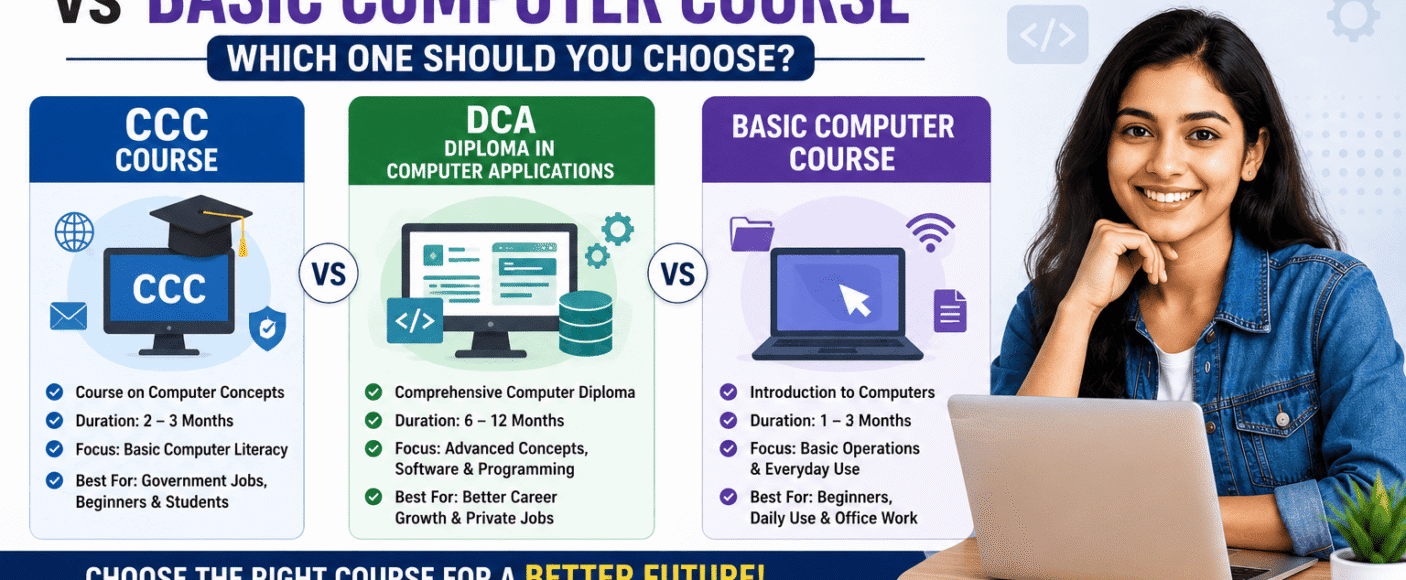
CCC Course vs DCA vs Basic Computer Course: Which One Should You Choose in 2026?
In today’s digital world, basic computer knowledge has become essential for students, job seekers, professionals, and entrepreneurs. Whether you’re preparing for government exams, applying for office jobs, or simply looking to improve your digital skills, choosing the right computer course is an important first step.
Among the most popular beginner computer courses are the CCC Course, DCA (Diploma in Computer Applications), and Basic Computer Course. While each course teaches computer fundamentals, they differ in depth, duration, certification, career opportunities, and industry recognition.
This guide compares all three courses to help you choose the one that best matches your career goals.
What is a CCC course?
The CCC (Course on Computer Concepts) is a beginner-level computer literacy programme that focuses on practical digital skills such as:
- Computer Fundamentals
- Microsoft Office
- Internet & Email
- Digital Payments
- Cyber Security
- e-Governance Services
The course is especially popular among candidates preparing for government jobs where computer proficiency is required.
What is DCA?
The Diploma in Computer Applications (DCA) is a more comprehensive computer diploma that goes beyond basic computer knowledge.
A typical DCA programme includes:
- Computer Fundamentals
- Microsoft Office
- Internet Applications
- Operating Systems
- Programming Basics
- Database Management
- Accounting Software
- Computer Networking
- Practical Projects
DCA is suitable for students seeking stronger technical skills and better career opportunities.
What is a Basic Computer Course?
A basic computer course is an introductory training programme designed for absolute beginners.
Topics generally include:
- Computer Basics
- Windows Operating System
- Typing Skills
- MS Word
- MS Excel
- MS PowerPoint
- Internet Browsing
- Email Usage
The syllabus varies depending on the training institute.
Quick Comparison: CCC vs DCA vs Basic Computer Course
| Feature | CCC Course | DCA | Basic Computer Course |
|---|---|---|---|
| Course Level | Beginner | Diploma | Beginner |
| Duration | 2–3 Months | 6–12 Months | 1–3 Months |
| Computer Skills | Basic | Intermediate | Basic |
| Practical Training | Yes | Extensive | Basic |
| Programming | No | Yes (Basic) | No |
| Government Job Value | High (where accepted) | Useful | Limited |
| Office Job Preparation | Good | Excellent | Basic |
| Career Growth | Moderate | High | Entry-Level |
| Certification | Recognized Computer Literacy | Diploma | Institute Certificate |
Eligibility
All three courses are beginner-friendly.
Most institutes accept:
- Class 10 students
- Class 12 students
- College students
- Graduates
- Working professionals
- Homemakers
No prior computer knowledge is usually required.
Course Duration
CCC Course
- Approximately 2–3 months
DCA
- Usually 6–12 months
Basic Computer Course
- Typically 1–3 months
If you’re looking for a quick certification, a CCC or a basic computer course may be suitable. For long-term career development, DCA provides broader learning.
Syllabus Comparison
CCC Course
Students learn:
- Computer Fundamentals
- Microsoft Word
- Microsoft Excel
- Microsoft PowerPoint
- Internet
- Digital Banking
- Cyber Security
- e-Governance
DCA
A DCA syllabus generally includes:
- Computer Fundamentals
- Windows
- MS Office
- Internet Applications
- Database Concepts
- Programming Fundamentals
- Computer Networking
- Accounting Software
- Practical Projects
Basic Computer Course
Usually covers:
- Introduction to Computers
- Typing Practice
- Windows
- MS Office
- Internet
- Basic File Management
Which Course is Best for Government Jobs?
If your primary goal is government employment, the CCC Course is often the preferred choice because many recruitment notifications require or accept proof of basic computer proficiency. Always read the official notification for the specific post, as accepted qualifications can vary by department and recruitment.
Which Course is Best for Private Jobs?
For private-sector careers, DCA generally offers greater value because it covers a wider range of practical computer applications, software, and office technologies.
DCA graduates may qualify for roles such as:
- Computer Operator
- Office Executive
- Data Entry Operator
- Administrative Assistant
- Customer Support Executive
- Back Office Executive
Which Course is Best for Beginners?
If you’ve never used a computer before:
- Basic Computer Course – Best for learning essential computer operations.
- CCC Course – Best for gaining practical digital literacy and a recognised computer qualification.
- DCA – Best for learners who want advanced knowledge and stronger career prospects.
Career Opportunities
After a CCC Course
- Computer Operator
- Office Assistant
- Data Entry Operator
- Reception Executive
- Government Contract Jobs
After DCA
- Computer Operator
- Office Executive
- Administrative Assistant
- Technical Support Executive
- Data Entry Specialist
- Junior IT Assistant
After a Basic Computer Course
- Receptionist
- Office Assistant
- Data Entry Operator
- Customer Service Assistant
Salary Comparison
| Course | Average Starting Monthly Salary |
|---|---|
| Basic Computer Course | ₹10,000–₹18,000 |
| CCC Course | ₹12,000–₹25,000 |
| DCA | ₹15,000–₹35,000 |
Actual salaries vary based on location, employer, skills, and experience.
Advantages of Each Course
CCC Course
- Short duration
- Practical digital skills
- Helpful for many government job applications
- Affordable
- Suitable for beginners
DCA
- Comprehensive computer education
- Better private-sector opportunities
- Includes advanced applications
- Strong foundation for higher IT courses
Basic Computer Course
- Quick to complete
- Easy for first-time computer users
- Affordable
- Builds confidence with everyday computer use
Which Course Should You Choose?
Choose a CCC course if you:
- Want a recognized computer literacy qualification.
- Are preparing for government job examinations.
- Need practical office computer skills.
Choose DCA if you:
- Want better long-term career growth.
- Plan to work in office administration or IT support.
- Want to learn beyond basic computer applications.
Choose a basic computer course if you:
- Are completely new to computers.
- Need basic digital skills for personal or office use.
- Want a short introductory program before pursuing advanced courses.
Frequently Asked Questions (FAQs)
1. Which is better: CCC or DCA?
It depends on your goals. CCC is ideal for building computer literacy and meeting basic computer qualification requirements where applicable, while DCA offers more extensive training and broader career opportunities.
2. Is the CCC course enough to get a job?
It can help you qualify for entry-level office roles and strengthen your profile for positions requiring basic computer skills. Developing additional skills and experience can improve job prospects.
3. Can I do DCA after completing a CCC course?
Yes. CCC provides a solid foundation, and many students continue with DCA to expand their technical knowledge.
4. Is a basic computer course useful?
Yes. It is valuable for beginners who want to become comfortable using computers for daily tasks and office work.
5. Which course has the highest salary potential?
Among these three, DCA generally offers the highest long-term salary potential because it includes more advanced computer applications.
6. Which course is best after Class 12?
Students who want broader career opportunities often choose DCA, while those preparing for government jobs may also benefit from a CCC course depending on the recruitment requirements.
Conclusion
Choosing between a CCC course, DCA, and a basic computer course depends on your career aspirations, available time, and learning objectives.
- Choose CCC if you want practical computer literacy and a qualification that can support applications where basic computer knowledge is required.
- Choose DCA if you’re looking for deeper technical skills, better employability, and long-term career growth.
- Choose a basic computer course if you’re starting from scratch and want to build confidence before progressing to more advanced training.
No matter which path you choose, investing in computer education today will improve your productivity, employability, and readiness for an increasingly digital workplace.



Leave a Comment